Department of Biosciences, University of Oslo, Blindernveien 31, PO Box 1041, 0316 Oslo, Norway.
J Cell Sci. 2024 Oct 15;137(20). doi: 10.1242/jcs.262198. Epub 2024 Oct 23.
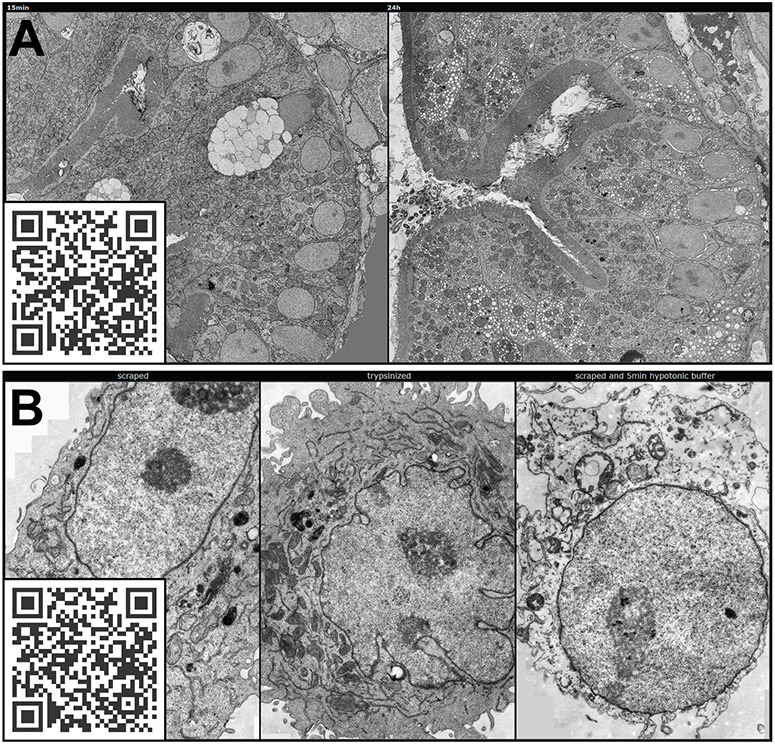
The unparalleled resolving power of electron microscopy is both a blessing and a curse. At 30,000× magnification, 1 µm corresponds to 3 cm in the image and the field of view is only a few micrometres or less, resulting in an inevitable reduction in the spatial data available in an image. Consequently, the gain in resolution is at the cost of loss of the contextual 'reference space', which is crucial for understanding the embedded structures of interest. This problem is particularly pronounced in immunoelectron microscopy, where the detection of a gold particle is crucial for the localisation of specific molecules. The common solution of presenting high-magnification and overview images side by side often insufficiently represents the cellular environment. To address these limitations, we propose here an interactive visualization strategy inspired by digital maps and GPS modules which enables seamless transitions between different magnifications by dynamically linking virtual low magnification overview images with primary high-resolution data. By enabling dynamic browsing, it offers the potential for a deeper understanding of cellular landscapes leading to more comprehensive analysis of the primary ultrastructural data.
电子显微镜无与伦比的分辨率既是福也是祸。在 30,000×的放大倍数下,1 µm 在图像中对应 3 cm,视场只有几微米或更小,这导致图像中可用的空间数据不可避免地减少。因此,分辨率的提高是以失去上下文“参考空间”为代价的,而参考空间对于理解感兴趣的嵌入结构至关重要。这个问题在免疫电子显微镜中尤为突出,因为金颗粒的检测对于特定分子的定位至关重要。常见的解决方案是并排呈现高倍放大和概览图像,但通常不足以代表细胞环境。为了解决这些限制,我们在这里提出了一种受数字地图和 GPS 模块启发的交互式可视化策略,通过动态链接虚拟低倍概览图像和主要高分辨率数据,实现不同放大倍数之间的无缝过渡。通过实现动态浏览,它有可能更深入地了解细胞景观,从而更全面地分析主要超微结构数据。