The Matilda Centre for Research in Mental Health and Substance Use, University of Sydney, Sydney, Australia.
University of Sydney Library, University of Sydney, Sydney, Australia.
Prev Sci. 2024 Oct;25(7):1104-1121. doi: 10.1007/s11121-024-01730-6. Epub 2024 Sep 26.
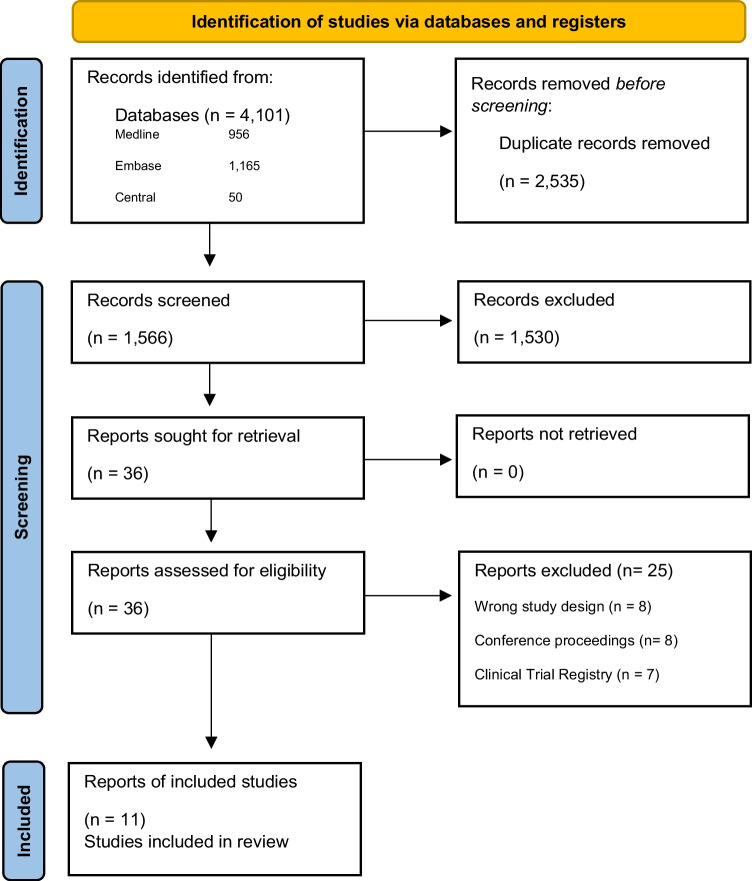
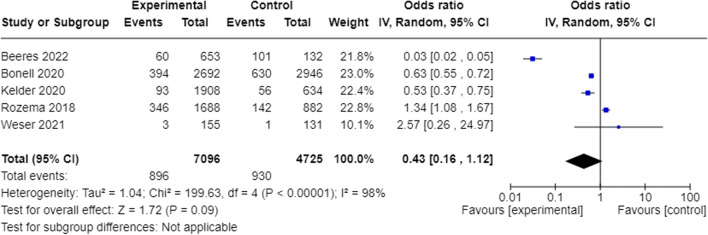
This study aimed to examine the efficacy of school-based e-cigarette preventive interventions via a systematic review and meta-analysis. We searched Medline, Embase, PsycINFO, Scopus, CINAHL, Cochrane, and clinical trial registries for studies published between January 2000 and June 2023 using keywords for e-cigarettes, adolescents, and school. Of 1566 double-screened records, 11 met the criteria of targeting adolescents, evaluating an e-cigarette preventive intervention, being conducted in a secondary school, using a randomized controlled trial (RCT), cluster RCT, or quasi-experimental design, and comparing an intervention to a control. Pre-specified data pertaining to the study design, outcomes, and quality were extracted by one reviewer and confirmed by a second, and where necessary, a third reviewer. Meta-analyses found no evidence that school-based interventions prevented e-cigarette use at the longest follow-up, which ranged between 6 and 36 months post-intervention (OR = 0.43, 95% CI = 0.16, 1.12; p = 0.09). However, subgroup analyses identified significant effects at post-test and when studies with < 12-month follow-up were omitted. No effect was found for tobacco use at the longest follow-up (OR = 1.01, 95% CI = 0.65, 1.59, p = 0.95); however, reductions in past 30-day tobacco use (OR = 0.59, 95% CI = 0.39, 0.89, p = 0.01) which encompassed e-cigarettes in some studies were identified. Narrative synthesis supported these mixed results and found some school-based interventions prevented or reduced e-cigarette and/or tobacco use; however, some increased use. School-based interventions were also associated with improved knowledge (SMD = - 0.38, 95% CI = - 0.68, - 0.08, p = 0.01), intentions (SMD = - 0.15, 95% CI = - 0.22, - 0.07, p = 0.0001), and attitudes (SMD = - 0.14, 95% CI = - 0.22, - 0.06; p = 0.0007) in the short term. Overall, the quality of evidence was low-to-moderate. School-based interventions hold the potential for addressing e-cigarette use, however, can have null or iatrogenic effects. More high-quality research is needed to develop efficacious interventions, and schools must be supported to adopt evidence-based programs. This is the first systematic review and meta-analysis to examine the efficacy of school-based preventive interventions for e-cigarette use. It provides crucial new knowledge about the efficacy of such interventions in preventing e-cigarette use and improving other outcomes (e.g., tobacco use, knowledge, intentions, attitudes, and mental health) among adolescents and the key characteristics associated with efficacious interventions. Our findings have important practical implications, highlighting future research directions for the development and evaluation of e-cigarette preventive interventions, along with the need to provide support to schools to help them identify and adopt evidence-based programs.
本研究旨在通过系统评价和荟萃分析来检验基于学校的电子烟预防干预措施的效果。我们使用电子烟、青少年和学校的关键词,在 2000 年 1 月至 2023 年 6 月期间在 Medline、Embase、PsycINFO、Scopus、CINAHL、Cochrane 和临床试验登记处进行了搜索。对 1566 篇经过双屏筛选的记录进行了筛选,其中 11 篇符合以下标准:针对青少年,评估电子烟预防干预措施,在中学进行,采用随机对照试验 (RCT)、聚类 RCT 或准实验设计,并将干预与对照进行比较。一位审查员预先规定了与研究设计、结果和质量相关的数据,并由第二位审查员确认,如有必要,由第三位审查员确认。荟萃分析发现,在最长随访时间(干预后 6 至 36 个月),基于学校的干预措施并没有预防电子烟的使用(OR=0.43,95%CI=0.16,1.12;p=0.09)。然而,亚组分析发现,在测试后和当排除随访时间少于 12 个月的研究时,存在显著效果。在最长随访时间(OR=1.01,95%CI=0.65,1.59,p=0.95),没有发现对烟草使用的影响;然而,一些研究中包含电子烟的情况下,过去 30 天的烟草使用减少(OR=0.59,95%CI=0.39,0.89,p=0.01)被发现。叙述性综合支持了这些混合结果,并发现一些基于学校的干预措施预防或减少了电子烟和/或烟草的使用;然而,一些干预措施增加了使用。基于学校的干预措施还与知识的提高有关(SMD=-0.38,95%CI=-0.68,-0.08,p=0.01)、意图(SMD=-0.15,95%CI=-0.22,-0.07,p=0.0001)和态度(SMD=-0.14,95%CI=-0.22,-0.06;p=0.0007)在短期内。总体而言,证据质量为低至中等。基于学校的干预措施有可能解决电子烟的使用问题,但也可能产生无效或治疗性的影响。需要更多高质量的研究来开发有效的干预措施,并且必须支持学校采用基于证据的项目。这是第一个系统评价和荟萃分析,旨在检验基于学校的预防电子烟使用干预措施的效果。它提供了关于此类干预措施在预防电子烟使用和改善青少年其他结果(如烟草使用、知识、意图、态度和心理健康)方面的有效性的重要新知识,以及与有效干预措施相关的关键特征。我们的研究结果具有重要的实际意义,突出了未来开发和评估电子烟预防干预措施的研究方向,以及为学校提供支持以帮助他们确定和采用基于证据的项目的必要性。