World Health Organization (WHO) Collaborating Center, University of Campania "Luigi Vanvitelli", Naples, Italy.
Department of Biomedical and Dental Sciences and Morphofunctional Imaging, University of Messina, Messina, Italy.
Eur Psychiatry. 2024 Sep 27;67(1):e60. doi: 10.1192/j.eurpsy.2024.1770.
Cognitive impairment (CI) is one of the most prevalent and burdensome consequences of COVID-19 infection, which can persist up to months or even years after remission of the infection. Current guidelines on post-COVID CI are based on available knowledge on treatments used for improving CI in other conditions. The current review aims to provide an updated overview of the existing evidence on the efficacy of treatments for post-COVID CI.
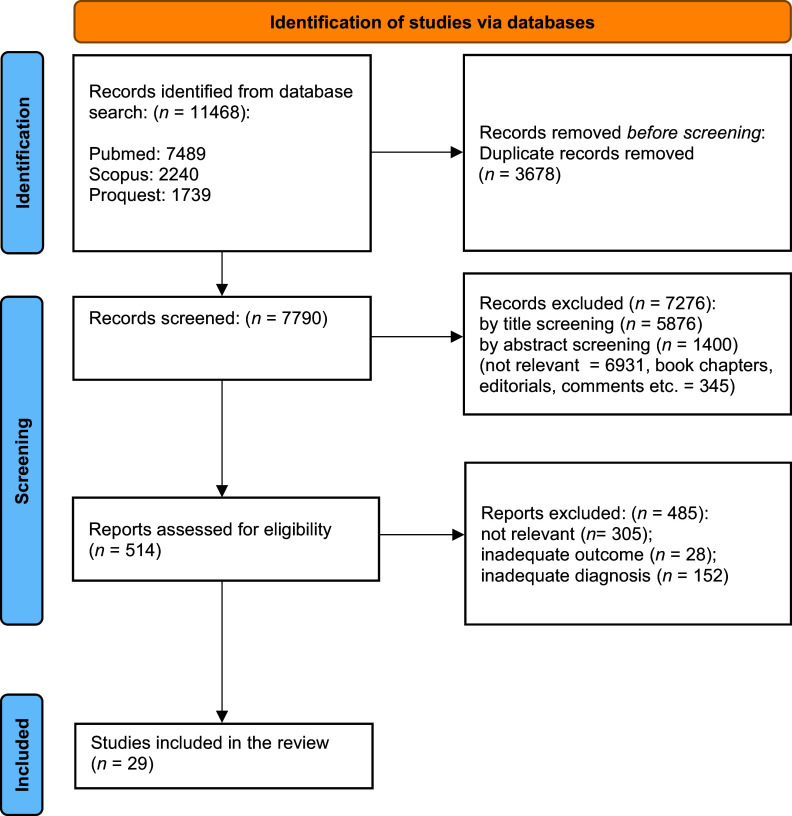
A systematic literature search was conducted for studies published up to December 2023 using three databases (PubMed-Scopus-ProQuest). Controlled and noncontrolled trials, cohort studies, case series, and reports testing interventions on subjects with CI following COVID-19 infection were included.
After screening 7790 articles, 29 studies were included. Multidisciplinary approaches, particularly those combining cognitive remediation interventions, physical exercise, and dietary and sleep support, may improve CI and address the different needs of individuals with post-COVID-19 condition. Cognitive remediation interventions can provide a safe, cost-effective option and may be tailored to deficits in specific cognitive domains. Noninvasive brain stimulation techniques and hyperbaric oxygen therapy showed mixed and preliminary results. Evidence for other interventions, including pharmacological ones, remains sparse. Challenges in interpreting existing evidence include heterogeneity in study designs, assessment tools, and recruitment criteria; lack of long-term follow-up; and under-characterization of samples in relation to confounding factors.
Further research, grounded on shared definitions of the post-COVID condition and on the accurate assessment of COVID-related CI, in well-defined study samples and with longer follow-ups, is crucial to address this significant unmet need.
认知障碍(CI)是 COVID-19 感染最普遍和负担最重的后果之一,在感染缓解后可持续数月甚至数年。目前关于 COVID 后 CI 的指南是基于在其他情况下改善 CI 的治疗方法的现有知识制定的。本综述旨在提供现有关于 COVID 后 CI 治疗效果的证据的最新概述。
使用三个数据库(PubMed-Scopus-ProQuest)对截至 2023 年 12 月发表的研究进行了系统的文献检索。纳入了针对 COVID-19 感染后出现 CI 的受试者进行干预的对照和非对照试验、队列研究、病例系列和报告。
经过筛选 7790 篇文章,纳入了 29 项研究。多学科方法,特别是将认知矫正干预、体育锻炼以及饮食和睡眠支持相结合的方法,可能改善 CI 并满足 COVID 后患者的不同需求。认知矫正干预可以提供一种安全、具有成本效益的选择,并且可以针对特定认知领域的缺陷进行定制。非侵入性脑刺激技术和高压氧治疗显示出混合和初步的结果。其他干预措施的证据仍然很少,包括药物干预。解释现有证据的挑战包括研究设计、评估工具和招募标准的异质性;缺乏长期随访;以及与混杂因素相关的样本特征不足。
进一步的研究,基于 COVID 后状况的共同定义以及对 COVID 相关 CI 的准确评估,在明确界定的研究样本中进行,并进行更长时间的随访,对于解决这一重大未满足的需求至关重要。