Laboratorio de Virología Perinatal y Diseño Molecular de Antígenos y Biomarcadores, Departamento de Inmunobioquímica, Instituto Nacional de Perinatología, Mexico City 11000, Mexico.
Posgrado en Biología Experimental, Departamento de Ciencias Biológicas y de la Salud (DCBS), Universidad Autónoma Metropolitana-Iztapalapa, Mexico City 09310, Mexico.
Cells. 2024 Sep 21;13(18):1591. doi: 10.3390/cells13181591.
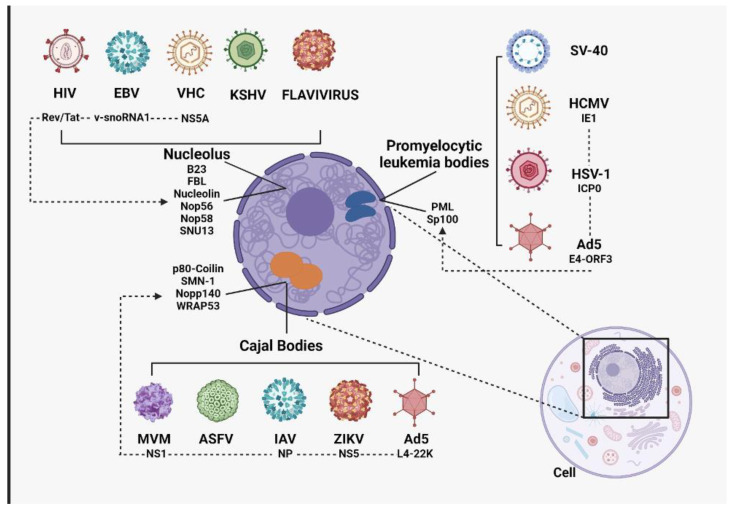
Nuclear bodies are structures in eukaryotic cells that lack a plasma membrane and are considered protein condensates, DNA, or RNA molecules. Known nuclear bodies include the nucleolus, Cajal bodies, and promyelocytic leukemia nuclear bodies. These bodies are involved in the concentration, exclusion, sequestration, assembly, modification, and recycling of specific components involved in the regulation of ribosome biogenesis, RNA transcription, and RNA processing. Additionally, nuclear bodies have been shown to participate in cellular processes such as the regulation of transcription of the cell cycle, mitosis, apoptosis, and the cellular stress response. The dynamics and functions of these bodies depend on the state of the cell. It is now known that both DNA and RNA viruses can direct their proteins to nuclear bodies, causing alterations in their composition, dynamics, and functions. Although many of these mechanisms are still under investigation, it is well known that the interaction between viral and nuclear body proteins is necessary for the success of the viral infection cycle. In this review, we concisely describe the interaction between viral and nuclear body proteins. Furthermore, we focus on the role of the nucleolus in RNA virus infections. Finally, we discuss the possible implications of the interaction of viral proteins on cellular transcription and the formation/degradation of non-coding RNAs.
核体是真核细胞中的结构,缺乏质膜,被认为是蛋白质凝聚物、DNA 或 RNA 分子。已知的核体包括核仁、Cajal 体和早幼粒细胞白血病核体。这些体参与核糖体生物发生、RNA 转录和 RNA 加工的特定成分的浓缩、排除、隔离、组装、修饰和再循环。此外,核体已被证明参与细胞过程,如细胞周期、有丝分裂、细胞凋亡和细胞应激反应的转录调节。这些体的动力学和功能取决于细胞的状态。现在已知 DNA 和 RNA 病毒都可以将其蛋白质定向到核体,导致其组成、动力学和功能发生改变。尽管这些机制仍在研究中,但众所周知,病毒和核体蛋白之间的相互作用是病毒感染周期成功的必要条件。在这篇综述中,我们简要描述了病毒和核体蛋白之间的相互作用。此外,我们专注于核仁在 RNA 病毒感染中的作用。最后,我们讨论了病毒蛋白相互作用对细胞转录和非编码 RNA 的形成/降解的可能影响。