Castello Alfredo, Kamel Wael
MRC-University of Glasgow Centre for Virus Research, Glasgow G61 1QH, United Kingdom
MRC-University of Glasgow Centre for Virus Research, Glasgow G61 1QH, United Kingdom.
RNA. 2025 Feb 19;31(3):444-451. doi: 10.1261/rna.080313.124.
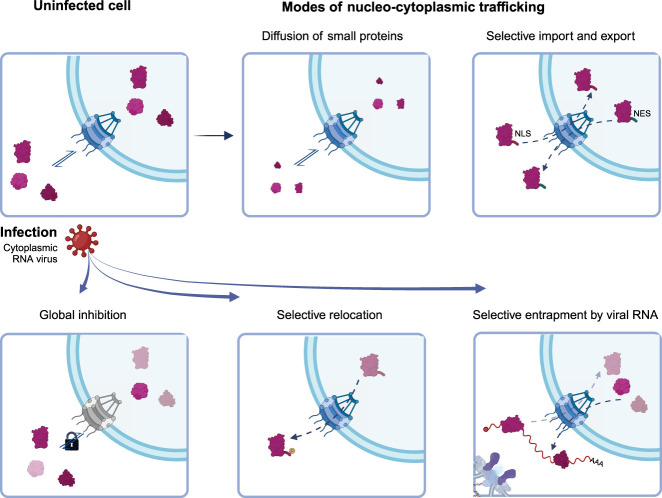
Cytoplasmic viruses interact intricately with the nuclear pore complex and nuclear import/export machineries, affecting nuclear-cytoplasmic trafficking. This can lead to the selective accumulation of nuclear RNA-binding proteins (RBPs) in the cytoplasm. Pioneering research has shown that relocated RBPs serve as an intrinsic defense mechanism against viruses, which involves RNA export, splicing, and nucleolar factors. For instance, the U2 small nuclear ribonucleoprotein (snRNP) relocates to the cytoplasm in infected cells and uses U2 snRNA to interact with viral genomes, repressing viral replication and gene expression. Here, we describe these emerging host-virus interactions and discuss the remaining questions to elucidate their antiviral mechanisms.
细胞质病毒与核孔复合体以及核输入/输出机制复杂地相互作用,影响核质运输。这可能导致核RNA结合蛋白(RBP)在细胞质中选择性积累。开创性研究表明,重新定位的RBP作为对抗病毒的一种内在防御机制,涉及RNA输出、剪接和核仁因子。例如,U2小核核糖核蛋白(snRNP)在受感染细胞中重新定位到细胞质,并利用U2 snRNA与病毒基因组相互作用,抑制病毒复制和基因表达。在这里,我们描述这些新出现的宿主-病毒相互作用,并讨论为阐明其抗病毒机制而遗留的问题。