Weiermair Theresia, Svehlikova Eva, Boulgaropoulos Beate, Magnes Christoph, Eberl Anita
Institute for Biomedical Research and Technologies (HEALTH), Joanneum Research Forschungsgesellschaft m.b.H, Neue Stiftingtalstrasse 2, 8010 Graz, Austria.
Division of Endocrinology and Diabetology, Department of Internal Medicine, Medical University of Graz, Auenbruggerplatz 15, 8036 Graz, Austria.
Sports (Basel). 2024 Aug 28;12(9):232. doi: 10.3390/sports12090232.
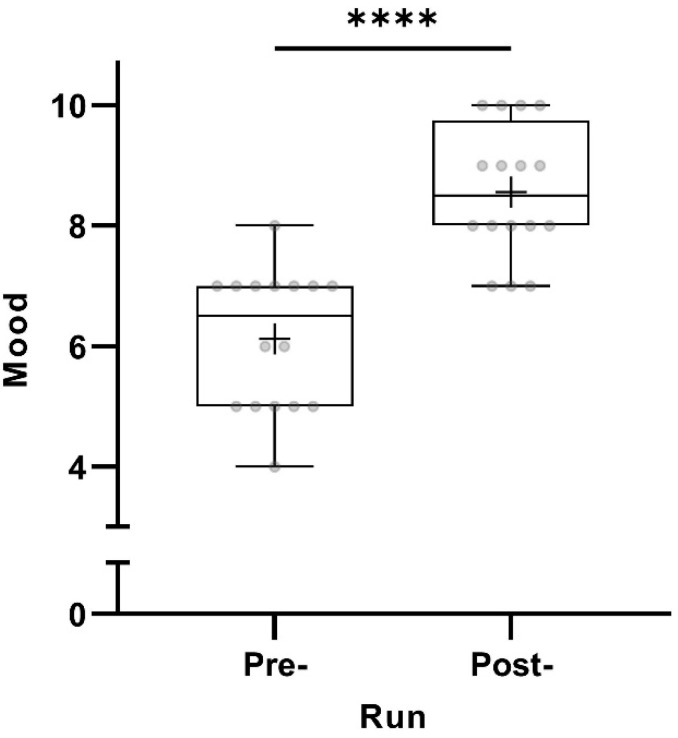
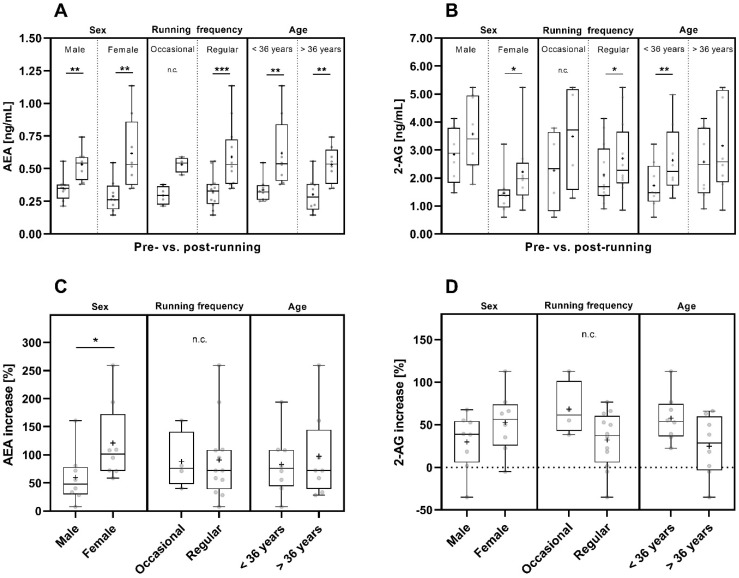
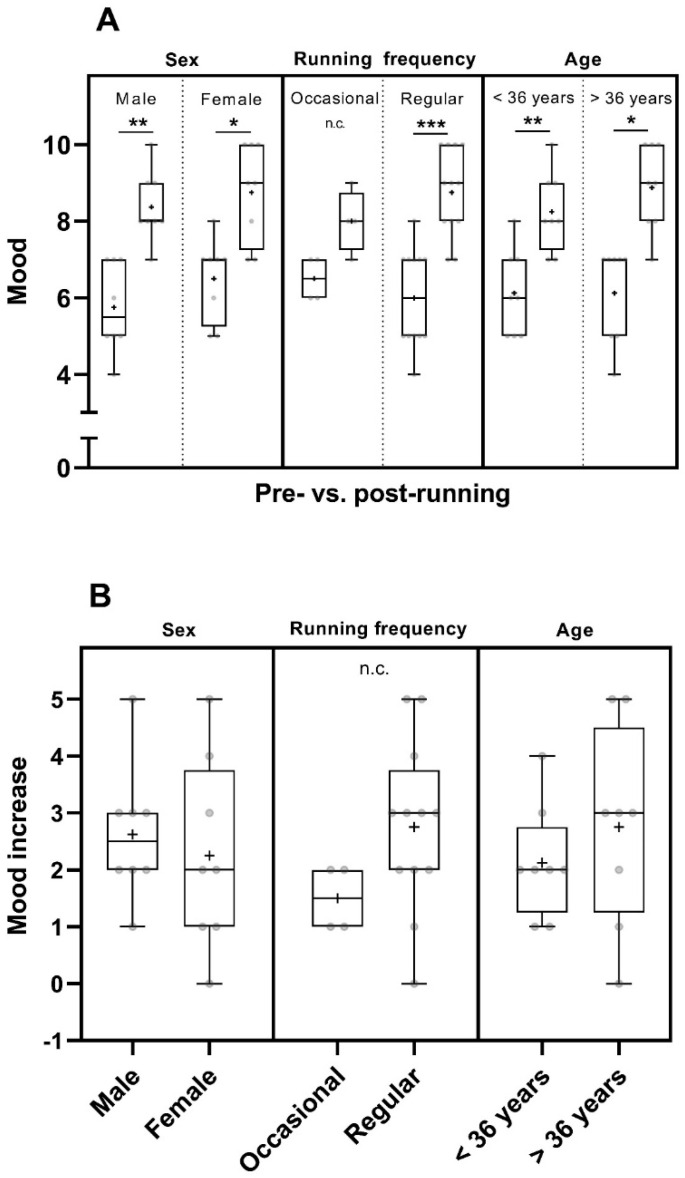
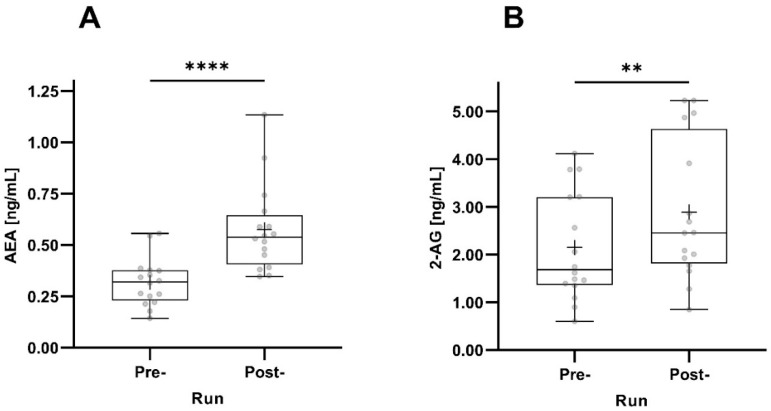
Runner's high is a euphoric emotional state occurring during and post-physical exercise. Although previous data indicate endocannabinoids' involvement in animal runner's high, their role in human runner's high remains to be established. We investigated runner's high in healthy humans assessing mood and plasma endocannabinoid concentration changes pre- and post a 60 min outdoor run, considering sex (8 females/8 males), running frequency (4 occasional/12 regular runners) and age (median split 36 years). Mood, AEA, and 2-AG concentrations were significantly increased post-run considering all participants ( < 0.0001, < 0.0001, < 0.01, respectively), with 2-AG varying more than AEA concentrations. Concentrations of both endocannabinoids increased pre- to post-run in women ( < 0.01) but the AEA concentration increase was higher in females than in males ( < 0.05). Post-run concentration increase appeared to be more pronounced in occasional than in regular runners for 2-AG but not for AEA. However, regular runners experienced stronger mood increases and better post-run mood than occasional runners. Post-run endocannabinoid concentrations were increased regardless of age. AEA concentrations and their post-run changes were less affected by running frequency and age than those of 2-AG. These findings provide insights into the interplay of physical exercise, physiological/psychological factors and demographics, laying a valuable foundation for future research.
跑步者高潮是一种在体育锻炼期间及之后出现的欣快情绪状态。尽管先前的数据表明内源性大麻素与动物的跑步者高潮有关,但其在人类跑步者高潮中的作用仍有待确定。我们对健康人群的跑步者高潮进行了研究,评估了60分钟户外跑步前后的情绪和血浆内源性大麻素浓度变化,考虑了性别(8名女性/8名男性)、跑步频率(4名偶尔跑步者/12名经常跑步者)和年龄(中位数划分36岁)。考虑所有参与者,跑步后情绪、花生四烯乙醇胺(AEA)和2-花生四烯酸甘油酯(2-AG)浓度均显著增加(分别为P<0.0001、P<0.0001、P<0.01),2-AG的变化大于AEA浓度。女性跑步前后两种内源性大麻素的浓度均升高(P<0.01),但女性AEA浓度的升高高于男性(P<0.05)。对于2-AG,偶尔跑步者跑步后浓度的增加似乎比经常跑步者更明显,但AEA并非如此。然而,经常跑步者比偶尔跑步者经历了更强的情绪提升和更好的跑步后情绪。无论年龄如何,跑步后内源性大麻素浓度都会升高。与2-AG相比,AEA浓度及其跑步后的变化受跑步频率和年龄的影响较小。这些发现为体育锻炼、生理/心理因素和人口统计学之间的相互作用提供了见解,为未来的研究奠定了宝贵的基础。