GROW Research Laboratory, Narayana Nethralaya Foundation, Narayana Nethralaya Eye Hospital, Bangalore, Karnataka, India.
Narayana Nethralaya, Bengaluru, Karnataka, India.
Indian J Ophthalmol. 2024 Oct 1;72(10):1412-1423. doi: 10.4103/IJO.IJO_2899_22. Epub 2024 Sep 27.
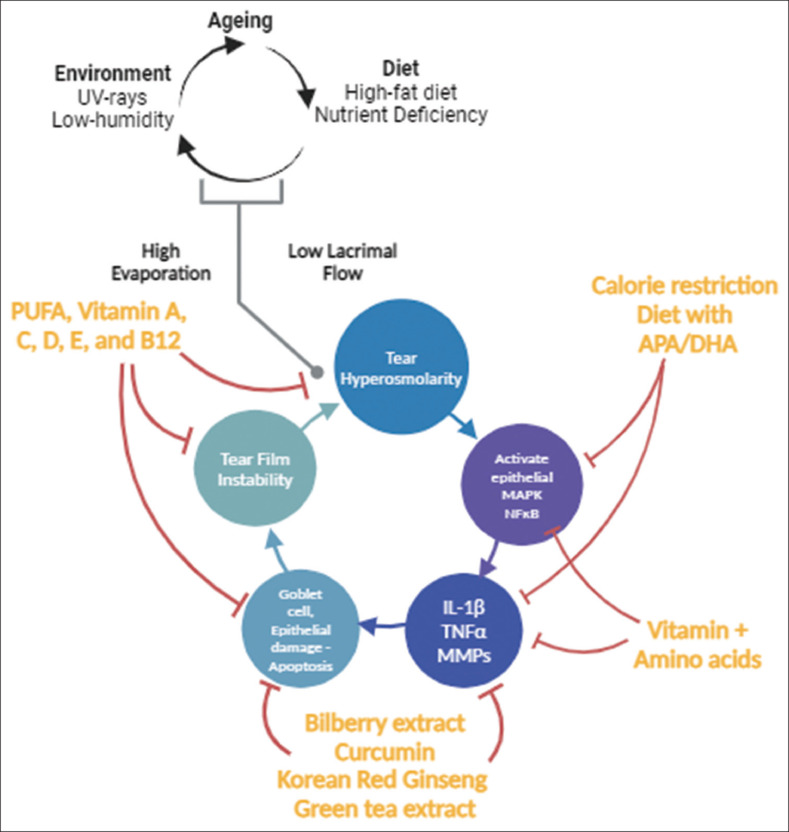
Dry eye disease (DED) is one of the most common eye problems in the aging population. Hyperosmolarity triggers the immune response in DED and consequently activates the self-perpetuating immune cycle, leading to chronic damage of the ocular surface. This event causes symptoms such as a burning sensation, irritation, redness, photophobia, and blurred vision in DED patients. Subsequently, the quality of life gets significantly affected. The rising demand for DED management and treatment solutions, and the desirable outcomes from innovative therapies that draw global interest provide evidence to demonstrate the role of diet and nutrition in DED. Nutritional deficiency and a Westernized diet contribute to the chronic systemic progression of DED symptoms. It has been revealed in several published studies that the use of nutrients and dietary supplements improves the ocular surface and acts as a protective factor against DED. - We reviewed nutrition and dietary aspects in managing DED and its associated consequences, based on published studies, and reached an evidence-based conclusion.
干眼症 (DED) 是老年人群中最常见的眼部问题之一。高渗透压会引发 DED 中的免疫反应,从而激活自我维持的免疫循环,导致眼表的慢性损伤。这一事件会导致 DED 患者出现烧灼感、刺激感、发红、畏光和视力模糊等症状。随后,生活质量会受到显著影响。对 DED 管理和治疗解决方案的需求不断增加,以及创新疗法引起的全球关注所带来的理想结果,都证明了饮食和营养在 DED 中的作用。营养缺乏和西方化饮食导致 DED 症状的慢性全身性进展。已有多项已发表的研究表明,使用营养物质和膳食补充剂可以改善眼表状况,并作为预防 DED 的保护因素。- 我们根据已发表的研究综述了营养和饮食方面在管理 DED 及其相关后果中的作用,并得出了基于证据的结论。