Institutional Care Division, Ghana Health Service Headquarters, Accra, Ghana.
School of Allied Health Sciences, University for Development Studies, Tamale, Ghana.
PLoS One. 2021 Mar 9;16(3):e0248282. doi: 10.1371/journal.pone.0248282. eCollection 2021.
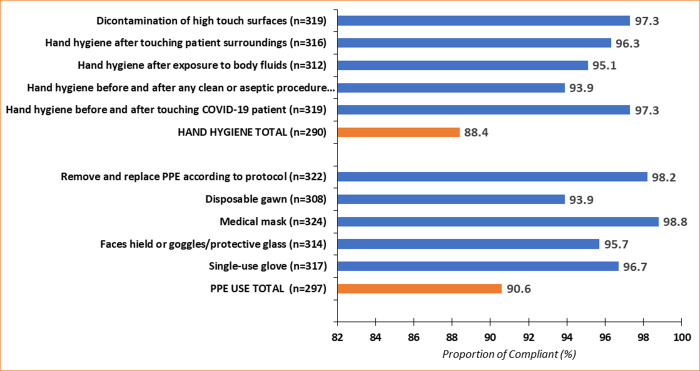
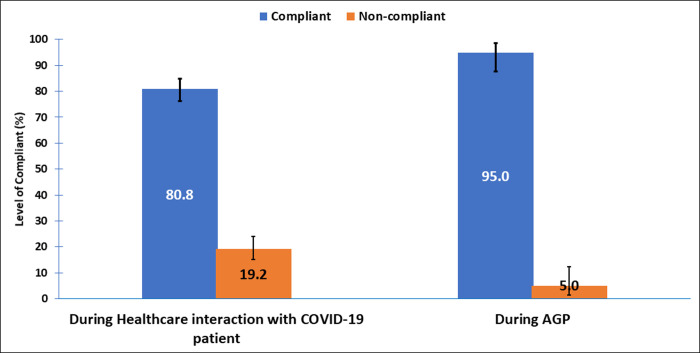
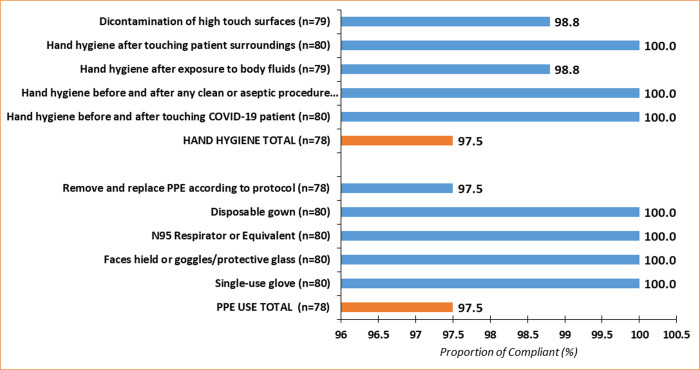
Compliance with infection prevention and control (IPC) protocols is critical in minimizing the risk of coronavirus disease (COVID-19) infection among healthcare workers. However, data on IPC compliance among healthcare workers in COVID-19 treatment centers are unknown in Ghana. This study aims to assess IPC compliance among healthcare workers in Ghana's COVID-19 treatment centers. The study was a secondary analysis of data, which was initially collected to determine the level of risk of COVID-19 virus infection among healthcare workers in Ghana. Quantitative data were conveniently collected using the WHO COVID-19 risk assessment tool. We analyzed the data using descriptive statistics and logistic regression analyses. We observed that IPC compliance during healthcare interactions was 88.4% for hand hygiene and 90.6% for Personal Protective Equipment (PPE) usage; IPC compliance while performing aerosol-generating procedures (AGPs), was 97.5% for hand hygiene and 97.5% for PPE usage. For hand hygiene during healthcare interactions, lower compliance was seen among nonclinical staff [OR (odds ratio): 0.43; 95% CI (Confidence interval): 0.21-0.89], and healthcare workers with secondary level qualification (OR: 0.24; 95% CI: 0.08-0.71). Midwives (OR: 0.29; 95% CI: 0.09-0.93) and Pharmacists (OR: 0.15; 95% CI: 0.02-0.92) compliance with hand hygiene was significantly lower than registered nurses. For PPE usage during healthcare interactions, lower compliance was seen among healthcare workers who were separated/divorced/widowed (OR: 0.08; 95% CI: 0.01-0.43), those with secondary level qualifications (OR 0.08; 95% CI 0.01-0.43), non-clinical staff (OR 0.16 95% CI 0.07-0.35), cleaners (OR: 0.16; 95% CI: 0.05-0.52), pharmacists (OR: 0.07; 95% CI: 0.01-0.49) and among healthcare workers who reported of insufficiency of PPEs (OR: 0.33; 95% CI: 0.14-0.77). Generally, healthcare workers' infection prevention and control compliance were high, but this compliance differs across the different groups of health professionals in the treatment centers. Ensuring an adequate supply of IPC logistics coupled with behavior change interventions and paying particular attention to nonclinical staff is critical in minimizing the risk of COVID-19 transmission in the treatment centers.
遵守感染预防和控制 (IPC) 协议对于最大限度地降低医护人员感染冠状病毒病 (COVID-19) 的风险至关重要。然而,加纳 COVID-19 治疗中心医护人员的 IPC 合规情况的数据尚不清楚。本研究旨在评估加纳 COVID-19 治疗中心医护人员的 IPC 合规情况。该研究是对最初收集的数据进行的二次分析,这些数据旨在确定加纳医护人员感染 COVID-19 病毒的风险水平。使用世界卫生组织 (WHO) COVID-19 风险评估工具,我们方便地收集了定量数据。我们使用描述性统计和逻辑回归分析对数据进行了分析。我们观察到,在医护人员互动期间,手部卫生的 IPC 合规率为 88.4%,个人防护设备 (PPE) 的使用合规率为 90.6%;在进行气溶胶生成程序 (AGP) 时,手部卫生的 IPC 合规率为 97.5%,PPE 的使用合规率也为 97.5%。在医护人员互动期间进行手部卫生时,非临床人员的合规率较低[比值比 (OR):0.43;95%置信区间 (CI):0.21-0.89],具有中学学历的医护人员的合规率也较低[OR:0.24;95%CI:0.08-0.71]。助产士 (OR:0.29;95%CI:0.09-0.93) 和药剂师 (OR:0.15;95%CI:0.02-0.92) 的手部卫生合规率明显低于注册护士。在医护人员互动期间使用 PPE 时,较低的合规率出现在离异/丧偶/鳏夫的医护人员中(OR:0.08;95%CI:0.01-0.43),具有中学学历的医护人员(OR 0.08;95%CI 0.01-0.43),非临床人员(OR 0.16;95%CI 0.07-0.35),清洁工(OR:0.16;95%CI:0.05-0.52),药剂师(OR:0.07;95%CI:0.01-0.49)和报告 PPE 不足的医护人员(OR:0.33;95%CI:0.14-0.77)。总的来说,医护人员的感染预防和控制合规率很高,但这种合规性在治疗中心的不同专业卫生人员群体中存在差异。确保足够的 IPC 后勤供应,结合行为改变干预措施,并特别关注非临床人员,对于最大限度地降低治疗中心 COVID-19 传播的风险至关重要。