Choi Yu-Mi, Shin Myoung-Jae, Yoon Hyemyeong, Lee Sukyeung, Yi Jungyoon, Wang Xiaohan, Desta Kebede Taye
National Agrobiodiversity Center, National Institute of Agricultural Sciences, Rural Development Administration, Jeonju 54874, Republic of Korea.
International Technology Cooperation Center, Technology Cooperation Bureau, Rural Development Administration, Jeonju 54875, Republic of Korea.
Antioxidants (Basel). 2024 Sep 19;13(9):1134. doi: 10.3390/antiox13091134.
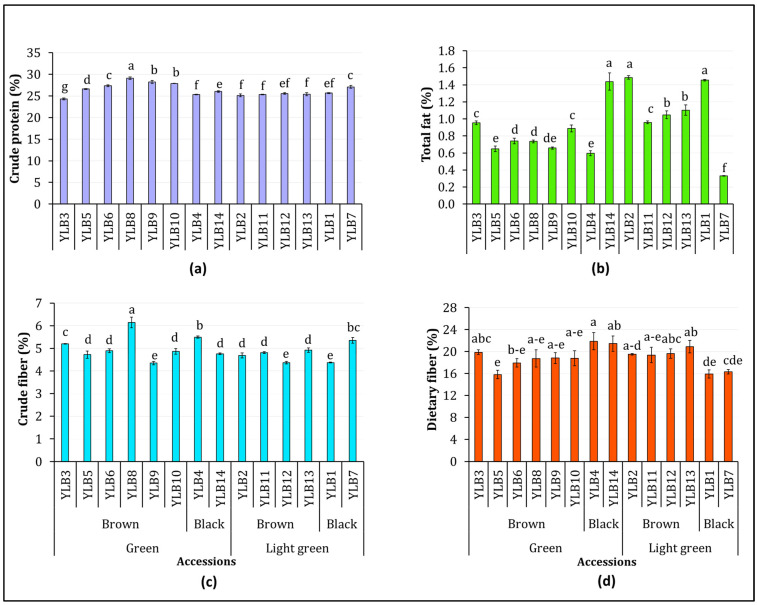
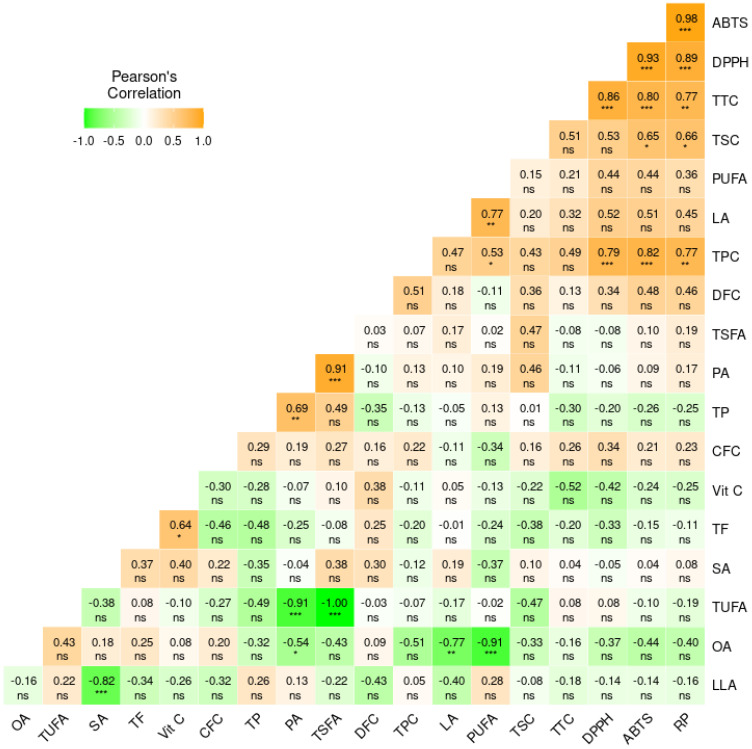
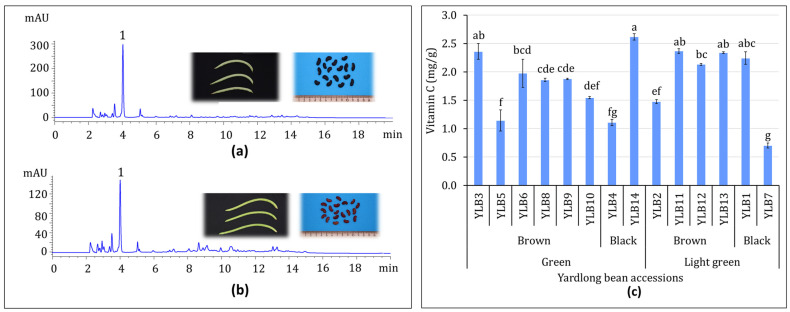
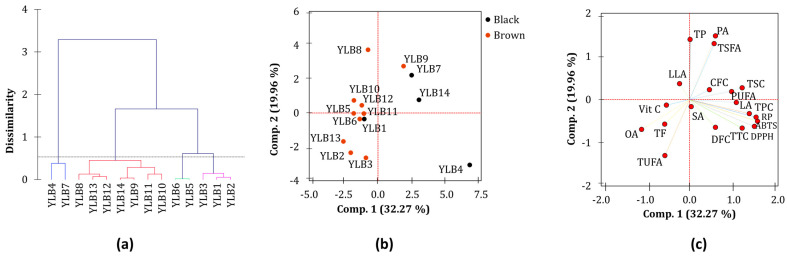
Studying the effects of genetic and environmental factors on plant biochemical components helps in selecting the best varieties for the food industry and breeding programs. This study analyzed the nutritional qualities, secondary metabolites, and antioxidant activities of 14 field-grown yardlong beans accessions and how they are affected by differences in pod and seed colors. The analyzed parameters varied significantly among the yardlong bean accessions, with variances ranging from 1.36% in total unsaturated fatty acid content to 51.01% in DPPH scavenging activity. Accessions YLB4, YLB7, and YLB14 performed the best, showing antioxidant indices of 100.00, 70.10, and 67.88%, respectively. Among these, YLB14 showed a characteristic property, having the highest levels of vitamin C (2.62 mg/g) and omega-6 to omega-3 ratio (2.67). It also had the second highest dietary fiber (21.45%), stearic acid (4.44%), and linoleic acid (40.39%) contents, as well as the lowest thrombogenicity index (0.38). Although cluster and principal component analyses did not clearly separate the yardlong beans based on pod or seed color, analysis of variance revealed that these factors and their interaction had significant effects on total phenol, DPPH scavenging activity, ABTS scavenging activity, and reducing power. In contrast, the nutritional parameters, except for dietary fiber, were not significantly affected by pod and seed color variations. Therefore, consuming yardlong beans of different pod and seed colors may not affect the overall nutrient intake. In general, this study identified yardlong beans with green pods and black seeds as good sources of antioxidants. Accordingly, further metabolomics and genomics studies are suggested to thoroughly explore their characteristics.
研究遗传和环境因素对植物生化成分的影响有助于为食品工业和育种计划选择最佳品种。本研究分析了14个田间种植的长豇豆品种的营养品质、次生代谢产物和抗氧化活性,以及它们如何受到豆荚和种子颜色差异的影响。分析的参数在长豇豆品种间差异显著,变异范围从总不饱和脂肪酸含量的1.36%到DPPH清除活性的51.01%。品种YLB4、YLB7和YLB14表现最佳,抗氧化指数分别为100.00%、70.10%和67.88%。其中,YLB14表现出一个特性,其维生素C含量最高(2.62毫克/克),ω-6与ω-3比例最高(2.67)。它的膳食纤维含量(21.45%)、硬脂酸含量(4.44%)和亚油酸含量(40.39%)也位居第二,血栓形成指数最低(0.38)。尽管聚类分析和主成分分析没有根据豆荚或种子颜色清晰地分离长豇豆,但方差分析表明,这些因素及其相互作用对总酚、DPPH清除活性、ABTS清除活性和还原力有显著影响。相比之下,除膳食纤维外,营养参数不受豆荚和种子颜色变化的显著影响。因此,食用不同豆荚和种子颜色的长豇豆可能不会影响总体营养摄入。总体而言,本研究确定绿荚黑籽的长豇豆是抗氧化剂的良好来源。因此,建议进一步开展代谢组学和基因组学研究,以全面探索其特性。