Ramirez Brandon, Banuelos Cristian, De La Cruz Alex, Nabil Shadman Tahsin, Arrieta Edel, Murr Lawrence E, Wicker Ryan B, Medina Francisco
Department of Aerospace and Mechanical Engineering, University of Texas at El Paso, El Paso, TX 79968, USA.
W.M. Keck Center for 3D Innovation, University of Texas at El Paso, El Paso, TX 79968, USA.
Materials (Basel). 2024 Sep 16;17(18):4548. doi: 10.3390/ma17184548.
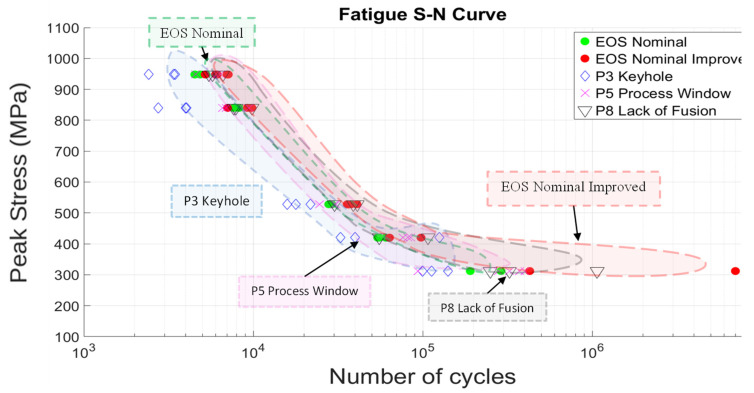
The fatigue performance of laser powder bed fusion-fabricated Ti-6Al-4V alloy was investigated using four-point bending testing. Specifically, the effects of keyhole and lack-of-fusion porosities along with various surface roughness parameters, were evaluated in the context of pore circularity and size using 2D optical metallography. Surface roughness of S = 15 to 7 microns was examined by SEM, and the corresponding fatigue performance was found to vary by 10 cycles to failure. The S-N curves for the various defects were also correlated with process window examination in laser beam power-velocity (P-V) space. Basquin's stress-life relation was well fitted to the experimental S-N curves for various process parameters except keyhole porosity, indicating reduced importance for LPBF-fabricated Ti-6Al-4V alloy components.
采用四点弯曲试验研究了激光粉末床熔融制造的Ti-6Al-4V合金的疲劳性能。具体而言,利用二维光学金相法,在孔隙圆度和尺寸的背景下,评估了匙孔和未熔合孔隙以及各种表面粗糙度参数的影响。通过扫描电子显微镜检查了15至7微米的表面粗糙度,发现相应的疲劳性能在失效循环次数上相差10次。各种缺陷的S-N曲线也与激光束功率-速度(P-V)空间中的工艺窗口检查相关。除匙孔孔隙率外,巴斯奎因应力-寿命关系与各种工艺参数的实验S-N曲线拟合良好,这表明激光粉末床熔融制造的Ti-6Al-4V合金部件的重要性降低。