Akbar Rasheed, Faheem Brekhna, Aziz Tariq, Ali Amjad, Ullah Asmat, Khan Imtiaz Ali, Sun Jianfan
Institute of Environment and Ecology, School of Environment and Safety Engineering, Jiangsu University, Zhenjiang 212013, China.
Department of Entomology, Faculty of Physical and Applied Sciences, The University of Haripur, Haripur 22620, Pakistan.
Insects. 2024 Sep 12;15(9):691. doi: 10.3390/insects15090691.
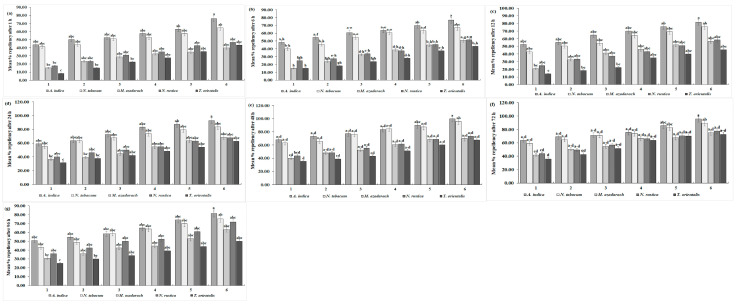
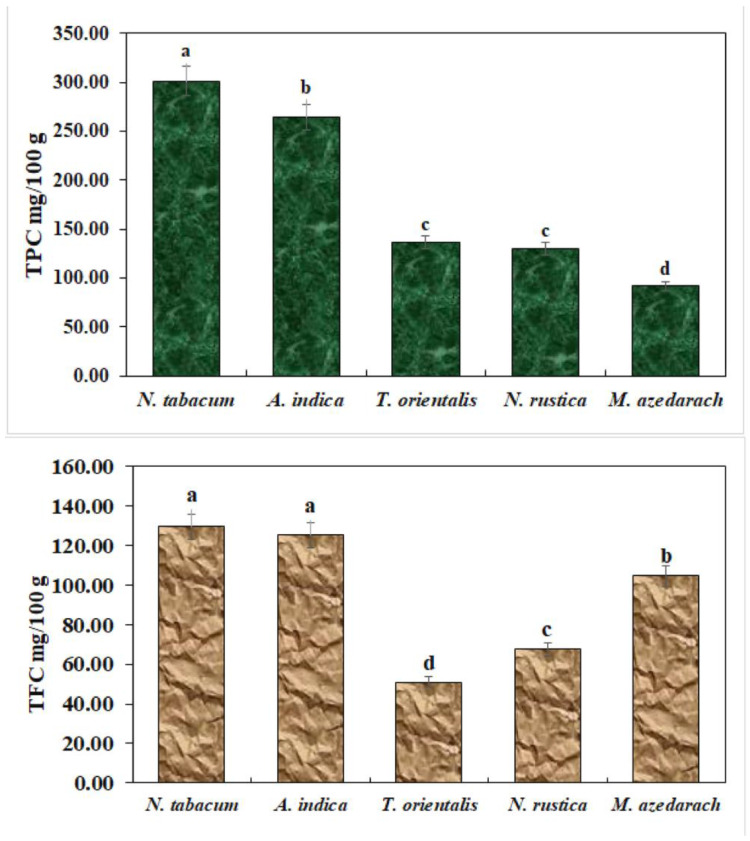
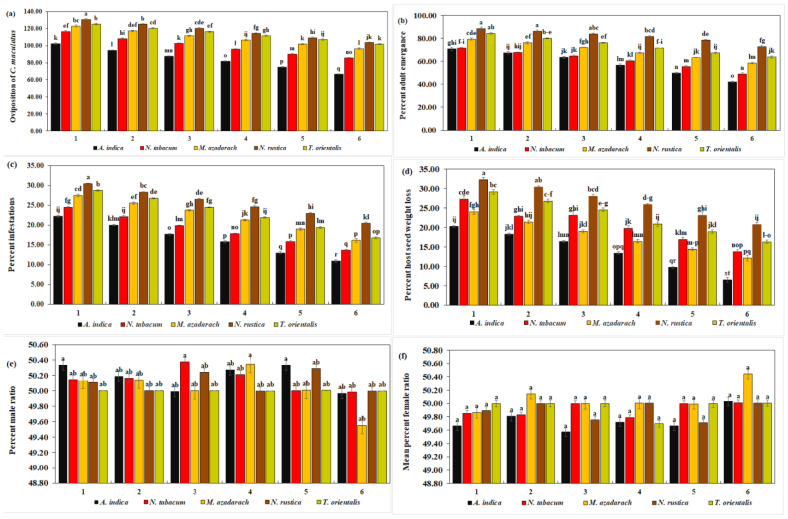
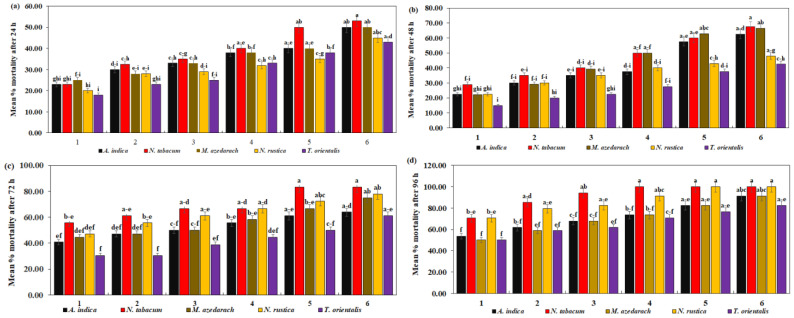
An estimated 2000 plant species have been employed for pest control worldwide. The use of these botanical derivatives is thought to be one of the most cost-effective and sustainable options for pest management in stored grain. The present study was designed to assess the efficacy of five plant extracts viz; L., L., A. Juss., L., and L. against L. Plant species extracts were applied at six different concentrations, i.e., 0.5, 1.0, 1.5, 2.0, 2.5, and 3.0% in four replications. The phytochemical analyses of ethanolic extracts of five plant species showed variable amounts of phytochemicals i.e., alkaloids, flavonoids, saponins, diterpenes, phytosterol, and phenols. Total phenolic and flavonoid compounds were also observed. The efficacy of was highest, characterized by the lowest infestation rate (16.65%), host seed weight loss (7.85%), mean oviposition (84.54), and adult emergence (58.40%). In contrast, was found to be the least effective against , with the highest infestation rate of 25.60%, host seed weight loss of 26.73%, mean oviposition of 117.17, and adult emergence rate of 82.01%. Probit analysis was performed by estimating LC and LC. The toxicity percentages of (LC = 0.69%, LC = 14.59%), (LC = 0.98%, LC = 22.06%), and (LC = 1.09%, LC = 68.52%) were notable in terms of the lower LC and LC values after the 96-h exposure period against . Repellency was assessed by using the area preference and filter paper method. The repellency of on plant extracts increased with the increasing dose and time, such that it was the highest after 48 h. Likewise, at a 3% concentration, demonstrated 100.00% (Class-V) repellency followed by (96.00%, Class-V), (74%, Class-IV), (70.00%, Class-IV), and (68.00%, Class-IV). Based on the findings of this study, we recommend integrating , , , and for effective management of and highlight the potential of these plant species in the formulation of new biocidal agents.
据估计,全球有2000种植物被用于害虫防治。这些植物衍生物的使用被认为是储存谷物害虫管理中最具成本效益和可持续性的选择之一。本研究旨在评估五种植物提取物,即[植物名称1]、[植物名称2]、[植物名称3]、[植物名称4]和[植物名称5]对[害虫名称]的防治效果。植物提取物以六种不同浓度(即0.5%、1.0%、1.5%、2.0%、2.5%和3.0%)进行施用,共四个重复。对五种植物的乙醇提取物进行的植物化学分析显示,其植物化学成分含量各不相同,即生物碱、黄酮类化合物、皂苷、二萜类化合物、植物甾醇和酚类。还观察到了总酚类和黄酮类化合物。[植物名称1]的防治效果最佳,其特征为侵染率最低(16.65%)、寄主种子重量损失最低(7.85%)、平均产卵量最低(84.54)和成虫羽化率最低(58.40%)。相比之下,[植物名称5]被发现对[害虫名称]防治效果最差,侵染率最高达25.60%,寄主种子重量损失达26.73%。平均产卵量为117.17,成虫羽化率为82.01%。通过估计LC50和LC90进行了概率分析。在对[害虫名称]暴露96小时后,[植物名称1](LC50 = 0.69%,LC90 = 14.59%)、[植物名称2](LC50 = 0.98%,LC90 = 22.06%)和[植物名称3](LC50 = 1.09%,LC90 = 68.52%)的毒性百分比因其较低的LC50和LC90值而显著。通过使用区域偏好和滤纸法评估驱避性。植物提取物对[害虫名称]的驱避性随剂量和时间增加而增强,在48小时后达到最高。同样,在3%浓度下,[植物名称1]表现出100.00%(V级)的驱避性,其次是[植物名称2](96.00%,V级)、[植物名称3](74%,IV级)、[植物名称4](70.00%,IV级)和[植物名称(5)](68.00%,IV级)。基于本研究的结果,我们建议整合[植物名称1]、[植物名称2]、[植物名称3]和[植物名称4]以有效管理[害虫名称],并强调这些植物物种在新型杀生物剂配方中的潜力。