Sheehy Lisa, Bouchard Stéphane, Kakkar Anupriya, El Hakim Rama, Lhoest Justine, Frank Andrew
Bruyère Research Institute, 43 Bruyère St., Ottawa, ON K1N 5C8, Canada.
Cyberpsychology Lab of UQO, Université du Québec en Outaouais, Gatineau, QC J8X 3X7, Canada.
J Clin Med. 2024 Sep 20;13(18):5574. doi: 10.3390/jcm13185574.
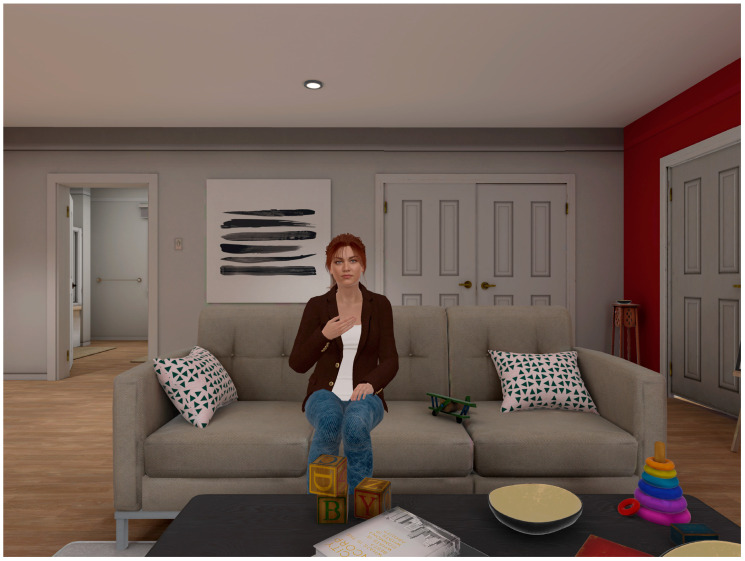
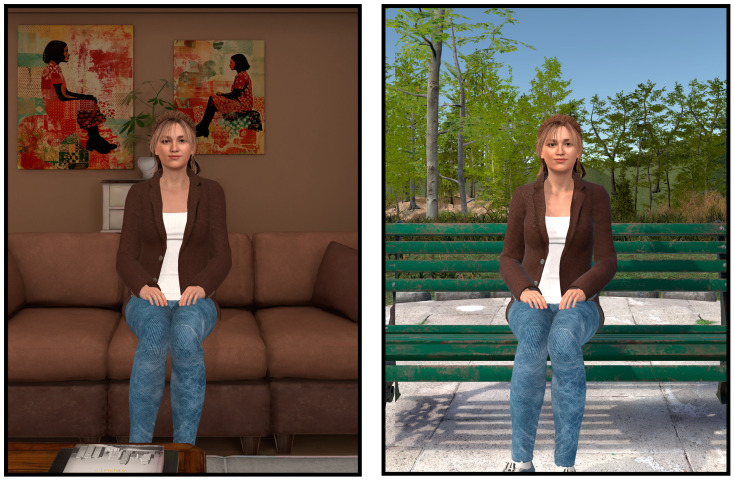
Feelings of loneliness are common in people living with dementia (PLWD) in long-term care (LTC). The goals of this study were to describe the development of a novel virtual companion for PLWD living in LTC and assess its feasibility and acceptability. : The computer-generated virtual companion, presented using a head-mounted virtual reality display, was developed in two stages. In Stage 1, the virtual companion asked questions designed to encourage conversation and reminiscence. In Stage 2, more powerful artificial intelligence tools allowed the virtual companion to engage users in nuanced discussions on any topic. PLWD in LTC tested the application at each stage to assess feasibility and acceptability. : Ten PLWD living in LTC participated in Stage 1 (4 men and 6 women; average 82 years old) and Stage 2 (2 men and 8 women; average 87 years old). Session lengths ranged from 0:00 to 5:30 min in Stage 1 and 0:00 to 53:50 min in Stage 2. Speech recognition issues and a limited repertoire of questions limited acceptance in Stage 1. Enhanced conversational ability in Stage 2 led to intimate and meaningful conversations with many participants. Many users found the head-mounted display heavy. There were no complaints of simulator sickness. The virtual companion was best suited to PLWD who could engage in reciprocal conversation. After Stage 2, response latency was identified as an opportunity for improvement in future versions. : Virtual reality and artificial intelligence can be used to create a virtual companion that is acceptable and enjoyable to some PLWD living in LTC. Ongoing innovations in hardware and software will allow future iterations to provide more natural conversational interaction and an enhanced social experience.
在长期护理机构(LTC)中,痴呆症患者(PLWD)常感到孤独。本研究的目的是描述一种针对长期护理机构中痴呆症患者的新型虚拟陪伴工具的开发过程,并评估其可行性和可接受性。:使用头戴式虚拟现实显示器呈现的计算机生成虚拟陪伴工具分两个阶段开发。在第一阶段,虚拟陪伴工具提出旨在鼓励对话和回忆的问题。在第二阶段,更强大的人工智能工具使虚拟陪伴工具能够与用户就任何话题进行细致入微的讨论。长期护理机构中的痴呆症患者在每个阶段对该应用程序进行测试,以评估其可行性和可接受性。:十名长期护理机构中的痴呆症患者参与了第一阶段(4名男性和6名女性;平均年龄82岁)和第二阶段(2名男性和8名女性;平均年龄87岁)。第一阶段的会话时长从0:00至5:30分钟不等,第二阶段为0:00至53:50分钟。语音识别问题和有限的问题库限制了第一阶段的接受度。第二阶段增强的对话能力引发了许多参与者进行亲密而有意义的对话。许多用户觉得头戴式显示器很重。没有关于模拟器不适的投诉。虚拟陪伴工具最适合能够进行双向对话的痴呆症患者。在第二阶段之后,响应延迟被确定为未来版本中有待改进之处。:虚拟现实和人工智能可用于创建一种虚拟陪伴工具,一些长期护理机构中的痴呆症患者可以接受并从中获得乐趣。硬件和软件方面的持续创新将使未来的迭代版本能够提供更自然的对话交互和增强的社交体验。