Department of Pathophysiology, University of Medicine and Pharmacy Grigore T. Popa, 700115 Iasi, Romania.
Department of Surgical Sciences, University of Medicine and Pharmacy Grigore T. Popa, 700115 Iasi, Romania.
Int J Mol Sci. 2024 Sep 13;25(18):9897. doi: 10.3390/ijms25189897.
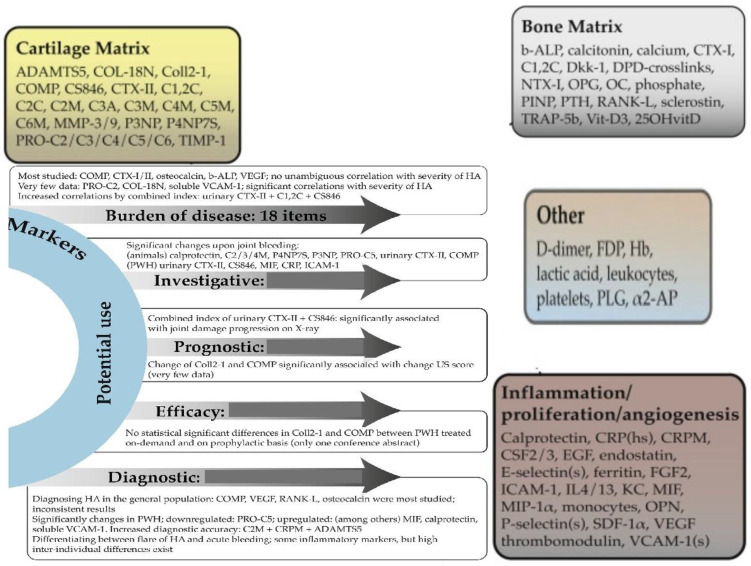
Hemophilia, which is a rare disease, results from congenital deficiencies of coagulation factors VIII and IX, respectively, leading to spontaneous bleeding into joints, resulting in hemophilic arthropathy (HA). HA involves complex processes, including synovial proliferation, angiogenesis, and tissue remodeling. Despite ongoing research, factors contributing to HA progression, especially in adults with severe HA experiencing joint pain, remain unclear. Blood markers, particularly collagen-related ones, have been explored to assess joint health in hemophilia. For example, markers like CTX-I and CTX-II reflect bone and cartilage turnover, respectively. Studies indicate elevated levels of certain markers post-bleeding episodes, suggesting joint health changes. However, longitudinal studies on collagen turnover and basement membrane or endothelial cell markers in relation to joint outcomes, particularly during painful episodes, are scarce. Given the role of the CX3CL1/CX3XR1 axis in arthritis, other studies investigate its involvement in HA. The importance of different inflammatory and bone damage biomarkers should be assessed, alongside articular cartilage and synovial membrane morphology, aiming to enhance understanding of hemophilic arthropathy progression.
血友病是一种罕见的疾病,分别由凝血因子 VIII 和 IX 的先天性缺乏引起,导致自发性关节出血,从而导致血友病性关节炎(HA)。HA 涉及复杂的过程,包括滑膜增殖、血管生成和组织重塑。尽管正在进行研究,但导致 HA 进展的因素,特别是在经历关节疼痛的严重 HA 成年患者中,仍不清楚。血液标志物,特别是与胶原相关的标志物,已被用于评估血友病患者的关节健康。例如,CTX-I 和 CTX-II 等标志物分别反映骨和软骨的代谢情况。研究表明,出血后某些标志物水平升高,表明关节健康发生变化。然而,关于胶原代谢和基底膜或内皮细胞标志物与关节结果的纵向研究,特别是在疼痛发作期间,相对较少。鉴于 CX3CL1/CX3XR1 轴在关节炎中的作用,其他研究也探讨了其在 HA 中的作用。应评估不同的炎症和骨损伤生物标志物的重要性,以及关节软骨和滑膜膜形态,旨在增强对血友病性关节炎进展的理解。