Department of Surgical Oncology, Regional Hospital of Jendouba, Faculty of Medicine of Tunis, University of Tunis El Manar, Tunisia.
Department of Surgical Oncology, Salah Azaiez Institute, Faculty of Medicine of Tunis, University of Tunis El Manar, Tunisia.
Womens Health (Lond). 2024 Jan-Dec;20:17455057241285396. doi: 10.1177/17455057241285396.
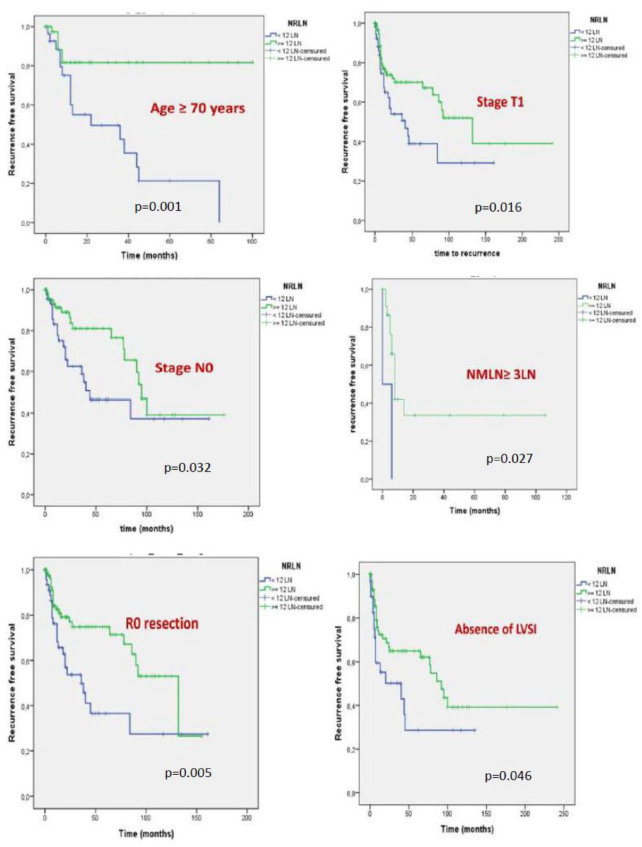
Inguinal lymph node (LN) metastasis and particularly the number of metastatic lymph nodes (NMLN) represent a determinant prognostic factor in vulvar squamous cell carcinoma (VSCC). However, the NMLN may be related to the number of removed LNs. Therefore, the lymph node ratio (LNR) reflects not only the burden of LN involvement but also the quality and extent of lymphadenectomy.
To investigate the value of the LNR and the count of LN on overall survival (OS) and recurrence-free survival (RFS).
This study is a retrospective, longitudinal, institution-based study.
This study included 192 patients treated for VSCC at the Salah Azaiez Institute between 1994 and 2022. Clinical, pathological, and evolutionary data were reported. Survival curves were generated by the Kaplan-Meier method, and predictive factors of outcome were analyzed using Cox proportional hazards models.
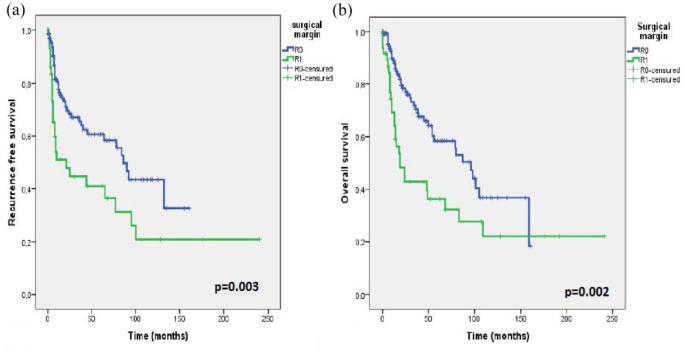
Surgery consisted of a radical vulvectomy, hemivulvectomy, and pelvic exenteration in, respectively, 96.4%, 2.1%, and 1.6% of cases followed by adjuvant radiotherapy in 38.5% of cases. LN dissection was bilateral in 88.5% of cases. LNR = 0, LNR = 0-0.2, and LNR ⩾0.2 were recorded in, respectively, 64.7%, 22.1%, and 13.2% of cases. With a mean follow-up time of 35 ± 42.06 months, the 5-year OS was 52.5% and the 5-year RFS was 55.8%. On multivariate analysis, the independent prognostic factors of OS were the LNR (hazard ratio (HR) = 5.702; 95% confidence interval (CI) = 2.282-14.245; < 0.0001), Federation of Gynecology and Obstetrics (FIGO) stage (HR = 2.089; 95% CI = 1.028-4.277; = 0.042), and free margins (HR = 2.247; 95% CI = 1.215-4.155; = 0.01). Recurrences were recorded in 37.5% of cases. Independent prognostic factors of RFS were the LNR (HR = 2.911; 95% CI = 1.468-5.779; = 0.002), FIGO stage (HR = 1.835; 95% CI = 1.071-3.141; = 0.027), and free margins (HR = 2.091; 95% CI = 1.286-3.999; = 0.003).
Surgical margin, FIGO stage, and LNR represent the independent prognostic factors of survival and LNR showed superior prognostic predictive accuracy compared with the revised 2021 FIGO staging system for predicting OS and RFS in VSCC.
腹股沟淋巴结(LN)转移,尤其是转移性淋巴结(NMLN)的数量,是外阴鳞癌(VSCC)的一个重要预后因素。然而,NMLN 可能与切除的 LN 数量有关。因此,淋巴结比率(LNR)不仅反映了 LN 受累的负担,还反映了淋巴结清扫的质量和范围。
探讨 LNR 和 LN 计数对总生存(OS)和无复发生存(RFS)的价值。
这是一项回顾性、纵向、基于机构的研究。
本研究纳入了 192 例 1994 年至 2022 年在 Salah Azaiez 研究所接受 VSCC 治疗的患者。报告了临床、病理和进化数据。使用 Kaplan-Meier 方法生成生存曲线,使用 Cox 比例风险模型分析预后因素。
手术包括根治性外阴切除术、半外阴切除术和盆腔切除术,分别占 96.4%、2.1%和 1.6%,38.5%的患者接受辅助放疗。88.5%的患者进行了双侧淋巴结清扫。LNR=0、LNR=0-0.2 和 LNR ⩾0.2 分别记录在 64.7%、22.1%和 13.2%的病例中。平均随访时间为 35±42.06 个月,5 年 OS 为 52.5%,5 年 RFS 为 55.8%。多因素分析显示,OS 的独立预后因素是 LNR(风险比(HR)=5.702;95%置信区间(CI)=2.282-14.245; < 0.0001)、FIGO 分期(HR=2.089;95%CI=1.028-4.277; = 0.042)和无肿瘤边缘(HR=2.247;95%CI=1.215-4.155; = 0.01)。37.5%的病例记录了复发。RFS 的独立预后因素是 LNR(HR=2.911;95%CI=1.468-5.779; = 0.002)、FIGO 分期(HR=1.835;95%CI=1.071-3.141; = 0.027)和无肿瘤边缘(HR=2.091;95%CI=1.286-3.999; = 0.003)。
手术切缘、FIGO 分期和 LNR 是生存的独立预后因素,LNR 显示出比 2021 年修订的 FIGO 分期系统更高的预后预测准确性,可用于预测 VSCC 的 OS 和 RFS。