Department of Psychology, Indiana University Indianapolis, 402 North Blackford Street, LD 124, Indianapolis, IN, 46202, USA.
Indiana University School of Medicine, 1101 West 10th Street, Indianapolis, IN, USA.
BMC Palliat Care. 2024 Sep 28;23(1):232. doi: 10.1186/s12904-024-01564-7.
Patients with advanced cancer and family caregivers often use avoidant coping strategies, such as delaying advance care planning discussions, which contribute to deterioration in their quality of life. Mindfulness-based interventions have shown promise in improving quality of life in this population but have rarely been applied to advance care planning. This pilot trial examined the preliminary efficacy of a group-based Mindfulness to Enhance Quality of Life and Support Advance Care Planning (MEANING) intervention for patient-caregiver dyads coping with advanced cancer. Primary outcomes were patient and caregiver quality of life or well-being, and secondary outcomes included patient advanced care planning engagement (self-efficacy and readiness) and other psychological and symptom outcomes.
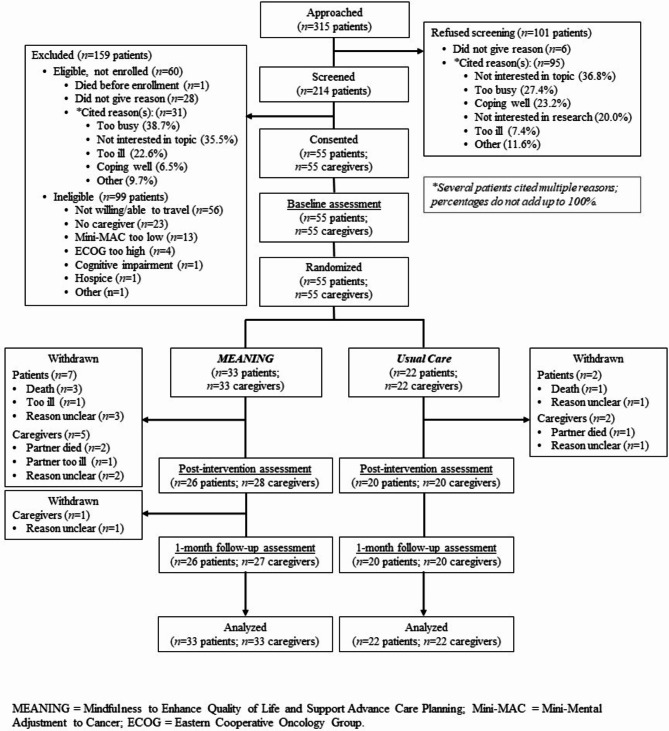
In this pilot trial, dyads coping with advanced cancer were recruited from five oncology clinics in the midwestern U.S. and randomized to six weekly group sessions of a mindfulness intervention (n = 33 dyads) or usual care (n = 22 dyads). Outcomes were assessed via surveys at baseline, post-intervention, and 1 month post-intervention. All available data were included in the multilevel models assessing intervention efficacy.
Patients in the MEANING condition experienced significant increases in existential well-being and self-efficacy for advance care planning across follow-ups, whereas usual care patients did not. Other group differences in outcomes were not statistically significant. These outcomes included other facets of patient well-being, caregiver quality of life, patient readiness for advance care planning, caregiver burden, and patient and caregiver depressive symptoms, anxiety, sleep disturbance, cognitive avoidance, and peaceful acceptance of cancer. However, only MEANING patients showed moderate increases in psychological well-being across follow-ups, and MEANING caregivers showed moderate increases in quality of life at 1-month follow-up. Certain psychological outcomes, such as caregiver burden at 1-month follow-up, also showed moderate improvement in the MEANING condition. Patients in both conditions reported small to moderate increases in readiness to engage in advance care planning.
A mindfulness-based intervention showed promise in improving quality-of-life and advance care planning outcomes in patients and caregivers coping with advanced cancer and warrants further testing.
ClinicalTrials.gov NCT03257007. Registered 22 August 2017, https://clinicaltrials.gov/ct2/show/NCT03257007 .
晚期癌症患者及其家属护理人员通常采用回避应对策略,例如推迟预先护理计划讨论,这会导致他们的生活质量下降。基于正念的干预措施已显示出在改善该人群生活质量方面的潜力,但很少应用于预先护理计划。这项初步试验研究了一种基于小组的正念以增强生活质量和支持预先护理计划(MEANING)干预措施对晚期癌症患者-护理人员配对的初步疗效。主要结果是患者和护理人员的生活质量或幸福感,次要结果包括患者预先护理计划的参与(自我效能和准备就绪)以及其他心理和症状结果。
在这项初步试验中,从美国中西部的五家肿瘤诊所招募了正在应对晚期癌症的配对患者和护理人员,并将他们随机分配到六次每周小组正念干预(n=33 对)或常规护理(n=22 对)。通过基线、干预后和干预后 1 个月的调查评估结果。在评估干预效果的多层次模型中包含了所有可用数据。
MEANING 条件下的患者在随访期间经历了存在幸福感和预先护理计划自我效能的显著提高,而常规护理组的患者则没有。其他组间结果差异没有统计学意义。这些结果包括患者幸福感的其他方面、护理人员的生活质量、患者对预先护理计划的准备程度、护理人员负担以及患者和护理人员的抑郁症状、焦虑、睡眠障碍、认知回避和对癌症的平和接受。然而,只有 MEANING 患者在随访期间表现出中等程度的心理幸福感提高,而 MEANING 护理人员在 1 个月随访时表现出中等程度的生活质量提高。在 MEANING 条件下,某些心理结果,如 1 个月随访时的护理人员负担,也表现出适度改善。两种情况下的患者都报告说在预先护理计划的参与方面,准备程度略有提高。
基于正念的干预措施在改善应对晚期癌症的患者和护理人员的生活质量和预先护理计划结果方面显示出了前景,值得进一步测试。
ClinicalTrials.gov NCT03257007。注册于 2017 年 8 月 22 日,https://clinicaltrials.gov/ct2/show/NCT03257007。