Biologie Intégrative et Physiologie - Parcours Neurosciences Cellulaires et Integrées, Faculté des Sciences et Ingénierie, Campus Pierre Et Marie Curie, Sorbonne Université, Paris, France.
Pathologies du Sommeil, Faculté de Médecine, Hopital Universitaire Pitié-Salpêtrière. Sorbonne Université, Paris, France.
Lipids Health Dis. 2024 Sep 28;23(1):320. doi: 10.1186/s12944-024-02302-x.
Sleep disorders, particularly insomnia and obstructive sleep apnea, are associated with dyslipidemia in the general population. The study's aim was to explore the association between pathological Cholesterol and Triglyceride levels, and sleep and nighttime behavior disorders (SNBD) in older adults, whether they might predict SNBD onset, and to emphasize the role of body mass index (BMI) in this association.
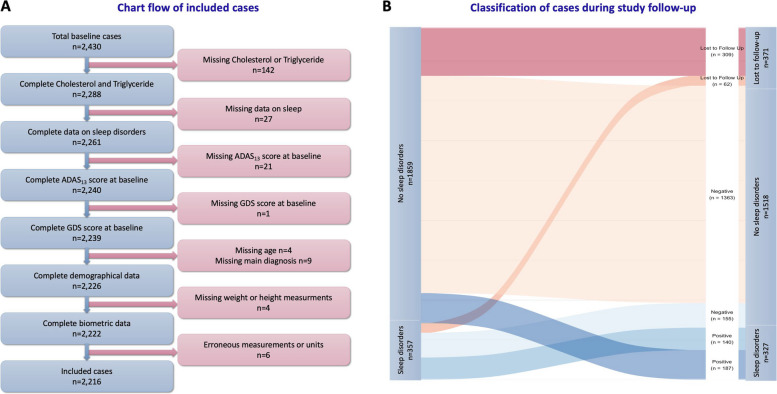
Alzheimer's Disease Neuroimaging Initiative (ADNI) population with complete Cholesterol, Triglyceride, SNBD, and neurocognitive data were included. Logistic regression was performed to study the association between hypercholesterolemia, hypertriglyceridemia, and SNBD at baseline and at 12 months. Relevant confounders, particularly BMI, were adjusted for.
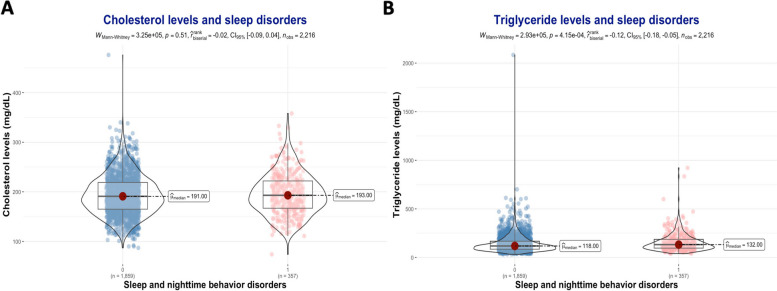
Among the 2,216 included cases, 1,045 (47%) were females, and the median age was 73 years (IQR: 68, 78). At baseline, 357 (16%) had SNBD and 327 (18%) at 12 months; 187 of them were incident cases. There were more cases of baseline SNBD in the hypertriglyceridemia group than in those without (19% vs. 14%, P-value = 0.003). Similarly, more follow-up SNBD cases had hypertriglyceridemia at baseline (21% vs. 16%, P-value = 0.025). SNBD cases at baseline had significantly higher serum Triglyceride levels than those without (132 vs. 118mg/dL, P-value < 0.001). Only hypertriglyceridemia was significantly associated with baseline SNBD (crude OR = 1.43, 95%CI: 1.13,1.80, P-value = 0.003), even after adjustment for confounding factors (adj. OR = 1.36, 95%CI: 1.06,1.74, P-value = 0.016) and (BMI-adj. OR = 1.29, 95%CI: 1.00,1.66, P-value = 0.048). None of the dyslipidemia forms did predict incident cases at 12 months.
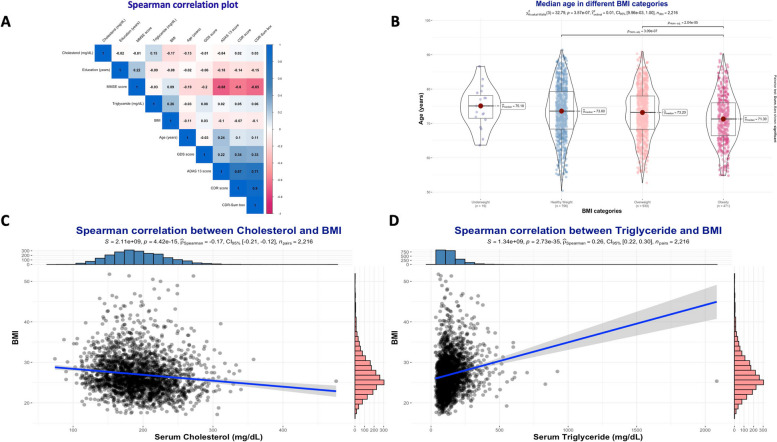
Hypertriglyceridemia, but not hypercholesterolemia, was associated with higher odds of SNBD. The association was independent of BMI. None of the dyslipidemia forms did predict incident SNBD over 12 months. Sleep disorders should motivate a systematic screening of dyslipidemia in older adults and vice versa.
睡眠障碍,尤其是失眠和阻塞性睡眠呼吸暂停,与普通人群中的血脂异常有关。本研究旨在探讨老年患者病理性胆固醇和甘油三酯水平与睡眠和夜间行为障碍(SNBD)之间的关系,它们是否可能预测 SNBD 的发生,并强调体重指数(BMI)在这种关联中的作用。
纳入了阿尔茨海默病神经影像学倡议(ADNI)人群中具有完整胆固醇、甘油三酯、SNBD 和神经认知数据的患者。使用逻辑回归研究基线和 12 个月时高胆固醇血症、高甘油三酯血症和 SNBD 之间的关联。调整了相关混杂因素,特别是 BMI。
在纳入的 2216 例病例中,有 1045 例(47%)为女性,中位年龄为 73 岁(IQR:68,78)。基线时有 357 例(16%)存在 SNBD,12 个月时有 327 例(18%);其中 187 例为新发病例。高甘油三酯血症组的基线 SNBD 病例多于无高甘油三酯血症组(19%比 14%,P 值=0.003)。同样,更多的随访 SNBD 病例在基线时存在高甘油三酯血症(21%比 16%,P 值=0.025)。基线 SNBD 病例的血清甘油三酯水平明显高于无 SNBD 病例(132 比 118mg/dL,P 值<0.001)。只有高甘油三酯血症与基线 SNBD 显著相关(未校正 OR=1.43,95%CI:1.13,1.80,P 值=0.003),即使在调整混杂因素后(校正 OR=1.36,95%CI:1.06,1.74,P 值=0.016)和(BMI 校正 OR=1.29,95%CI:1.00,1.66,P 值=0.048)也是如此。血脂异常形式均不能预测 12 个月时的新发病例。
高甘油三酯血症,而不是高胆固醇血症,与 SNBD 的发生几率更高相关。这种关联独立于 BMI。血脂异常形式均不能预测 12 个月时的新发 SNBD。睡眠障碍应促使老年人系统筛查血脂异常,反之亦然。