Center for Health Systems Research, The National Institute of Public Health of Mexico, Universidad Av. 655, 62100, Cuernavaca, Morelos, Mexico.
The George Institute for Global Health, UNSW, Sydney, NSW, Australia.
Glob Health Res Policy. 2024 Sep 29;9(1):40. doi: 10.1186/s41256-024-00377-8.
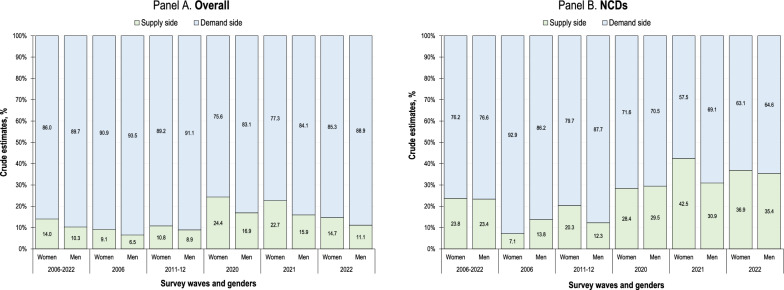
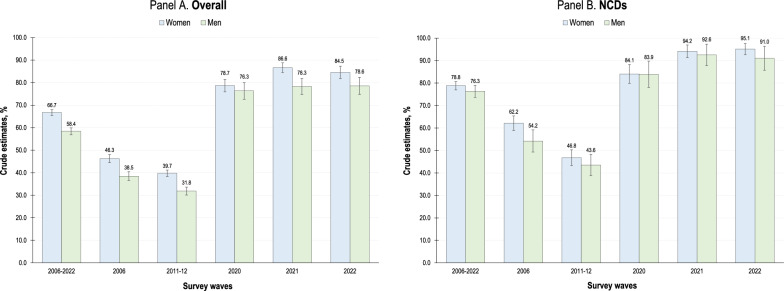
Equitable health service utilization is key to health systems' optimal performance and universal health coverage. The evidence shows that men and women use health services differently. However, current analyses have failed to explore these differences in depth and investigate how such gender disparities vary by service type. This study examined the gender gap in the use of outpatient health services by Mexican adults with non-communicable diseases (NCDs) from 2006 to 2022.
A cross-sectional population-based analysis of data drawn from National Health and Nutrition Surveys of 2006, 2011-12, 2020, 2021, and 2022 was performed. Information was gathered from 300,878 Mexican adults aged 20 years and older who either had some form of public health insurance or were uninsured. We assessed the use of outpatient health services provided by qualified personnel for adults who reported having experienced an NCD and seeking outpatient care in the 2 weeks before the survey. Outpatient service utilization was disaggregated into four categories: non-use, use of public health services from providers not corresponding to the user's health insurance, use of public health services from providers not corresponding to the user's health insurance, and use of private services. This study reported the mean percentages (with 95% confidence intervals [95% CIs]) for each sociodemographic covariate associated with service utilization, disaggregated by gender. The percentages were reported for each survey year, the entire study period, the types of service use, and the reasons for non-use, according to the type of health problem. The gender gap in health service utilization was calculated using predictive margins by gender, type of disease, and survey year, and adjusted through a multinomial logistic regression model.
Overall, we found that women were less likely to fall within the "non-use" category than men during the entire study period (21.8% vs. 27.8%, P < 0.001). However, when taking into account the estimated gender gap measured by incremental probability and comparing health needs caused by NCDs against other conditions, compared with women, men had a 7.4% lower incremental likelihood of falling within the non-use category (P < 0.001), were 10.8% more likely to use services from providers corresponding to their health insurance (P < 0.001), and showed a 12% lower incremental probability of using private services (P < 0.001). Except for the gap in private service utilization, which tended to shrink, the others remained stable throughout the period analyzed.
Over 16 years of outpatient service utilization by Mexican adults requiring care for NCDs has been characterized by the existence of gender inequalities. Women are more likely either not to receive care or resort to using private outpatient services, often resulting in catastrophic out-of-pocket expenses for them and their families. Such inequalities are exacerbated by the segmented structure of the Mexican health system, which provides health insurance conditional on formal employment participation. These findings should be considered as a key factor in reorienting NCD health policies and programs from a gender perspective.
公平利用卫生服务是卫生系统最佳绩效和全民健康覆盖的关键。有证据表明,男性和女性使用卫生服务的方式不同。然而,目前的分析未能深入探讨这些差异,并调查这种性别差距如何因服务类型而异。本研究调查了 2006 年至 2022 年期间墨西哥患有非传染性疾病(NCDs)的成年门诊卫生服务利用方面的性别差距。
对 2006 年、2011-12 年、2020 年、2021 年和 2022 年全国健康和营养调查的数据进行了横断面人群分析。数据来自 300878 名 20 岁及以上的墨西哥成年人,他们要么有某种形式的公共医疗保险,要么没有保险。我们评估了报告患有 NCD 并在调查前两周内寻求门诊护理的成年人从合格人员那里获得的门诊卫生服务的利用情况。门诊服务利用分为四类:不利用、利用与用户医疗保险不符的提供者提供的公共卫生服务、利用与用户医疗保险不符的提供者提供的公共卫生服务、以及利用私人服务。本研究报告了按性别和每个社会人口学协变量分组的服务利用相关的平均百分比(95%置信区间[95%CI])。按性别、调查年份、服务利用类型和按卫生问题划分的不利用原因报告了每个调查年份、整个研究期间的百分比。使用预测边际按性别、疾病类型和调查年份计算卫生服务利用方面的性别差距,并通过多项逻辑回归模型进行调整。
总体而言,我们发现,在整个研究期间,女性比男性更不可能属于“不利用”类别(21.8%对 27.8%,P<0.001)。然而,当考虑到通过增量概率衡量的估计性别差距,并将由 NCD 引起的卫生需求与其他条件进行比较时,与女性相比,男性属于“不利用”类别的增量可能性低 7.4%(P<0.001),更有可能利用与其医疗保险相符的提供者提供的服务(P<0.001),并且利用私人服务的增量可能性低 12%(P<0.001)。除了私人服务利用差距趋于缩小外,其他差距在整个分析期间保持稳定。
16 多年来,墨西哥需要治疗 NCD 的成年人的门诊服务利用一直存在性别不平等。女性更有可能要么得不到护理,要么求助于使用私人门诊服务,这往往给她们及其家庭带来灾难性的自付费用。墨西哥卫生系统的分割结构加剧了这种不平等,该结构将医疗保险与正规就业参与挂钩。这些发现应被视为从性别角度重新调整非传染性疾病卫生政策和方案的关键因素。