Department of Cardiology Renmin Hospital of Wuhan University Wuhan China.
Cardiovascular Research Institute Wuhan University Wuhan China.
J Am Heart Assoc. 2024 Oct;13(19):e035868. doi: 10.1161/JAHA.124.035868. Epub 2024 Sep 30.
Sympathetic hyperactivity plays an important role in the initiation and maintenance of pulmonary hypertension. Carotid baroreceptor stimulation (CBS) is an effective autonomic neuromodulation therapy. We aim to investigate the effects of CBS on hypoxia-induced pulmonary hypertension and its underlying mechanisms.
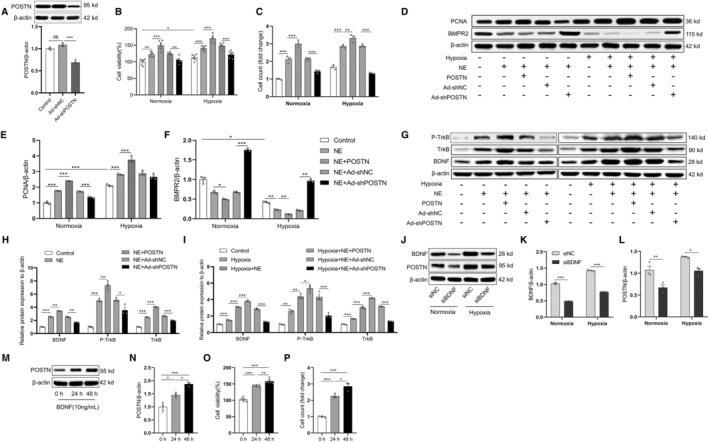
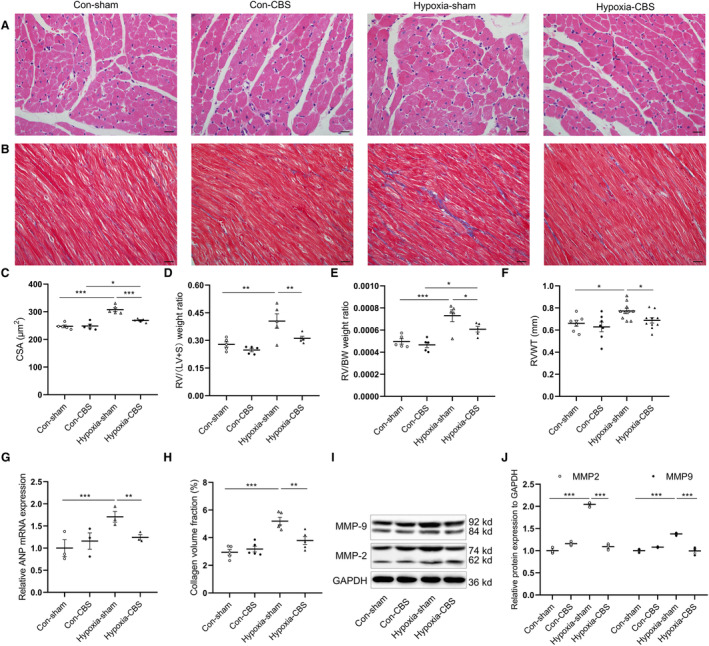
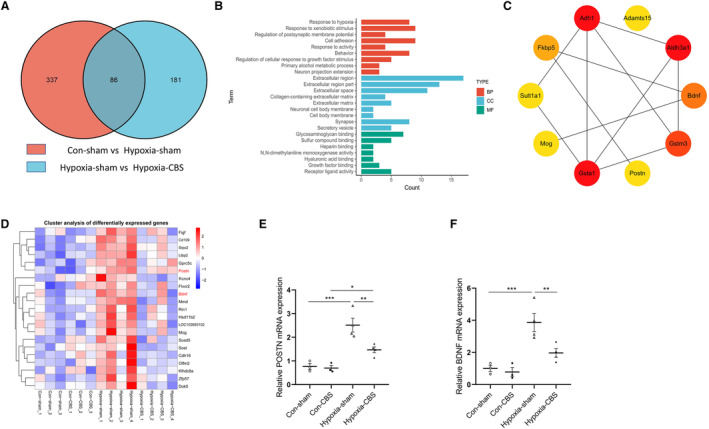
Rats were randomly assigned into 4 groups, including a Control-sham group (n=7), a Control-CBS group (n=7), a Hypoxia-sham group (n=10) and a Hypoxia-CBS group (n=10). Echocardiography, ECG, and hemodynamics examination were performed. Samples of blood, lung tissue, pulmonary arteries, and right ventricle were collected for the further analysis. In the in vivo study, CBS reduced wall thickness and muscularization degree in pulmonary arterioles, thereby improving pulmonary hemodynamics. Right ventricle hypertrophy, fibrosis and dysfunction were all improved. CBS rebalanced autonomic tone and reduced the density of sympathetic nerves around pulmonary artery trunks and bifurcations. RNA-seq analysis identified and periostin () as key genes involved in hypoxia-induced pulmonary hypertension, and CBS downregulated the mRNA expression of and in rat pulmonary arteries. In the in vitro study, norepinephrine was found to promote pulmonary artery smooth muscle cell proliferation while upregulating and expression. The proliferative effect was alleviated by silence or .
Our results showed that CBS could rebalance autonomic tone, inhibit pulmonary arterial remodeling, and improve pulmonary hemodynamics and right ventricle function, thus delaying hypoxia-induced pulmonary hypertension progression. There may be a reciprocal interaction between and that is responsible for the underlying mechanism.
交感神经过度活跃在肺动脉高压的发生和维持中起重要作用。颈动脉压力感受器刺激(CBS)是一种有效的自主神经调节治疗方法。我们旨在研究 CBS 对低氧诱导性肺动脉高压的影响及其潜在机制。
大鼠被随机分为 4 组,包括对照组假手术组(n=7)、对照组 CBS 组(n=7)、低氧组假手术组(n=10)和低氧 CBS 组(n=10)。进行超声心动图、心电图和血流动力学检查。采集血液、肺组织、肺血管和右心室样本进行进一步分析。在体内研究中,CBS 降低了肺小动脉的壁厚度和肌化程度,从而改善了肺血流动力学。右心室肥大、纤维化和功能障碍均得到改善。CBS 重新平衡了自主神经张力,减少了肺动脉主干和分支周围交感神经的密度。RNA-seq 分析鉴定了 periostin()作为参与低氧诱导性肺动脉高压的关键基因,CBS 下调了大鼠肺血管中periostin()和()的 mRNA 表达。在体外研究中,去甲肾上腺素被发现可促进肺动脉平滑肌细胞增殖,同时上调 periostin()和()的表达。沉默 periostin()或()可减轻增殖作用。
我们的结果表明,CBS 可重新平衡自主神经张力,抑制肺血管重塑,改善肺血流动力学和右心室功能,从而延缓低氧诱导性肺动脉高压的进展。periostin()和()之间可能存在相互作用,这可能是其潜在机制。