Department of Biological Sciences, Myongji University, Yongin, Gyeonggido, Republic of Korea.
mSystems. 2024 Oct 22;9(10):e0096424. doi: 10.1128/msystems.00964-24. Epub 2024 Sep 30.
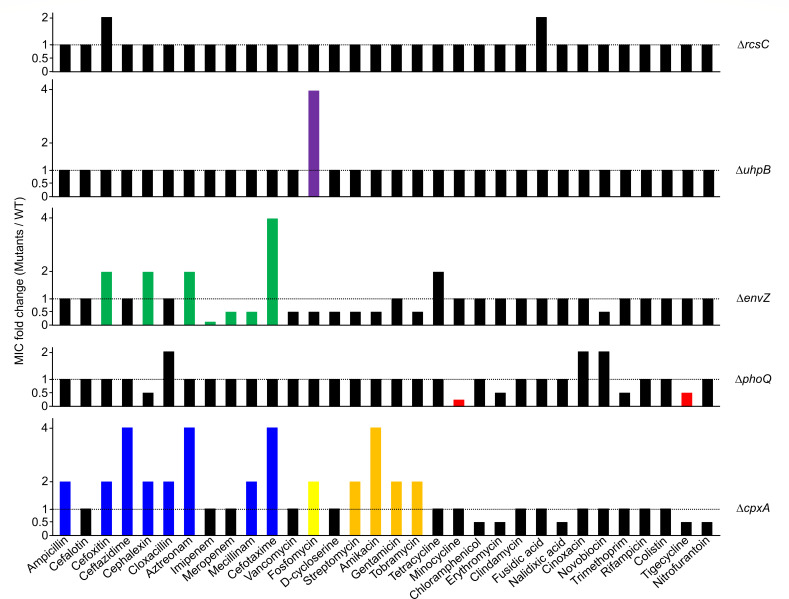
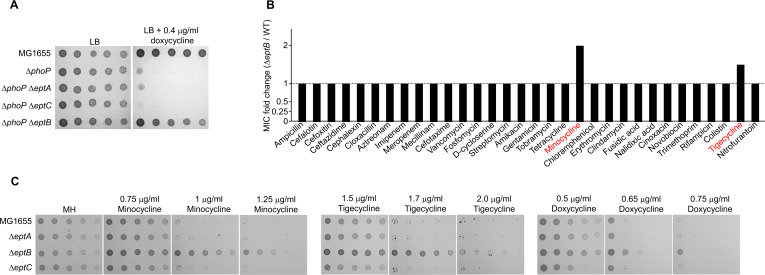
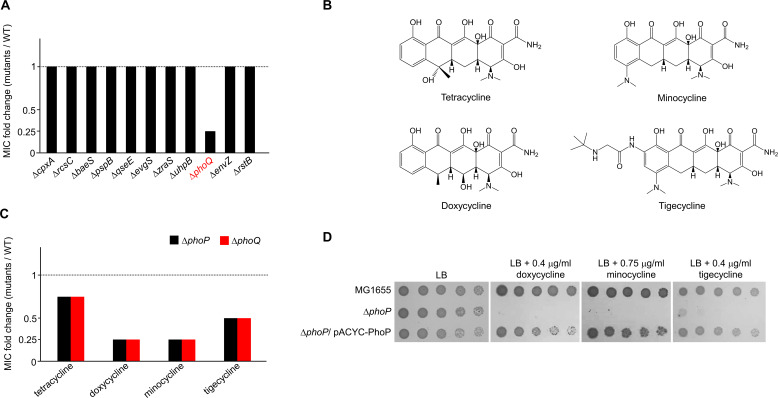
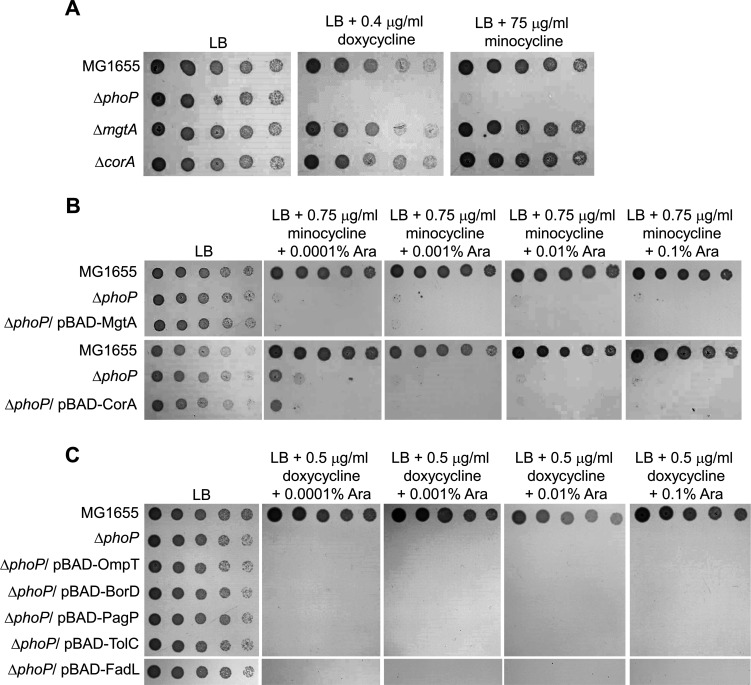
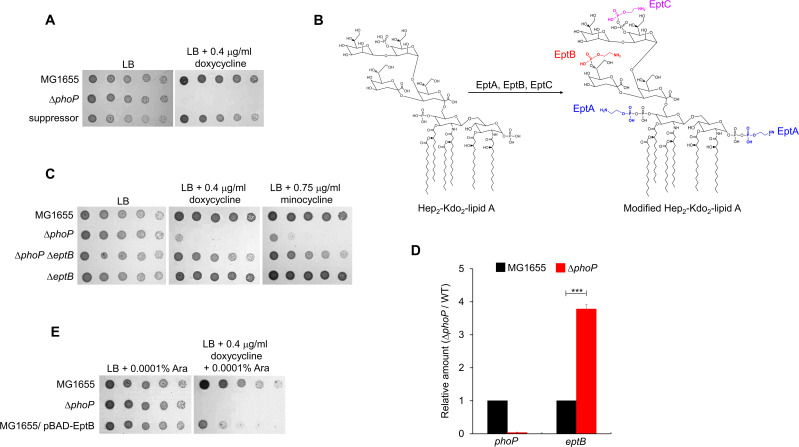
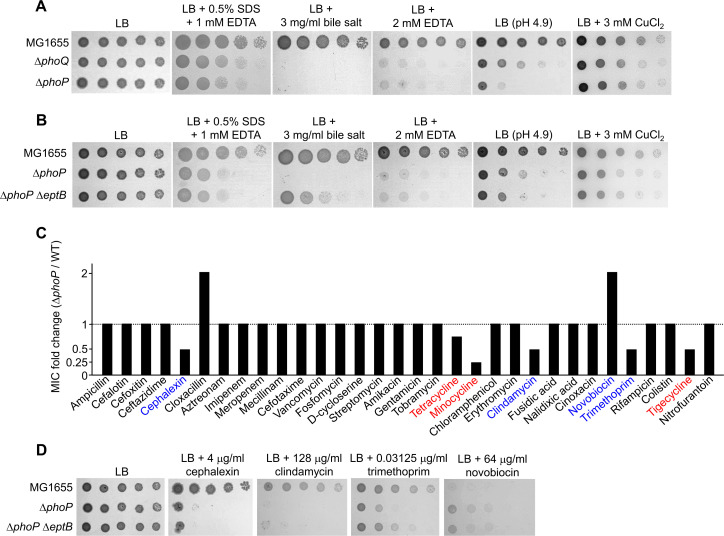
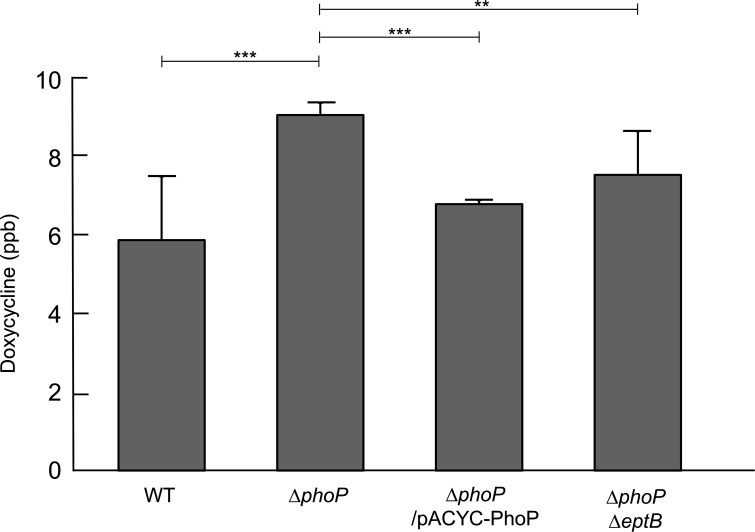
Tetracyclines and glycylcycline are among the important antibiotics used to combat infections caused by multidrug-resistant Gram-negative pathogens. Despite the clinical importance of these antibiotics, their mechanisms of resistance remain unclear. In this study, we elucidated a novel mechanism of resistance to tetracycline and glycylcycline antibiotics via lipopolysaccharide (LPS) modification. Disruption of the PhoPQ two-component system, which regulates the transcription of various genes involved in magnesium transport and LPS modification, leads to increased susceptibility to tetracycline, minocycline, doxycycline, and tigecycline. These phenotypes are caused by enhanced expression of phosphoethanolamine transferase EptB, which catalyzes the modification of the inner core sugar of LPS. PhoPQ-mediated regulation of EptB expression appears to affect the intracellular transportation of doxycycline. Disruption of EptB increases resistance to tetracycline and glycylcycline antibiotics, whereas the other two phosphoethanolamine transferases, EptA and EptC, that participate in the modification of other LPS residues, are not associated with resistance to tetracyclines and glycylcycline. Overall, our results demonstrated that PhoPQ-mediated modification of a specific residue of LPS by phosphoethanolamine transferase EptB governs intrinsic resistance to tetracycline and glycylcycline antibiotics.
Elucidating the resistance mechanisms of clinically important antibiotics helps in maintaining the clinical efficacy of antibiotics and in the prescription of adequate antibiotic therapy. Although tetracycline and glycylcycline antibiotics are clinically important in combating multidrug-resistant Gram-negative bacterial infections, their mechanisms of resistance are not fully understood. Our research demonstrates that the PhoPQ two-component system affects resistance to tetracycline and glycylcycline antibiotics by controlling the expression of phosphoethanolamine transferase EptB, which catalyzes the modification of the inner core residue of lipopolysaccharide (LPS). Therefore, our findings highlight a novel resistance mechanism to tetracycline and glycylcycline antibiotics and the physiological significance of LPS core modification in .
四环素类和甘氨环素是用于对抗多药耐药革兰氏阴性病原体引起的感染的重要抗生素之一。尽管这些抗生素具有临床重要性,但它们的耐药机制仍不清楚。在这项研究中,我们通过脂多糖 (LPS) 修饰阐明了一种对抗四环素类和甘氨环素抗生素的新型耐药机制。破坏 PhoPQ 双组分系统,该系统调节涉及镁运输和 LPS 修饰的各种基因的转录,导致对四环素、米诺环素、多西环素和替加环素的敏感性增加。这些表型是由磷酸乙醇胺转移酶 EptB 的表达增强引起的,磷酸乙醇胺转移酶 EptB 催化 LPS 内核心糖的修饰。PhoPQ 介导的 EptB 表达调控似乎影响多西环素的细胞内运输。EptB 的破坏增加了对四环素和甘氨环素抗生素的耐药性,而参与修饰其他 LPS 残基的另外两种磷酸乙醇胺转移酶 EptA 和 EptC 与四环素和甘氨环素的耐药性无关。总的来说,我们的结果表明,PhoPQ 介导的磷酸乙醇胺转移酶 EptB 对 LPS 特定残基的修饰决定了对四环素和甘氨环素抗生素的固有耐药性。
阐明临床重要抗生素的耐药机制有助于维持抗生素的临床疗效和适当抗生素治疗的处方。尽管四环素类和甘氨环素抗生素在对抗多药耐药革兰氏阴性细菌感染方面具有临床重要性,但它们的耐药机制尚不完全清楚。我们的研究表明,PhoPQ 双组分系统通过控制磷酸乙醇胺转移酶 EptB 的表达来影响对四环素类和甘氨环素抗生素的耐药性,磷酸乙醇胺转移酶 EptB 催化脂多糖 (LPS) 内核心残基的修饰。因此,我们的发现强调了一种对抗四环素类和甘氨环素抗生素的新型耐药机制,以及 LPS 核心修饰在. 中的生理意义。