Liu Hua, Wu Wenxi, Xu Min, Ling Xiaoyang, Lu Wei, Cheng Feng, Wang Jian
Department of Neurosurgery, Affiliated Kunshan Hospital of Jiangsu University, Kunshan, 215300, People's Republic of China.
Department of Neurosurgery, Kunshan Hospital of Traditional Chinese Medicine, Kunshan Affiliated Hospital of Nanjing University of Chinese Medicine, Kunshan, 215300, People's Republic of China.
Ther Clin Risk Manag. 2024 Sep 23;20:665-675. doi: 10.2147/TCRM.S475412. eCollection 2024.
Traumatic brain injury (TBI) is a severe public health problem in elderly patients, and frailty is associated with higher mortality rates in older patients. This study aims to assess the prognostic value of frailty in patients with TBI.
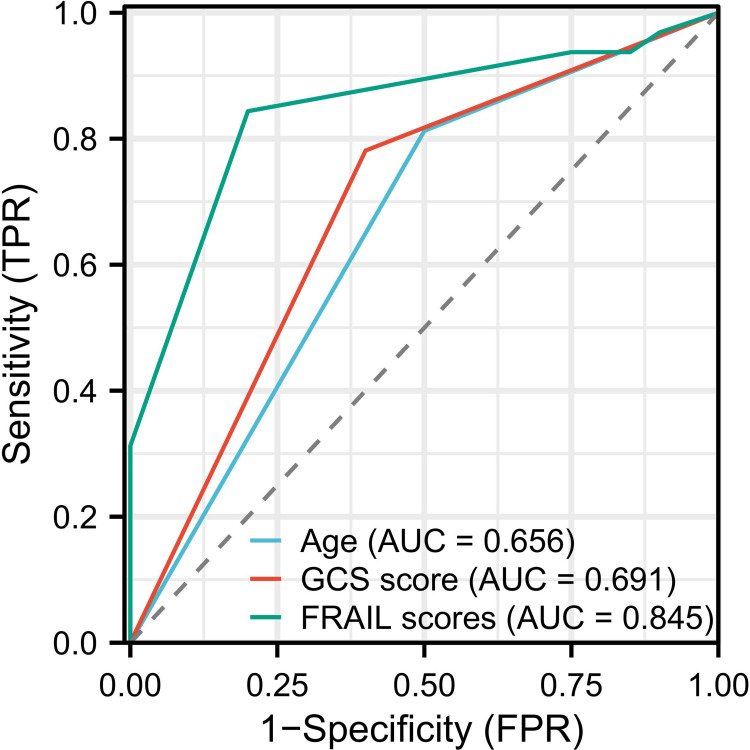
Clinical data from 348 TBI patients treated at Affiliated Kunshan Hospital of Jiangsu University and Kunshan Hospital of Traditional Chinese Medicine between December 2018 and December 2020 were retrospectively collected. Univariate and multivariate logistic regression analyses were used to determine risk factors affecting in-hospital mortality, and receiver operating characteristic (ROC) curves were plotted to assess the discriminatory power of the frailty index. Frailty was assessed using the FRAIL scale, where FRAIL stands for Fatigue, Resistance, Ambulation, Illness, and Loss of weight, with each item scored as 0 or 1.
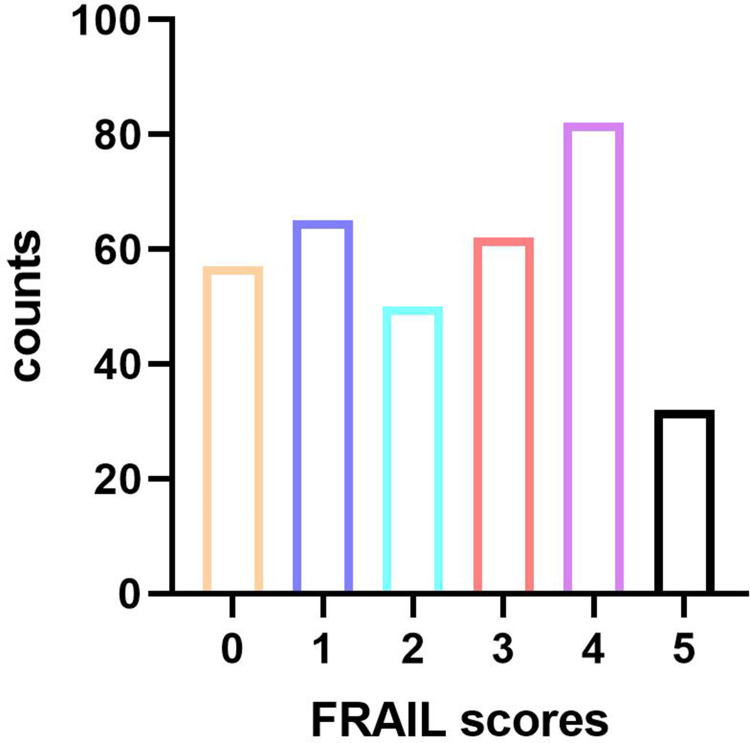
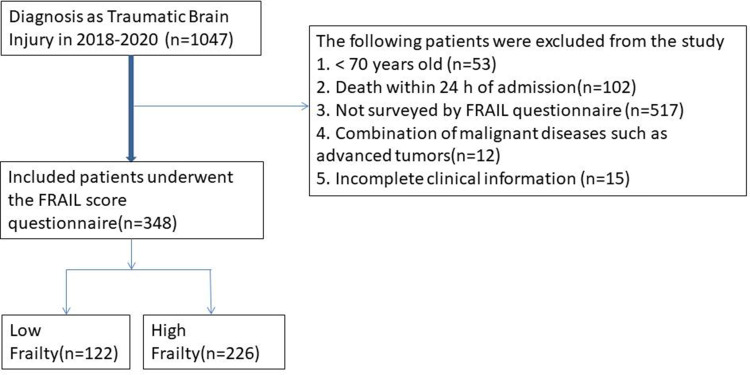
Using the FRIAL questionnaire, 122 patients had low frailty and 226 had high frailty. Multivariate logistic regression analysis showed that high frailty was a risk factor for in-hospital mortality in TBI patients (P<0.001, OR=2.012 [1.788-2.412]). The proportion of infections occurring in the two groups was statistically different (P=0.015), with severely infected TBI patients being more likely to develop complications. The ROC curve showed an area under the curve for the FRAIL score of 0.845 [0.752-0.938].
Frailty is an important risk factor for in-hospital mortality in elderly TBI patients, and more attention should be paid to patients with high levels of frailty. Clinicians should consider the degree of frailty when assessing TBI and making treatment decisions.
创伤性脑损伤(TBI)在老年患者中是一个严重的公共卫生问题,而虚弱与老年患者较高的死亡率相关。本研究旨在评估虚弱对TBI患者的预后价值。
回顾性收集2018年12月至2020年12月在江苏大学附属昆山医院和昆山市中医医院接受治疗的348例TBI患者的临床资料。采用单因素和多因素逻辑回归分析确定影响住院死亡率的危险因素,并绘制受试者工作特征(ROC)曲线以评估虚弱指数的辨别能力。使用FRAIL量表评估虚弱,其中FRAIL代表疲劳、抵抗力、行走能力、疾病和体重减轻,每个项目评分为0或1。
使用FRIAL问卷,122例患者虚弱程度低,226例患者虚弱程度高。多因素逻辑回归分析显示,高虚弱是TBI患者住院死亡的危险因素(P<0.001,OR=2.012[1.788-2.412])。两组感染发生率有统计学差异(P=0.015),TBI严重感染患者更易发生并发症。ROC曲线显示FRAIL评分的曲线下面积为0.845[0.752-0.938]。
虚弱是老年TBI患者住院死亡的重要危险因素,应更多关注虚弱程度高的患者。临床医生在评估TBI和制定治疗决策时应考虑虚弱程度。