Department of Sports Medicine Norwegian School of Sports Sciences, Oslo 0806, Norway.
J Pregnancy. 2024 Sep 21;2024:4040825. doi: 10.1155/2024/4040825. eCollection 2024.
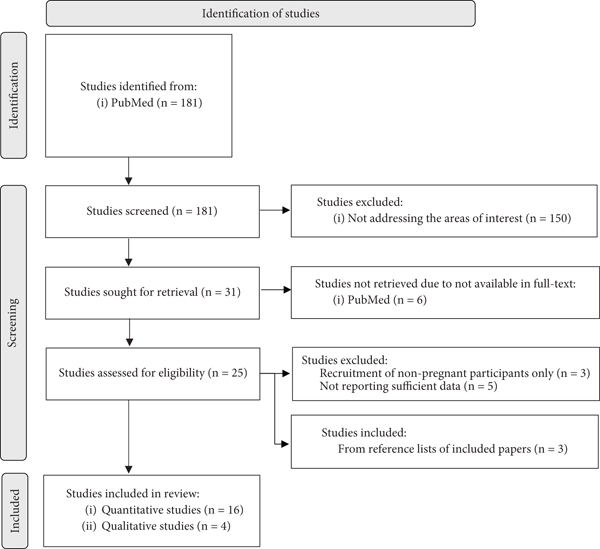
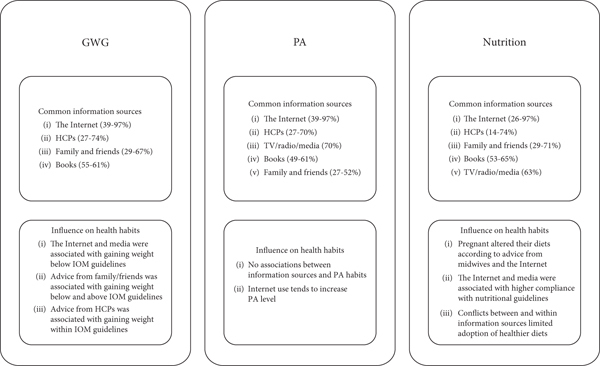
Accessible health information during pregnancy is important to positively affect maternal and fetal health. However, the quality and accuracy of health information can greatly vary across numerous sources. This narrative review is aimed at summarizing the literature on pregnant individuals' information sources and how these sources influence their habits toward GWG, PA, and nutrition. Such data will highlight preferences and needs, reveal challenges, and identify opportunities for improvement. We searched PubMed for studies published in the last decade. Out of 299 studies initially identified, 20 (16 quantitative and four qualitative) met the eligibility criteria (investigating information sources and their influence on health habits toward GWG, PA, nutrition, pregnant participants, adequate data reporting, and being available in full text). Primary sources of health information varied. The Internet (26%-97%) and healthcare providers (HCPs) (14%-74%) predominated, followed by family/friends (12%71%), books/magazines (49%-65%), and guidelines/brochures (25%-53%). Despite the widespread use of the Internet, HCPs were considered the most reliable source. The use of the Internet to retrieve health information was reported to be 2-4 h a week, and < 50% discussed the online information with their HCP. The Internet was also used as a supplementary resource on topics raised by HCPs. Regarding the influence on health habits, the Internet, HCPs, media, and family positively influenced GWG and promoted adherence to recommended guidelines (OR = 0.55-15.5). Only one study showed a positive association between Internet use and PA level. The Internet, media, HCPs, and information brochures were associated with better adherence to nutritional recommendations. Pregnant individuals relied on the Internet and HCP, with a preference for the Internet despite trust in midwives. Several sources of health information were positively associated with adherence to GWG and nutrition recommendations. Improving the quality of online information should be a priority for policymakers and health authorities.
怀孕期间可获取的健康信息对改善母婴健康至关重要。然而,大量来源的健康信息质量和准确性可能存在较大差异。本综述旨在总结有关孕妇信息来源的文献,并探讨这些来源如何影响其对 GWG、PA 和营养的习惯。这些数据将突出偏好和需求,揭示挑战,并为改进提供机会。我们在 PubMed 上搜索了过去十年发表的研究。在最初确定的 299 项研究中,有 20 项(16 项定量研究和 4 项定性研究)符合入选标准(调查信息来源及其对 GWG、PA、营养、孕妇参与者、充足数据报告和全文获取的健康习惯的影响)。健康信息的主要来源各不相同。互联网(26%-97%)和医疗保健提供者(HCP)(14%-74%)占主导地位,其次是家人/朋友(12%-71%)、书籍/杂志(49%-65%)和指南/手册(25%-53%)。尽管互联网的使用广泛,但 HCP 被认为是最可靠的信息来源。检索健康信息的互联网使用量每周为 2-4 小时,<50%的人会与 HCP 讨论在线信息。互联网也被用作 HCP 提出的主题的补充资源。关于对健康习惯的影响,互联网、HCP、媒体和家庭积极影响 GWG 并促进遵守推荐的指南(OR=0.55-15.5)。只有一项研究表明互联网使用与 PA 水平呈正相关。互联网、媒体、HCP 和信息手册与更好地遵守营养建议相关。孕妇依赖互联网和 HCP,尽管信任助产士,但更倾向于使用互联网。许多健康信息来源与遵守 GWG 和营养建议呈正相关。提高在线信息质量应成为政策制定者和卫生当局的优先事项。