Fanizzi Annarita, Catino Annamaria, Bove Samantha, Comes Maria Colomba, Montrone Michele, Sicolo Angela, Signorile Rahel, Perrotti Pia, Pizzutilo Pamela, Galetta Domenico, Massafra Raffaella
Laboratorio di Biostatistica e Bioinformatica, Istituto di Ricovero e Cura a Carattere Scientifico (IRCCS) Istituto Tumori 'Giovanni Paolo II', Bari, Italy.
Struttura Semplice Dipartimentale di Oncologia Medica Toracica, Istituto di Ricovero e Cura a Carattere Scientifico (IRCCS) Istituto Tumori 'Giovanni Paolo II', Bari, Italy.
Front Oncol. 2024 Sep 16;14:1432188. doi: 10.3389/fonc.2024.1432188. eCollection 2024.
Malignant pleural mesothelioma (MPM) is a poor-prognosis disease. Owing to the recent availability of new therapeutic options, there is a need to better assess prognosis. The initial clinical response could represent a useful parameter.
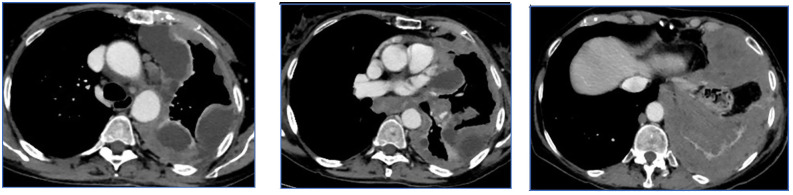
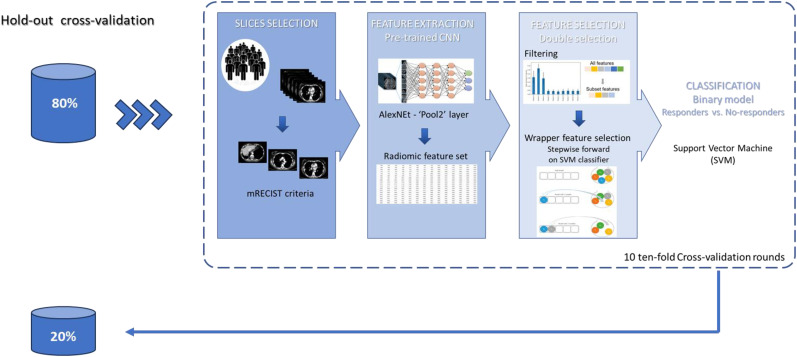
We proposed a transfer learning approach to predict an initial treatment response starting from baseline CT scans of patients with advanced/unresectable MPM undergoing first-line systemic therapy. The therapeutic response has been assessed according to the mRECIST criteria by CT scan at baseline and after two to three treatment cycles. We used three slices of baseline CT scan as input to the pre-trained convolutional neural network as a radiomic feature extractor. We identified a feature subset through a double feature selection procedure to train a binary SVM classifier to discriminate responders (partial response) from non-responders (stable or disease progression).
The performance of the prediction classifiers was evaluated with an 80:20 hold-out validation scheme. We have evaluated how the developed model was robust to variations in the slices selected by the radiologist. In our dataset, 25 patients showed an initial partial response, whereas 13 patients showed progressive or stable disease. On the independent test, the proposed model achieved a median AUC and accuracy of 86.67% and 87.50%, respectively.
The proposed model has shown high performance even by varying the reference slices. Novel tools could help to improve the prognostic assessment of patients with MPM and to better identify subgroups of patients with different therapeutic responsiveness.
恶性胸膜间皮瘤(MPM)是一种预后较差的疾病。由于最近出现了新的治疗选择,因此有必要更好地评估预后。初始临床反应可能是一个有用的参数。
我们提出了一种迁移学习方法,用于从接受一线全身治疗的晚期/不可切除MPM患者的基线CT扫描预测初始治疗反应。根据mRECIST标准,在基线和两到三个治疗周期后通过CT扫描评估治疗反应。我们使用基线CT扫描的三层切片作为预训练卷积神经网络的输入,该网络作为放射组学特征提取器。我们通过双重特征选择程序确定一个特征子集,以训练二元支持向量机分类器,区分反应者(部分缓解)和无反应者(病情稳定或进展)。
使用80:20留出验证方案评估预测分类器的性能。我们评估了所开发模型对放射科医生选择的切片变化的稳健性。在我们的数据集中,25例患者显示初始部分缓解,而13例患者显示病情进展或稳定。在独立测试中,所提出的模型分别实现了86.67%的中位数AUC和87.50%的准确率。
即使改变参考切片,所提出的模型也显示出高性能。新型工具有助于改善MPM患者的预后评估,并更好地识别具有不同治疗反应性的患者亚组。