Occupational and Environmental Medicine, Epidemiology and Hygiene Department, Italian Workers' Compensation Authority (INAIL), Roma, Italy.
Department of Public Health Environment and Society, London School of Hygiene & Tropical Medicine, London, United Kingdom.
Ann Glob Health. 2023 Feb 13;89(1):11. doi: 10.5334/aogh.4012. eCollection 2023.
The causal association between mesothelioma and asbestos exposure is conclusive, and many studies have proved that the trend in asbestos use is a strong predictor of the pattern in mesothelioma cases with an adequate latency time (generally around 30-40 years or more). Recently, a novel approach for predicting malignant pleural mesothelioma, based on asbestos consumption trend and using distributed non-linear models, has been applied.
The purpose of this study is to analyse trends in asbestos consumption and malignant mesothelioma mortality in the major asbestos-user countries. Furthermore, we applied distributed non-linear models to estimate and compare epidemiological relationships between asbestos consumption and mesothelioma mortality across these countries.
The study involves major asbestos-user countries in which historical asbestos consumption and mesothelioma mortality data are available. Data on asbestos consumption were derived from worldwide asbestos supply and mesothelioma mortality data from World Health Organization (WHO) mortality archives. A quasi-Poisson generalized linear model was used to model past asbestos exposure and male mesothelioma mortality rates in each country. Exposure-response associations have been modelled using distributed lag non-linear models.
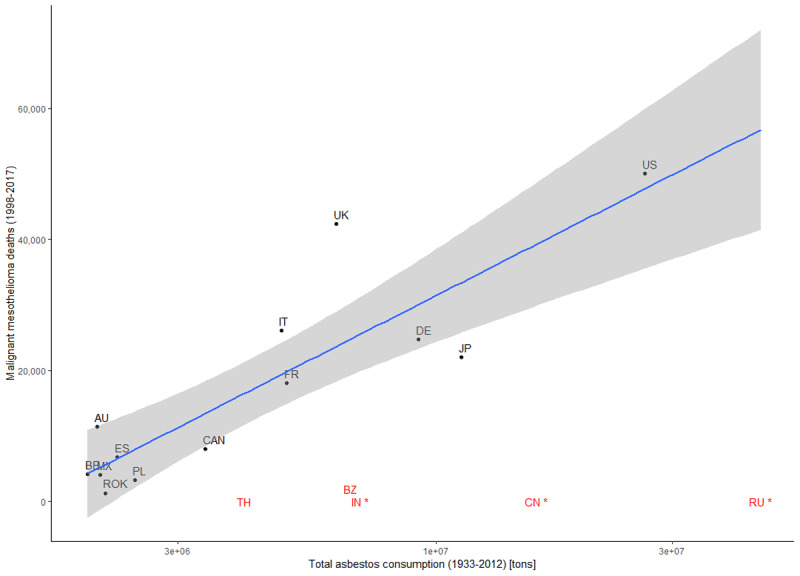
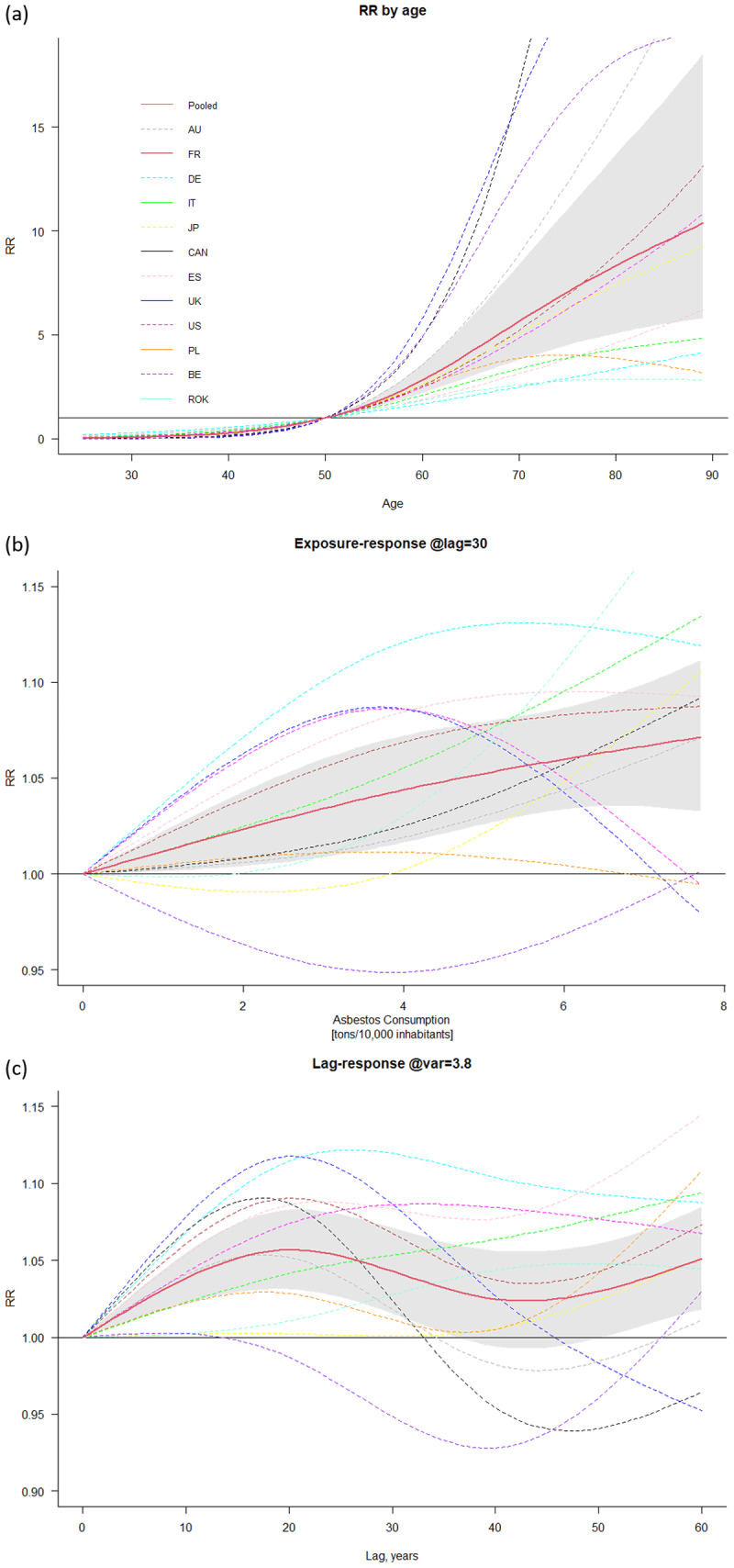
According to the criteria defined above, we selected 18 countries with raw asbestos cumulative consumptions higher than two million tons in the period 1933-2012. Overall, a clear linear relationship can be observed between total consumption and total deaths for mesothelioma. Country-specific exposure, lag and age-response relationships were identified and common functions extracted by a meta-analysis procedure. Non-linear models appear suitable and flexible tools for investigating the association between mesothelioma mortality and asbestos consumption. There is a need to improve the global epidemiological surveillance of asbestos-related diseases, particularly mesothelioma mortality, and the absence of reliable data for some major asbestos-user countries is a real concern. A reliable assessment of mesothelioma mortality is a fundamental step towards increasing the awareness of related risks and the need of an international ban on asbestos.
间皮瘤与石棉暴露之间的因果关系是明确的,许多研究已经证明,石棉使用趋势是间皮瘤病例模式的一个强有力的预测因素,潜伏期一般在 30-40 年或更长时间。最近,一种基于石棉消费趋势并使用分布式非线性模型的预测恶性胸膜间皮瘤的新方法已经得到应用。
本研究旨在分析主要石棉使用国的石棉消费趋势和恶性间皮瘤死亡率。此外,我们应用分布式非线性模型来估计和比较这些国家石棉消费与间皮瘤死亡率之间的流行病学关系。
本研究涉及主要的石棉使用国,这些国家有历史石棉消费和间皮瘤死亡率的数据。石棉消费数据来自全球石棉供应数据,间皮瘤死亡率数据来自世界卫生组织(WHO)死亡率档案。采用拟泊松广义线性模型对每个国家的既往石棉暴露和男性间皮瘤死亡率进行建模。使用分布式滞后非线性模型对暴露-反应关系进行建模。
根据上述标准,我们选择了 1933-2012 年间累计原纤化石棉消费量高于 200 万吨的 18 个国家。总的来说,在所有国家中,总消费量与间皮瘤总死亡人数之间存在明显的线性关系。确定了国家特定的暴露、滞后和年龄反应关系,并通过荟萃分析程序提取了共同的函数。非线性模型似乎是研究间皮瘤死亡率与石棉消费之间关系的合适和灵活的工具。需要改善全球与石棉相关疾病(特别是间皮瘤死亡率)的流行病学监测,一些主要石棉使用国缺乏可靠数据令人担忧。对间皮瘤死亡率进行可靠评估是提高对相关风险的认识以及对国际禁止石棉的必要性的一个基本步骤。