Kwon Eui-Jong, Park Youngjae, Kwok Seung-Ki, Ju Ji Hyeon
Division of Rheumatology, Department of Internal Medicine, Seoul St. Mary's Hospital, College of Medicine, The Catholic University of Korea, Seoul, Korea.
J Rheum Dis. 2024 Oct 1;31(4):230-243. doi: 10.4078/jrd.2024.0043. Epub 2024 Jun 12.
This study aimed to elucidate the clinical and laboratory differences between chronic sclerosing sialadenitis (CSS) and primary Sjögren's syndrome (pSS), highlighting CSS as a distinct pathological entity within the spectrum of salivary gland pathology.
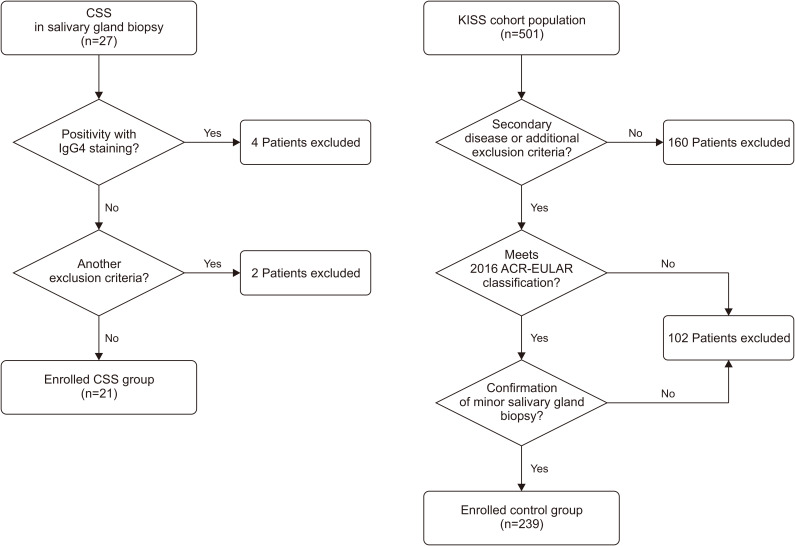
This retrospective, single-center study was conducted at Seoul St. Mary's Hospital between January 2000 and December 2022. Patients diagnosed with CSS via salivary gland biopsy were included, and those with IgG4-related disease (IgG4-RD) or other confounding factors were excluded. Clinical and laboratory CSS profiles were compared with those of a control group of patients with typical pSS from the Korean Initiative of Primary Sjögren's Syndrome (KISS) prospective cohort study. Twenty-one with CSS and 501 patients with pSS from Seoul St. Mary's Hospital were retrospectively analyzed.
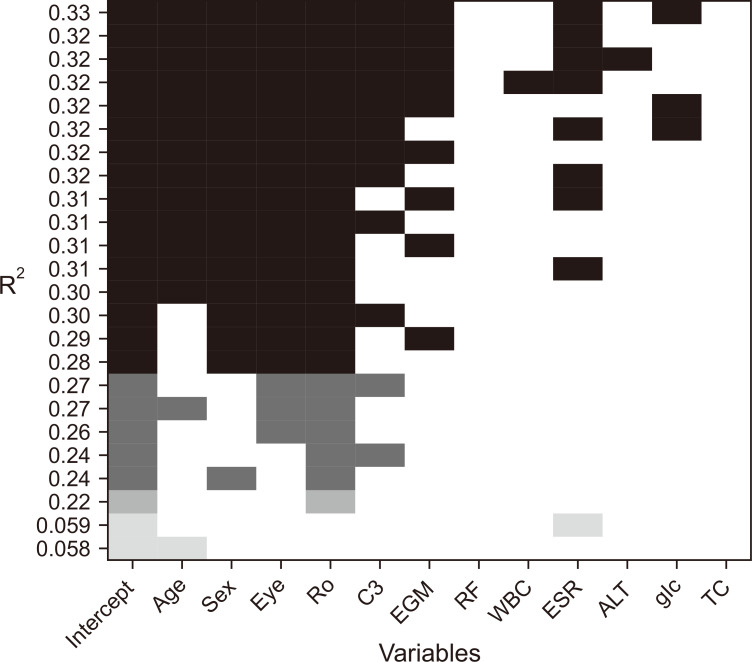
Patients with CSS were older at diagnosis, had a lower prevalence of ocular symptoms, and exhibited distinct immunological markers compared to those with pSS. Logistic regression analysis revealed that anti-Ro antibody positivity, elevated erythrocyte sedimentation rate levels, low serum complement 3 levels, and accompanying dry eye symptoms were factors distinguishing pSS from CSS.
Even after excluding IgG4-RD, CSS was significantly different from pSS in terms of clinical and laboratory findings. Recognition of these differences is crucial for the accurate diagnosis and management of CSS, underscoring its status as a distinct pathological entity among salivary gland pathologies.
本研究旨在阐明慢性硬化性涎腺炎(CSS)与原发性干燥综合征(pSS)在临床和实验室检查方面的差异,强调CSS是涎腺病理学范畴内一种独特的病理实体。
本回顾性单中心研究于2000年1月至2022年12月在首尔圣母医院进行。纳入经涎腺活检诊断为CSS的患者,排除患有IgG4相关疾病(IgG4-RD)或其他混杂因素的患者。将CSS的临床和实验室特征与韩国原发性干燥综合征倡议(KISS)前瞻性队列研究中典型pSS患者的对照组特征进行比较。对来自首尔圣母医院的21例CSS患者和501例pSS患者进行回顾性分析。
与pSS患者相比,CSS患者诊断时年龄较大,眼部症状患病率较低,且表现出不同的免疫标志物。逻辑回归分析显示,抗Ro抗体阳性、红细胞沉降率升高、血清补体3水平降低以及伴有干眼症状是区分pSS和CSS的因素。
即使排除IgG4-RD,CSS在临床和实验室检查结果方面与pSS仍存在显著差异。认识到这些差异对于CSS的准确诊断和管理至关重要,凸显了其在涎腺疾病中作为独特病理实体的地位。