Xing Xing, Zhou Zongning, Peng Hongwei, Cheng Shaoping
Department of Urology, The First Affiliated Hospital of Yangtze University, Jingzhou, Hubei 434000, P.R. China.
Human Genetic Resources Preservation Center of Wuhan University, Wuhan, Hubei 430071, P.R. China.
Oncol Lett. 2024 Sep 20;28(6):558. doi: 10.3892/ol.2024.14691. eCollection 2024 Dec.
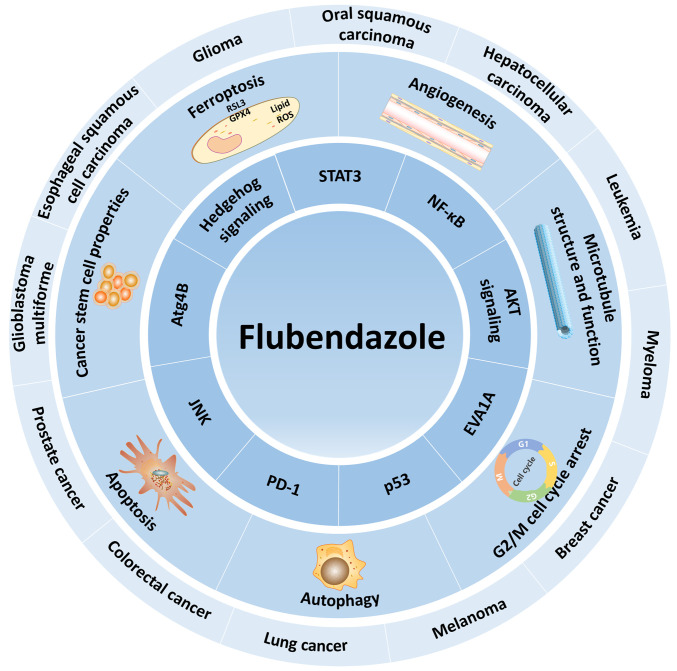
Flubendazole, an anthelmintic agent with a well-established safety profile, has emerged as a promising anticancer drug that has demonstrated efficacy against a spectrum of cancer types over the past decade. Its anticancer properties encompass a multifaceted mechanism of action, including the inhibition of cancer cell proliferation, disruption of microtubule dynamics, regulation of cell cycle, autophagy, apoptosis, suppression of cancer stem cell characteristics, promotion of ferroptosis and inhibition of angiogenesis. The present review aimed to provide a comprehensive overview of the molecular underpinnings of the anticancer activity of flubendazole, highlighting key molecules and regulatory pathways. Given the breadth of the potential of flubendazole, further research is imperative to identify additional cancer types sensitive to flubendazole, refine experimental methodologies for enhancing its reliability, uncover synergistic drug combinations, improve its bioavailability and explore innovative administration methods. The present review provided a foundation for future studies on the role of flubendazole in oncology and described its molecular mechanisms of action.
氟苯达唑是一种安全性已得到充分确立的驱虫剂,在过去十年中已成为一种有前景的抗癌药物,已证明对多种癌症类型有效。其抗癌特性包括多方面的作用机制,包括抑制癌细胞增殖、破坏微管动力学、调节细胞周期、自噬、凋亡、抑制癌症干细胞特征、促进铁死亡和抑制血管生成。本综述旨在全面概述氟苯达唑抗癌活性的分子基础,突出关键分子和调控途径。鉴于氟苯达唑潜力巨大,必须进一步开展研究,以确定对氟苯达唑敏感的其他癌症类型,完善实验方法以提高其可靠性,发现协同药物组合,提高其生物利用度,并探索创新给药方法。本综述为今后研究氟苯达唑在肿瘤学中的作用提供了基础,并描述了其作用的分子机制。