Lanfranco Renzo C, Canales-Johnson Andrés, Rabagliati Hugh, Cleeremans Axel, Carmel David
Department of Psychology, University of Edinburgh, EH8 9JZ, Edinburgh, United Kingdom.
Department of Neuroscience, Karolinska Institutet, 171 65, Stockholm, Sweden.
Nat Commun. 2024 Oct 2;15(1):8523. doi: 10.1038/s41467-024-52778-5.
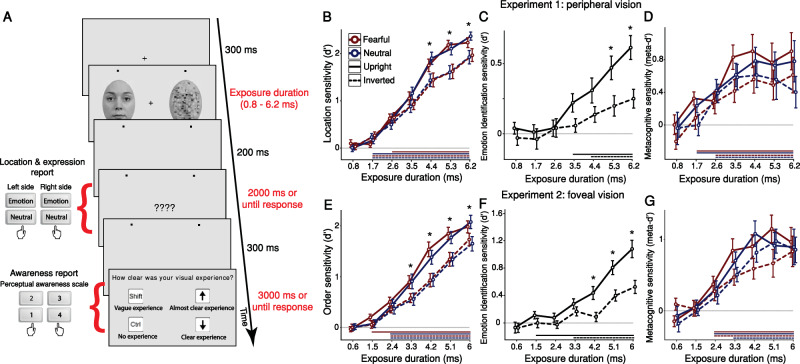
Human vision can detect a single photon, but the minimal exposure required to extract meaning from stimulation remains unknown. This requirement cannot be characterised by stimulus energy, because the system is differentially sensitive to attributes defined by configuration rather than physical amplitude. Determining minimal exposure durations required for processing various stimulus attributes can thus reveal the system's priorities. Using a tachistoscope enabling arbitrarily brief displays, we establish minimal durations for processing human faces, a stimulus category whose perception is associated with several well-characterised behavioural and neural markers. Neural and psychophysical measures show a sequence of distinct minimal exposures for stimulation detection, object-level detection, face-specific processing, and emotion-specific processing. Resolving ongoing debates, face orientation affects minimal exposure but emotional expression does not. Awareness emerges with detection, showing no evidence of subliminal perception. These findings inform theories of visual processing and awareness, elucidating the information to which the visual system is attuned.
人类视觉能够检测到单个光子,但从刺激中提取意义所需的最小曝光量仍然未知。这一要求无法用刺激能量来表征,因为该系统对由配置定义的属性而非物理幅度具有不同的敏感性。因此,确定处理各种刺激属性所需的最小曝光持续时间可以揭示该系统的优先级。使用能够进行任意短暂显示的速示器,我们确定了处理人脸所需的最小持续时间,人脸是一种其感知与几种特征明确的行为和神经标记相关联的刺激类别。神经和心理物理学测量结果显示,对于刺激检测、物体级检测、面部特定处理和情感特定处理,存在一系列不同的最小曝光量。解决了当前的争议,面部朝向会影响最小曝光量,但情感表达不会。意识随着检测而出现,没有显示出阈下感知的证据。这些发现为视觉处理和意识理论提供了信息,阐明了视觉系统所适应的信息。