Wu Zipeng, Cheng Lingyan, Cai Shuhua, Su Baochang, Chen Yaowei, Cai Chunzong, Guo Weijin, Ma Dong, Cui Xin
Key Laboratory of Biomaterials of Guangdong Higher Education Institutes Department of Biomedical Engineering Jinan University, Guangzhou 510632, China.
Transfusion Department The First Affiliated Hospital of Jinan University, Guangzhou 510632, China.
Int J Anal Chem. 2024 Sep 25;2024:9944426. doi: 10.1155/2024/9944426. eCollection 2024.
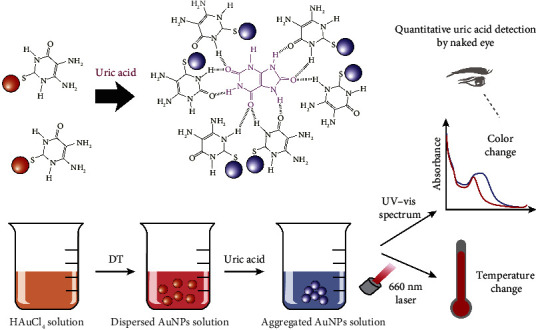
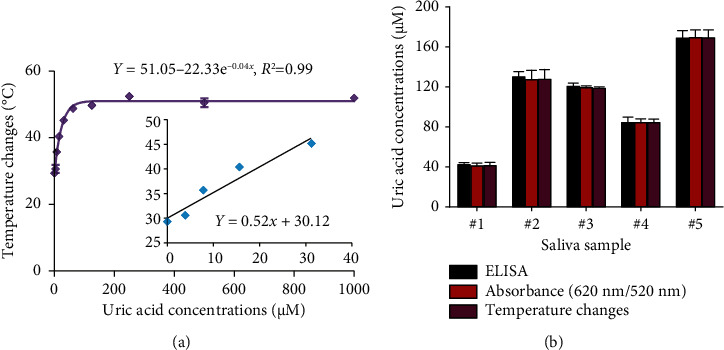
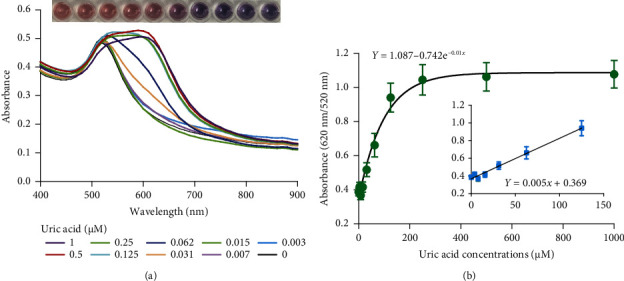
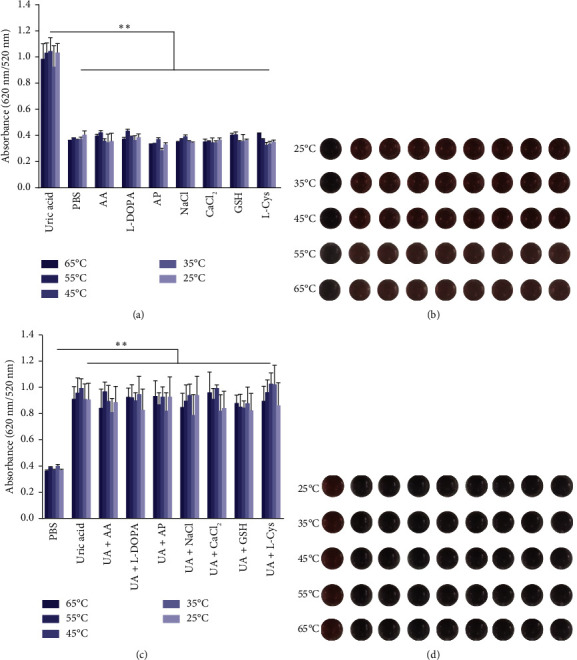
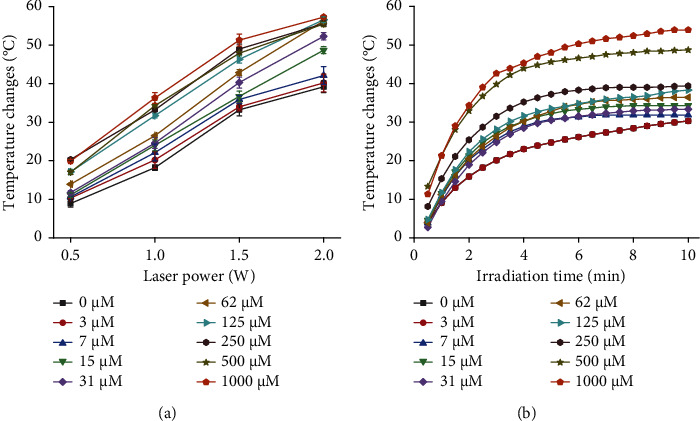
Nonenzymatic and rapid monitoring of uric acid levels is of great value for early diagnosis, prevention, and management of oxidative stress-associated diseases. However, fast, convenient, and low-cost uric acid detection remains challenging, especially in resource-limited settings. In this study, a novel and rapid biosensing approach was developed for the simultaneous visualization and quantification of uric acid levels by using the unique surface plasmon resonance and photothermal property of 4,5-diamino-2-thiouracil (DT)-capped gold nanoparticles (AuNPs). With the presence of uric acid, DT-capped AuNPs rapidly aggregated, and a visible color/photothermal change was used for uric acid quantification within 15 min. The limit of detection was determined to be 11.3 and 6.6 M for the dual-mode biosensor, leveraging the unique structure of DT to optimize reaction kinetics. Moreover, the sensor exhibited excellent anti-interference capabilities and demonstrated potential for detecting a wide range of uric acid concentrations in complex samples, thereby reducing the need for extensive sample dilution and complex material synthesis procedures. Furthermore, validation against gold standard testing indicates that this biosensor could serve as a highly sensitive assay for quantifying uric acid levels in point-of-care applications, particularly in resource-limited settings.
非酶法快速监测尿酸水平对于氧化应激相关疾病的早期诊断、预防和管理具有重要价值。然而,快速、便捷且低成本的尿酸检测仍然具有挑战性,尤其是在资源有限的环境中。在本研究中,开发了一种新型快速生物传感方法,利用4,5-二氨基-2-硫脲嘧啶(DT)包覆的金纳米颗粒(AuNPs)独特的表面等离子体共振和光热特性,同时实现尿酸水平的可视化和定量分析。在尿酸存在的情况下,DT包覆的AuNPs迅速聚集,并利用可见颜色/光热变化在15分钟内对尿酸进行定量分析。利用DT的独特结构优化反应动力学,该双模式生物传感器的检测限分别为11.3和6.6 μM。此外,该传感器具有出色的抗干扰能力,在复杂样品中检测宽范围尿酸浓度时表现出潜力,从而减少了对大量样品稀释和复杂材料合成程序的需求。此外,与金标准测试的验证表明,这种生物传感器可作为即时检测应用中定量尿酸水平的高灵敏度检测方法,特别是在资源有限的环境中。