Hussain Zahid, Huo Chunhui, Ahmad Ashfaq, Shaheen Wasim Abbas
Business School, Faculty of Economics, Liaoning University, Shenyang, China.
Department of Economics, GC Women University Sialkot, Sialkot, Punjab, Pakistan.
Health Econ Rev. 2024 Oct 3;14(1):80. doi: 10.1186/s13561-024-00544-0.
Good health can prolong one's lifespan and is a fundamental human right. Thus, human health is being influenced by prejudiced from sociological, environmental, economic, and geographic aspects. The economy and transportation system pose a serious challenge to the assessment of the health performance of economies.
This study aims to assess the health performance of Organization for Economic Cooperation and Development (OECD) economies by using economic and transport-related indicators and examining the role of health expenditure and governance in improving efficiency.
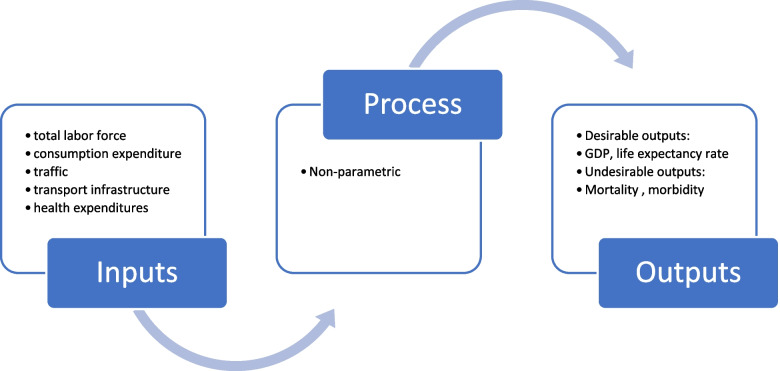
This study measures the economy- and transport-oriented health efficiency of 35 OECD economies for the period of 2000-2022. In the first stage, this study employs a slacks-based measure and the data envelopment analysis-window analysis approach to conduct individual (economy and transportation) and joint assessments to measure health efficiency. In the second stage, this study uses the tobit regression method to investigate the effects of influencing factors, namely, government general health and pharmaceutical expenditures, the medical infrastructure, and governance, on health efficiency.
Empirical results reveal that a 1-unit change in the health expenditure during the research period improves economy-oriented health efficiency by 71% and transport-oriented health efficiency by 58%. The econometric analysis demonstrates that all the coefficients of economy- and transport-oriented health efficiency are significant and positive. Notably, a 1-unit change in the medical infrastructure increases economy- and transport-oriented health efficiency by 50.8%, and a 1% increase in pharmaceutical expenditure increases the health, economy, and transport efficiency scores by 16.3%, 33%, and 58.6%, respectively.
The findings suggest that some of the economies were efficient with regard to their health-oriented outputs, that is, quality of life and mortality and morbidity rates, and most of the economies demonstrated excellent economic performance. The findings of the transport-oriented health efficiency assessment reveal that the economies were unable to perform well in the last year of the research period owing to the nationwide lockdowns. Nonetheless, they demonstrated efficiency in the first half of the research period. The joint assessment of economy- and transport-oriented health efficiency indicates that economic and transport input resources can adversely affect the GDP and life expectancy simultaneously, and the medical infrastructure, pharmaceutical expenditure, and number of medical graduates serve as constructive stimuli for health efficiency improvement.
良好的健康状况可以延长人的寿命,是一项基本人权。因此,人类健康受到社会学、环境、经济和地理等方面偏见的影响。经济和交通系统对经济体健康绩效的评估构成了严峻挑战。
本研究旨在通过使用与经济和交通相关的指标,并考察卫生支出和治理在提高效率方面的作用,来评估经济合作与发展组织(经合组织)经济体的健康绩效。
本研究衡量了2000 - 2022年期间35个经合组织经济体以经济和交通为导向的健康效率。在第一阶段,本研究采用基于松弛变量的测度方法和数据包络分析 - 窗口分析方法进行个体(经济和交通)及联合评估,以衡量健康效率。在第二阶段,本研究使用托比特回归方法来研究影响因素,即政府一般卫生和药品支出、医疗基础设施以及治理对健康效率的影响。
实证结果表明,研究期间卫生支出每变化1个单位,以经济为导向的健康效率提高71%,以交通为导向的健康效率提高58%。计量分析表明,以经济和交通为导向的健康效率的所有系数均显著且为正。值得注意的是,医疗基础设施每变化1个单位,以经济和交通为导向的健康效率提高50.8%,药品支出每增加1%,健康、经济和交通效率得分分别提高16.3%、33%和58.6%。
研究结果表明,一些经济体在其以健康为导向的产出方面,即生活质量以及死亡率和发病率方面是有效的,并且大多数经济体表现出出色的经济绩效。以交通为导向的健康效率评估结果显示,由于全国范围的封锁,这些经济体在研究期的最后一年表现不佳。尽管如此,它们在研究期的上半年表现出了效率。以经济和交通为导向的健康效率的联合评估表明,经济和交通投入资源可能同时对国内生产总值和预期寿命产生不利影响,而医疗基础设施、药品支出和医学毕业生数量是提高健康效率的建设性刺激因素。