Department of Kinesiology, McMaster University, 1280 Main St West, Hamilton, ON, L8S 4K1, Canada.
Department of Anesthesiology and Perioperative Medicine, Mayo Clinic, Rochester, MN, USA.
Sports Med. 2023 Dec;53(Suppl 1):85-96. doi: 10.1007/s40279-023-01938-6. Epub 2023 Oct 7.
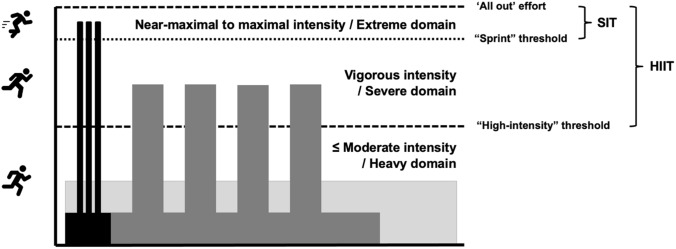
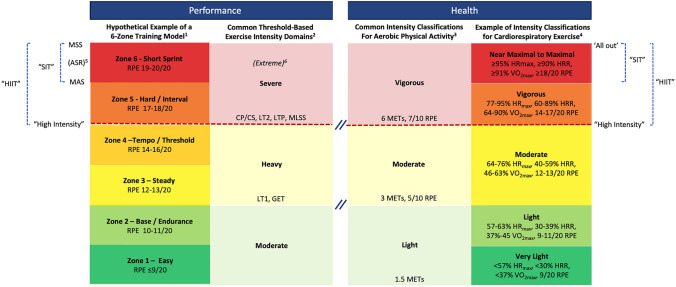
Interval training is a simple concept that refers to repeated bouts of relatively hard work interspersed with recovery periods of easier work or rest. The method has been used by high-level athletes for over a century to improve performance in endurance-type sports and events such as middle- and long-distance running. The concept of interval training to improve health, including in a rehabilitative context or when practiced by individuals who are relatively inactive or deconditioned, has also been advanced for decades. An important issue that affects the interpretation and application of interval training is the lack of standardized terminology. This particularly relates to the classification of intensity. There is no common definition of the term "high-intensity interval training" (HIIT) despite its widespread use. We contend that in a performance context, HIIT can be characterized as intermittent exercise bouts performed above the heavy-intensity domain. This categorization of HIIT is primarily encompassed by the severe-intensity domain. It is demarcated by indicators that principally include the critical power or critical speed, or other indices, including the second lactate threshold, maximal lactate steady state, or lactate turnpoint. In a health context, we contend that HIIT can be characterized as intermittent exercise bouts performed above moderate intensity. This categorization of HIIT is primarily encompassed by the classification of vigorous intensity. It is demarcated by various indicators related to perceived exertion, oxygen uptake, or heart rate as defined in authoritative public health and exercise prescription guidelines. A particularly intense variant of HIIT commonly termed "sprint interval training" can be distinguished as repeated bouts performed with near-maximal to "all out" effort. This characterization coincides with the highest intensity classification identified in training zone models or exercise prescription guidelines, including the extreme-intensity domain, anaerobic speed reserve, or near-maximal to maximal intensity classification. HIIT is considered an essential training component for the enhancement of athletic performance, but the optimal intensity distribution and specific HIIT prescription for endurance athletes is unclear. HIIT is also a viable method to improve cardiorespiratory fitness and other health-related indices in people who are insufficiently active, including those with cardiometabolic diseases. Research is needed to clarify responses to different HIIT strategies using robust study designs that employ best practices. We offer a perspective on the topic of HIIT for performance and health, including a conceptual framework that builds on the work of others and outlines how the method can be defined and operationalized within each context.
间歇训练是一个简单的概念,指的是反复进行相对高强度的工作,穿插恢复阶段,进行较轻松的工作或休息。这种方法已经被高水平运动员使用了一个多世纪,以提高耐力型运动和中长跑等项目的成绩。间歇训练提高健康水平的概念,包括在康复背景下或在相对不活跃或身体不适的个体中进行,也已经被提出了几十年。影响间歇训练的解释和应用的一个重要问题是缺乏标准化术语。这尤其涉及到强度分类。尽管“高强度间歇训练”(HIIT)被广泛使用,但它没有一个通用的定义。我们认为,在表现层面,HIIT 可以被定义为在高强度域以上进行的间歇性运动。这种 HIIT 的分类主要包括剧烈强度域。其主要指标包括临界功率或临界速度,或其他指标,包括第二乳酸阈、最大乳酸稳态或乳酸转折点。在健康层面,我们认为 HIIT 可以被定义为在中等强度以上进行的间歇性运动。这种 HIIT 的分类主要包括剧烈强度分类。其主要指标与感知用力、摄氧量或心率有关,这些指标在权威的公共卫生和运动处方指南中都有定义。HIIT 的一个特别强烈的变体,通常称为“冲刺间歇训练”,可以被区分开来,即进行多次近乎最大或“全力以赴”的运动。这种特征与训练区模型或运动处方指南中确定的最高强度分类相吻合,包括极端强度域、无氧速度储备或近最大至最大强度分类。HIIT 被认为是提高运动表现的重要训练组成部分,但对于耐力运动员来说,最佳的强度分布和特定的 HIIT 处方还不清楚。HIIT 也是提高身体活动不足人群(包括患有心血管代谢疾病的人群)心肺健康和其他健康相关指标的可行方法。需要进行研究,以澄清使用稳健的研究设计和最佳实践的不同 HIIT 策略的反应。我们提供了一个关于 HIIT 在表现和健康方面的观点,包括一个基于他人工作的概念框架,概述了如何在每个背景下定义和操作该方法。