• 文献检索
  • 文档翻译
  • 深度研究
  • 学术资讯
  • Suppr Zotero 插件Zotero 插件
  • 邀请有礼
  • 套餐&价格
  • 历史记录
应用&插件
Suppr Zotero 插件Zotero 插件浏览器插件Mac 客户端Windows 客户端微信小程序
定价
高级版会员购买积分包购买API积分包
服务
文献检索文档翻译深度研究API 文档MCP 服务
关于我们
关于 Suppr公司介绍联系我们用户协议隐私条款
关注我们

Suppr 超能文献

核心技术专利:CN118964589B侵权必究
粤ICP备2023148730 号-1Suppr @ 2026

文献检索

告别复杂PubMed语法,用中文像聊天一样搜索,搜遍4000万医学文献。AI智能推荐,让科研检索更轻松。

立即免费搜索

文件翻译

保留排版,准确专业,支持PDF/Word/PPT等文件格式,支持 12+语言互译。

免费翻译文档

深度研究

AI帮你快速写综述,25分钟生成高质量综述,智能提取关键信息,辅助科研写作。

立即免费体验

接种 COVID-19 疫苗的时间按语言和原籍国划分。

Time to COVID-19 Vaccination by Language and Country of Origin.

机构信息

HealthPartners Institute for Medical Education and Research, Bloomington, Minnesota.

出版信息

JAMA Netw Open. 2024 Oct 1;7(10):e2437388. doi: 10.1001/jamanetworkopen.2024.37388.

DOI:10.1001/jamanetworkopen.2024.37388
PMID:39361282
原文链接:https://pmc.ncbi.nlm.nih.gov/articles/PMC11450518/
Abstract

IMPORTANCE

Disparities in COVID-19 vaccination rates by race and ethnicity are well documented. Less is known about primary language and COVID-19 vaccine uptake.

OBJECTIVE

To describe the time to COVID-19 primary series vaccination and booster doses by primary language and country of origin.

DESIGN, SETTING, AND PARTICIPANTS: This retrospective cohort study included patients aged 6 months or older with at least 1 health encounter from July 1, 2019, to June 30, 2023, at a single health care system serving patients across Minnesota and western Wisconsin.

EXPOSURE

Primary language and country of origin documented in the electronic health record.

MAIN OUTCOMES AND MEASURES

Three COVID-19 vaccine coverage outcomes were evaluated: (1) primary series (1 Ad26.COV.S vaccine or 2 mRNA COVID-19 vaccines), (2) first-generation booster (primary series Ad26.COV.S vaccine plus 1 Ad26.COV.S or mRNA COVID-19 vaccine at least 2 months after the second dose or primary series mRNA vaccine plus 1 mRNA vaccine at least 5 months after the second dose), and (3) bivalent booster. Vaccine coverage was described by patient characteristics. Associations of primary language, race and ethnicity, and other patient characteristics with COVID-19 vaccine uptake were evaluated using time-to-event analysis in multivariable Cox proportional hazards regression models, and adjusted hazard ratios (AHRs) with 95% CIs were reported.

RESULTS

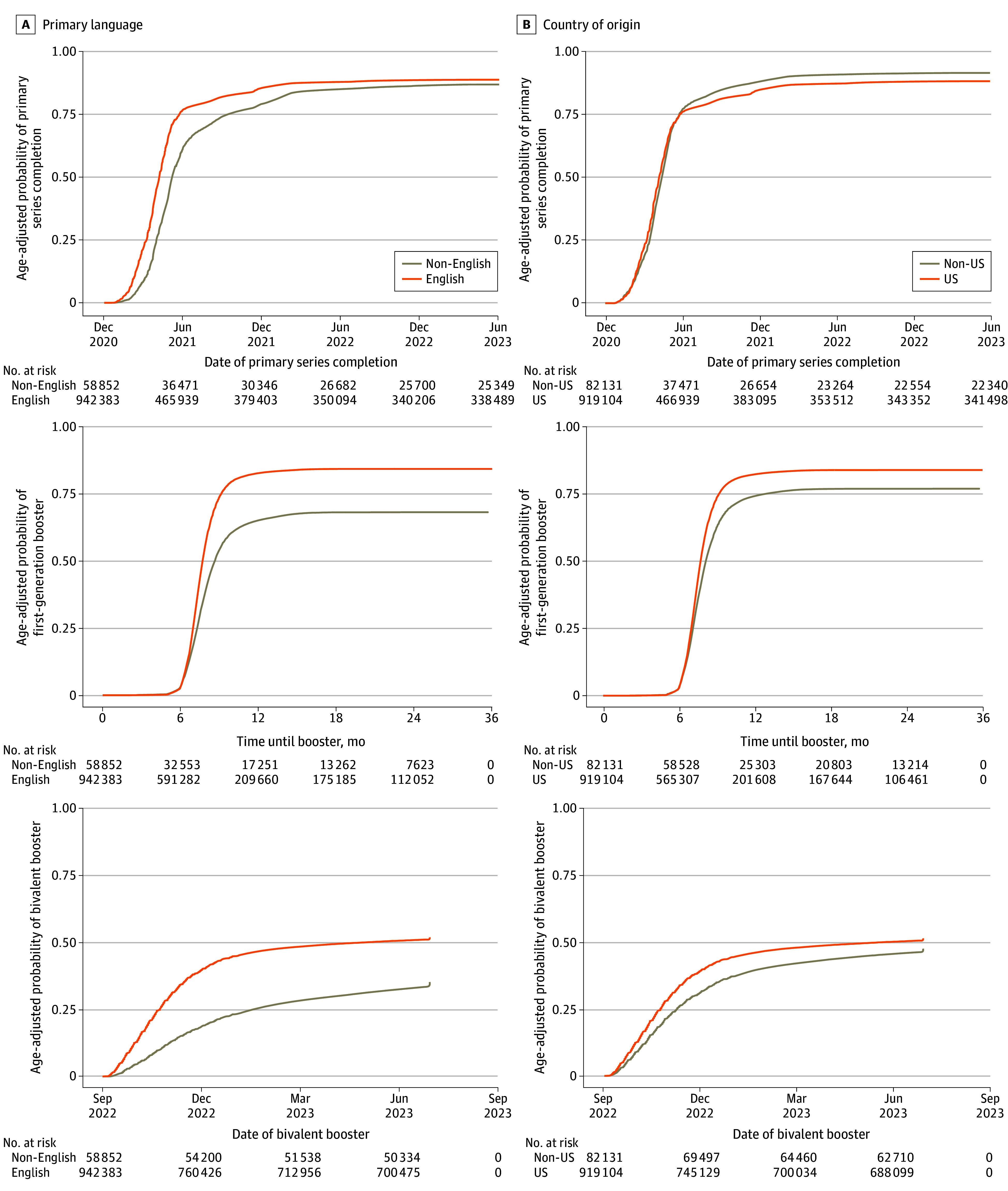
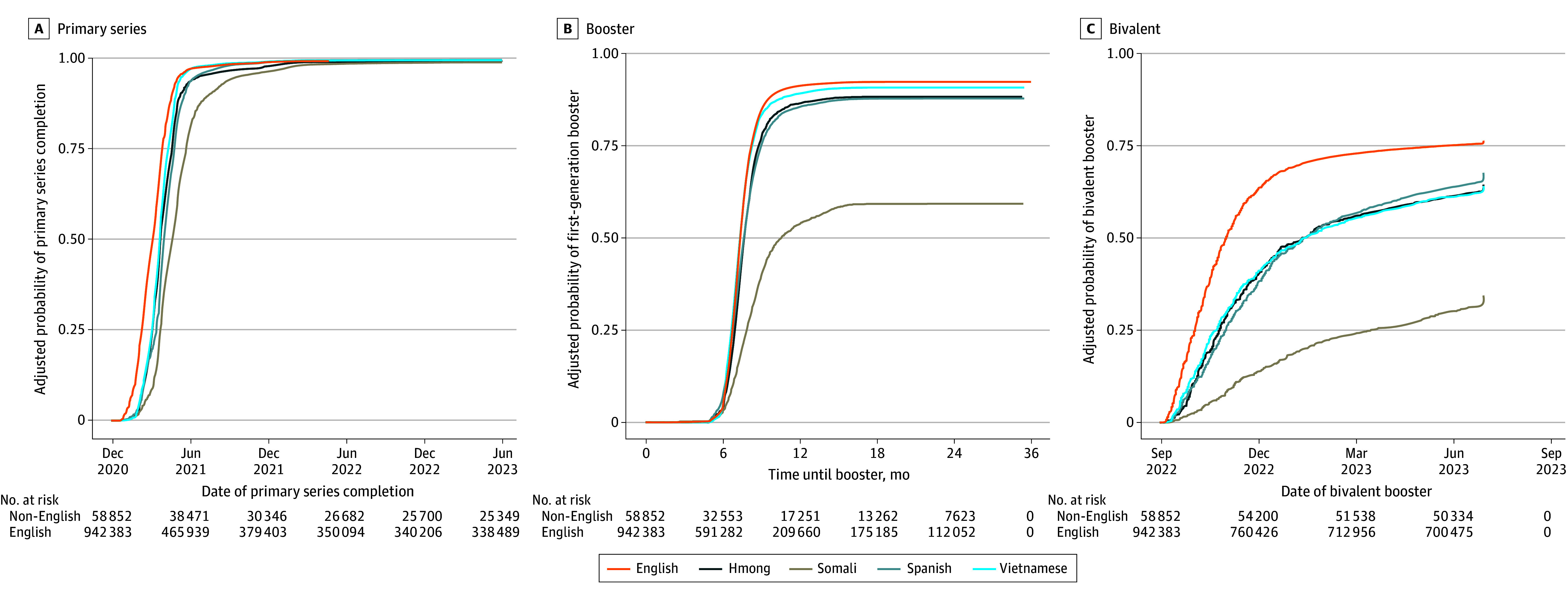
There were 1 001 235 patients included (53.7% female). Most patients reported English as a primary language (94.1%) and were born in the US (91.8%). Primary series coverage was 63.7%; first-generation booster coverage, 64.4%; and bivalent booster coverage, 39.5%. Coverage for all outcomes was lower among those with a non-English primary language compared with English as the primary language (56.9% vs 64.1% for primary series; 47.5% vs 65.3% for first-generation booster; 26.2% vs 40.3% for bivalent booster). Those with a non-English primary language had lower COVID-19 vaccine uptake for the primary series (AHR, 0.85; 95% CI, 0.84-0.86), first-generation booster (AHR, 0.74; 95% CI, 0.73-0.75), and bivalent booster (AHR, 0.65; 95% CI, 0.64-0.67) compared with patients with English as their primary language. Non-US-born patients had higher primary series uptake compared with US-born patients (AHR, 1.19; 95% CI, 1.18-1.20) but similar first-generation booster (AHR, 1.01; 95% CI, 0.99-1.02) and bivalent booster (AHR, 1.00; 95% CI, 0.98-1.02) uptake.

CONCLUSIONS AND RELEVANCE

In this retrospective cohort study, patients with a non-English primary language had both lower coverage and delays in receiving COVID-19 vaccines compared with those with English as their primary language. Reporting on language may identify health disparities that can be addressed with language-specific interventions.
https://cdn.ncbi.nlm.nih.gov/pmc/blobs/f9ee/11450518/bc872b623919/jamanetwopen-e2437388-g002.jpg
https://cdn.ncbi.nlm.nih.gov/pmc/blobs/f9ee/11450518/d3bc3f715d78/jamanetwopen-e2437388-g001.jpg
https://cdn.ncbi.nlm.nih.gov/pmc/blobs/f9ee/11450518/bc872b623919/jamanetwopen-e2437388-g002.jpg
https://cdn.ncbi.nlm.nih.gov/pmc/blobs/f9ee/11450518/d3bc3f715d78/jamanetwopen-e2437388-g001.jpg
https://cdn.ncbi.nlm.nih.gov/pmc/blobs/f9ee/11450518/bc872b623919/jamanetwopen-e2437388-g002.jpg
摘要

重要性

种族和民族的 COVID-19 疫苗接种率差异有充分的记录。关于主要语言和 COVID-19 疫苗接种率的了解较少。

目的

描述按主要语言和原籍国划分的 COVID-19 初级系列疫苗接种和加强剂量的时间。

设计、地点和参与者:这项回顾性队列研究纳入了 2019 年 7 月 1 日至 2023 年 6 月 30 日期间在一家为明尼苏达州和威斯康星州西部的患者提供服务的单一医疗保健系统中至少有 1 次健康就诊的 6 个月或以上的患者。

暴露情况

电子健康记录中记录的主要语言和原籍国。

主要结果和措施

评估了三种 COVID-19 疫苗接种情况:(1)初级系列(1 剂 Ad26.COV.S 疫苗或 2 剂 mRNA COVID-19 疫苗);(2)第一代加强剂(初级系列 Ad26.COV.S 疫苗加 1 剂 Ad26.COV.S 或 mRNA COVID-19 疫苗,至少在第二剂后 2 个月或初级系列 mRNA 疫苗加 1 剂 mRNA 疫苗,至少在第二剂后 5 个月);(3)双价加强剂。根据患者特征描述疫苗接种情况。使用多变量 Cox 比例风险回归模型中的时间到事件分析评估主要语言、种族和民族以及其他患者特征与 COVID-19 疫苗接种率的关系,并报告调整后的危险比(AHR)及其 95%置信区间。

结果

共纳入 1001235 例患者(53.7%为女性)。大多数患者报告英语为主要语言(94.1%),出生于美国(91.8%)。初级系列接种率为 63.7%;第一代加强剂接种率为 64.4%;双价加强剂接种率为 39.5%。与英语为主要语言的患者相比,主要语言为非英语的患者的所有结果的疫苗接种率均较低(初级系列为 56.9%比 64.1%;第一代加强剂为 47.5%比 65.3%;双价加强剂为 26.2%比 40.3%)。与英语为主要语言的患者相比,主要语言为非英语的患者的 COVID-19 疫苗接种率较低(AHR,0.85;95%CI,0.84-0.86),第一代加强剂(AHR,0.74;95%CI,0.73-0.75)和双价加强剂(AHR,0.65;95%CI,0.64-0.67)。非美国出生的患者的初级系列接种率高于美国出生的患者(AHR,1.19;95%CI,1.18-1.20),但第一代加强剂(AHR,1.01;95%CI,0.99-1.02)和双价加强剂(AHR,1.00;95%CI,0.98-1.02)的接种率相似。

结论和相关性

在这项回顾性队列研究中,与英语为主要语言的患者相比,主要语言为非英语的患者的 COVID-19 疫苗接种率较低,且接种时间也较晚。报告语言状况可能有助于发现语言方面的差异,从而可以通过具体语言的干预措施来解决这些差异。

相似文献

1
Time to COVID-19 Vaccination by Language and Country of Origin.接种 COVID-19 疫苗的时间按语言和原籍国划分。
JAMA Netw Open. 2024 Oct 1;7(10):e2437388. doi: 10.1001/jamanetworkopen.2024.37388.
2
Efficacy and safety of COVID-19 vaccines.新型冠状病毒疫苗的有效性和安全性。
Cochrane Database Syst Rev. 2022 Dec 7;12(12):CD015477. doi: 10.1002/14651858.CD015477.
3
Signs and symptoms to determine if a patient presenting in primary care or hospital outpatient settings has COVID-19.在基层医疗机构或医院门诊环境中,如果患者出现以下症状和体征,可判断其是否患有 COVID-19。
Cochrane Database Syst Rev. 2022 May 20;5(5):CD013665. doi: 10.1002/14651858.CD013665.pub3.
4
Risk of myocarditis and pericarditis after a COVID-19 mRNA vaccine booster and after COVID-19 in those with and without prior SARS-CoV-2 infection: A self-controlled case series analysis in England.在有和没有先前 SARS-CoV-2 感染的人群中,COVID-19 mRNA 疫苗加强针接种后和 COVID-19 后心肌炎和心包炎的风险:在英国的一项自身对照病例系列分析。
PLoS Med. 2023 Jun 7;20(6):e1004245. doi: 10.1371/journal.pmed.1004245. eCollection 2023 Jun.
5
Immunogenicity and seroefficacy of pneumococcal conjugate vaccines: a systematic review and network meta-analysis.肺炎球菌结合疫苗的免疫原性和血清效力:系统评价和网络荟萃分析。
Health Technol Assess. 2024 Jul;28(34):1-109. doi: 10.3310/YWHA3079.
6
Falls prevention interventions for community-dwelling older adults: systematic review and meta-analysis of benefits, harms, and patient values and preferences.社区居住的老年人跌倒预防干预措施:系统评价和荟萃分析的益处、危害以及患者的价值观和偏好。
Syst Rev. 2024 Nov 26;13(1):289. doi: 10.1186/s13643-024-02681-3.
7
Face-to-face interventions for informing or educating parents about early childhood vaccination.针对向父母宣传或教育幼儿疫苗接种情况的面对面干预措施。
Cochrane Database Syst Rev. 2018 May 8;5(5):CD010038. doi: 10.1002/14651858.CD010038.pub3.
8
Antibody tests for identification of current and past infection with SARS-CoV-2.抗体检测用于鉴定 SARS-CoV-2 的现症感染和既往感染。
Cochrane Database Syst Rev. 2022 Nov 17;11(11):CD013652. doi: 10.1002/14651858.CD013652.pub2.
9
Prophylactic vaccination against human papillomaviruses to prevent cervical cancer and its precursors.接种人乳头瘤病毒预防性疫苗以预防宫颈癌及其癌前病变。
Cochrane Database Syst Rev. 2018 May 9;5(5):CD009069. doi: 10.1002/14651858.CD009069.pub3.
10
COVID-19 severity and risk of SARS-CoV-2-associated asthma exacerbation by time since booster vaccination: a longitudinal analysis of data from the COVIDENCE UK study.自加强疫苗接种以来的时间与新冠病毒相关哮喘加重的新冠病毒疾病严重程度及风险:来自英国COVIDENCE研究数据的纵向分析
BMJ Open Respir Res. 2025 May 15;12(1):e003158. doi: 10.1136/bmjresp-2025-003158.

本文引用的文献

1
Advocating for language equity: a community-public health partnership.倡导语言公平:社区-公共卫生伙伴关系。
Front Public Health. 2023 Oct 17;11:1245849. doi: 10.3389/fpubh.2023.1245849. eCollection 2023.
2
Inequities in COVID-19 Vaccination Coverage Among Pregnant Persons, by Disaggregated Race and Ethnicity - Massachusetts, May 2021-October 2022.按种族和民族细分的 COVID-19 疫苗接种覆盖差距-马萨诸塞州,2021 年 5 月至 2022 年 10 月。
MMWR Morb Mortal Wkly Rep. 2023 Sep 29;72(39):1052-1056. doi: 10.15585/mmwr.mm7239a2.
3
COVID-19 Vaccination Hesitancies: A Spanish-Language Focus Group Analysis in Texas.
COVID-19 疫苗犹豫:德克萨斯州西班牙语焦点小组分析。
Health Commun. 2024 Nov;39(12):2431-2442. doi: 10.1080/10410236.2023.2258310. Epub 2023 Sep 15.
4
Understanding COVID-19 Health Disparities With Birth Country and Language Data.理解基于出生国家和语言数据的 COVID-19 健康差异。
Am J Prev Med. 2023 Dec;65(6):993-1002. doi: 10.1016/j.amepre.2023.06.018. Epub 2023 Jul 4.
5
Increasing COVID-19 Vaccination Coverage for Newcomer Communities: The Importance of Disaggregation by Language.提高新移民社区的 COVID-19 疫苗接种覆盖率:按语言分类的重要性。
Am J Trop Med Hyg. 2023 Apr 17;109(1):90-93. doi: 10.4269/ajtmh.22-0724. Print 2023 Jul 5.
6
Evaluation of Preferred Language and Timing of COVID-19 Vaccine Uptake and Disease Outcomes.评价对 COVID-19 疫苗接种和疾病结果的首选语言和时间。
JAMA Netw Open. 2023 Apr 3;6(4):e237877. doi: 10.1001/jamanetworkopen.2023.7877.
7
Overcoming barriers and enhancing facilitators to COVID-19 vaccination in the Hispanic community.克服西班牙裔社区 COVID-19 疫苗接种的障碍和促进因素。
BMC Public Health. 2022 Dec 20;22(1):2393. doi: 10.1186/s12889-022-14825-y.
8
Interim Recommendations from the Advisory Committee on Immunization Practices for the Use of Bivalent Booster Doses of COVID-19 Vaccines - United States, October 2022.免疫实践咨询委员会关于使用二价加强针 COVID-19 疫苗的临时建议-美国,2022 年 10 月。
MMWR Morb Mortal Wkly Rep. 2022 Nov 11;71(45):1436-1441. doi: 10.15585/mmwr.mm7145a2.
9
The COVID-19 vaccination experience of non-English speaking immigrant and refugee communities of color: A community co-created study.非英语裔有色人种的移民和难民社区的 COVID-19 疫苗接种体验:一项社区共创研究。
Community Health Equity Res Policy. 2024 Jan;44(2):177-188. doi: 10.1177/2752535X221133140. Epub 2022 Oct 25.
10
Racial And Ethnic Disparities In COVID-19 Booster Uptake.新冠病毒加强针接种中的种族和族裔差异
Health Aff (Millwood). 2022 Aug;41(8):1202-1207. doi: 10.1377/hlthaff.2022.00287.