Kinkade Carolyn W, Brinker Anita, Buckley Brian, Waysack Olivia, Fernandez I Diana, Kautz Amber, Meng Ying, Shi Huishan, Brunner Jessica, Ohman-Strickland Pamela, Groth Susan W, O'Connor Thomas G, Aleksunes Lauren M, Barrett Emily S, Rivera-Núñez Zorimar
Environmental and Occupational Health Sciences Institute, Rutgers University, Piscataway, NJ, USA.
Department of Public Health Sciences, University of Rochester Medical Center, Rochester, NY, USA.
J Expo Sci Environ Epidemiol. 2025 May;35(3):382-392. doi: 10.1038/s41370-024-00722-6. Epub 2024 Oct 4.
Zearalenone (ZEN) is a mycotoxin contaminating grains and processed foods. ZEN alters nuclear estrogen receptor α/β signaling earning its designation as a mycoestrogen. Experimental evidence demonstrates that mycoestrogen exposure during pregnancy is associated with altered maternal sex steroid hormones, changes in placental size, and decreases in fetal weight and length. While mycoestrogens have been detected in human biospecimens worldwide, exposure assessment of ZEN in US populations, particularly during pregnancy, is lacking.
To characterize urinary and placental concentrations of ZEN and its metabolites in healthy US pregnant people and examine demographic, perinatal, and dietary predictors of exposure.
Urine samples were collected in each trimester from pregnant participants in the UPSIDE study and placenta samples were collected at delivery (Rochester, NY, n = 317). We used high performance liquid chromatography and high-resolution tandem mass spectrometry to measure total urinary (ng/ml) and placental mycoestrogens (ng/g). Using linear regression and linear mixed effect models, we examined associations between mycoestrogen concentrations and demographic, perinatal, and dietary factors (Healthy Eating Index [HEI], ultra-processed food [UPF] consumption).
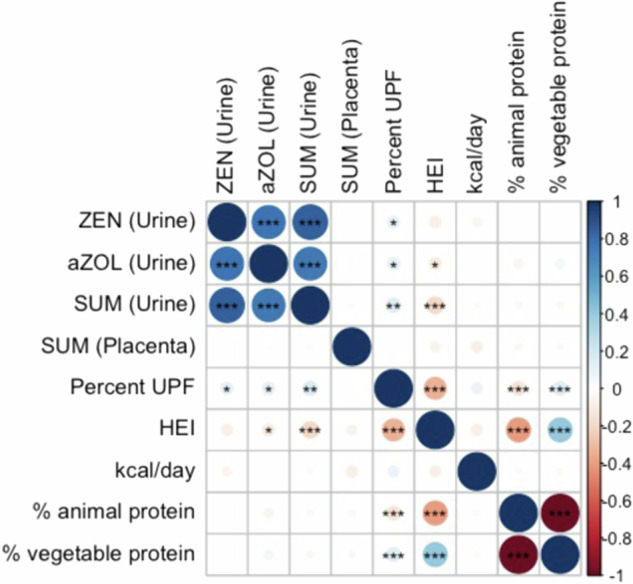
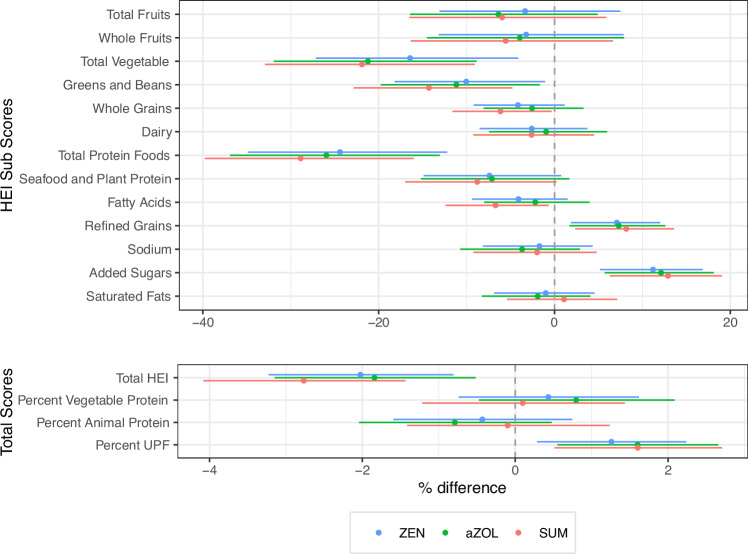
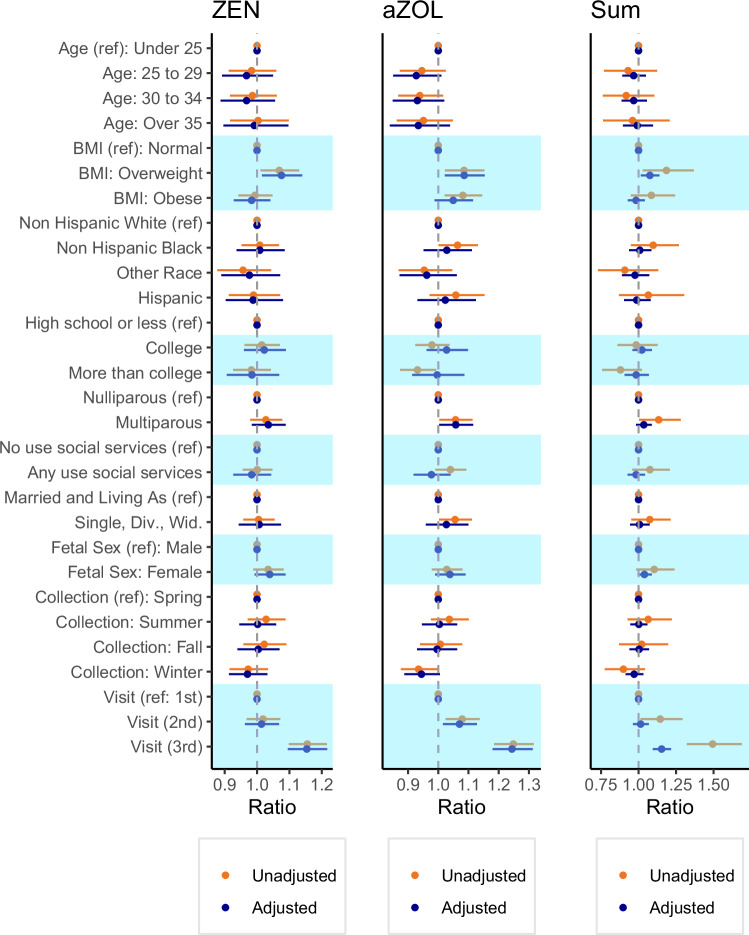
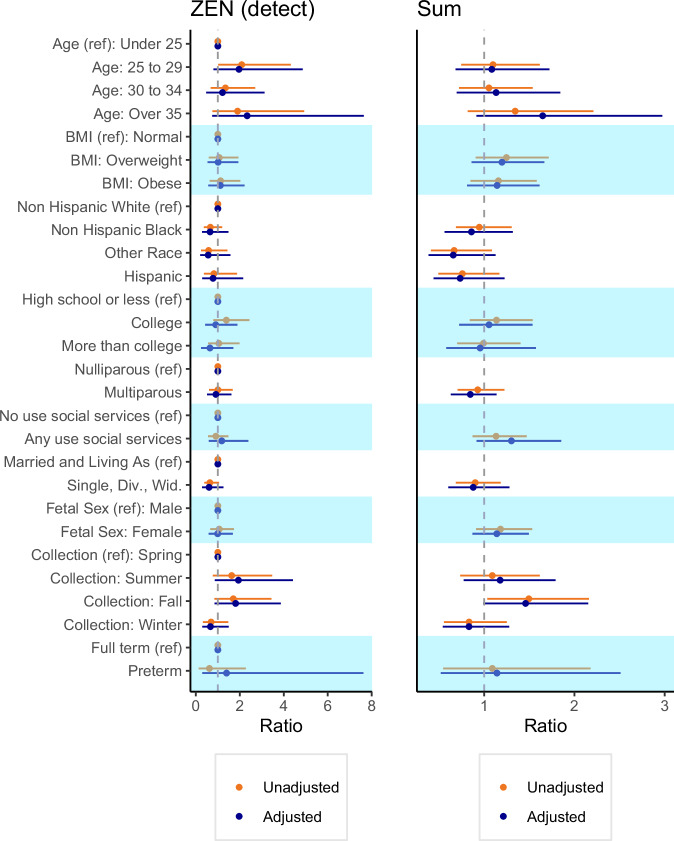
Mycoestrogens were detected in 97% of urines (median 0.323 ng/ml) and 84% of placentas (median 0.012 ng/g). Stability of urinary mycoestrogens across pregnancy was low (ICC: 0.16-0.22) and did not correlate with placental levels. In adjusted models, parity (multiparous) and pre-pregnancy BMI (higher) predicted higher urinary concentrations. Birth season (fall) corresponded with higher placental mycoestrogens. Dietary analyses indicated that higher HEI (healthier diets) predicted lower exposure (e.g., Σmycoestrogens %∆ -2.03; 95%CI -3.23, -0.81) and higher percent calories from UPF predicted higher exposure (e.g., Σmycoestrogens %∆ 1.26; 95%CI 0.29, 2.24).
The mycotoxin, zearalenone (ZEN), has been linked to adverse health and reproductive impacts in animal models and livestock. Despite evidence of widespread human exposure, relatively little is known about predictors of exposure. In a pregnant population, we observed that maternal ZEN concentrations varied by maternal pre-pregnancy BMI and parity. Consumption of ultra-processed foods, added sugars, and refined grains were linked to higher ZEN concentrations while healthier diets were associated with lower levels. Our research suggests disparities in exposure that are likely due to diet. Further research is needed to understand the impacts of ZEN on maternal and offspring health.
玉米赤霉烯酮(ZEN)是一种污染谷物及加工食品的霉菌毒素。ZEN可改变核雌激素受体α/β信号传导,因此被称为霉菌雌激素。实验证据表明,孕期接触霉菌雌激素与母体性类固醇激素改变、胎盘大小变化以及胎儿体重和身长降低有关。虽然全球人类生物样本中均检测到了霉菌雌激素,但美国人群,尤其是孕期人群的ZEN暴露评估仍较为缺乏。
描述美国健康孕妇尿液和胎盘中ZEN及其代谢物的浓度,并研究暴露的人口统计学、围产期和饮食预测因素。
在UPSIDE研究中,于孕早期、孕中期和孕晚期分别收集孕妇的尿液样本,并在分娩时收集胎盘样本(纽约州罗切斯特市,n = 317)。我们使用高效液相色谱法和高分辨率串联质谱法测量尿液中总霉菌雌激素(ng/ml)和胎盘中霉菌雌激素(ng/g)的含量。通过线性回归和线性混合效应模型,研究霉菌雌激素浓度与人口统计学、围产期和饮食因素(健康饮食指数[HEI]、超加工食品[UPF]摄入量)之间的关联。
97%的尿液(中位数为0.323 ng/ml)和84%的胎盘(中位数为0.012 ng/g)中检测到了霉菌雌激素。孕期尿液中霉菌雌激素的稳定性较低(组内相关系数:0.16 - 0.22),且与胎盘水平无关。在调整模型中,经产妇和孕前体重指数较高可预测尿液中霉菌雌激素浓度较高。分娩季节为秋季与胎盘霉菌雌激素含量较高相关。饮食分析表明,较高的HEI(更健康的饮食)可预测较低的暴露水平(例如,总霉菌雌激素百分比变化-2.03;95%置信区间-3.23,-0.81),而来自UPF的热量百分比越高则预测暴露水平越高(例如,总霉菌雌激素百分比变化1.26;95%置信区间0.29,2.24)。
霉菌毒素玉米赤霉烯酮(ZEN)在动物模型和家畜中与不良健康及生殖影响有关。尽管有证据表明人类普遍暴露于该毒素,但对暴露的预测因素了解相对较少。在孕妇群体中,我们观察到母体ZEN浓度因孕前体重指数和产次而异。超加工食品、添加糖和精制谷物的摄入与较高的ZEN浓度相关,而更健康的饮食则与较低水平相关。我们的研究表明暴露存在差异,这可能与饮食有关。需要进一步研究以了解ZEN对母体和后代健康的影响。