Medical Biology and Pathology Department, Gustave Roussy, Villejuif, France.
AMMICa UAR3655/US23, Gustave Roussy, Villejuif, France.
Mol Cancer. 2024 Oct 4;23(1):221. doi: 10.1186/s12943-024-02134-4.
Understanding the resistance mechanisms of tumor is crucial for advancing cancer therapies. The prospective MATCH-R trial (NCT02517892), led by Gustave Roussy, aimed to characterize resistance mechanisms to cancer treatments through molecular analysis of fresh tumor biopsies. This report presents the genomic data analysis of the MATCH-R study conducted from 2015 to 2022 and focuses on targeted therapies.
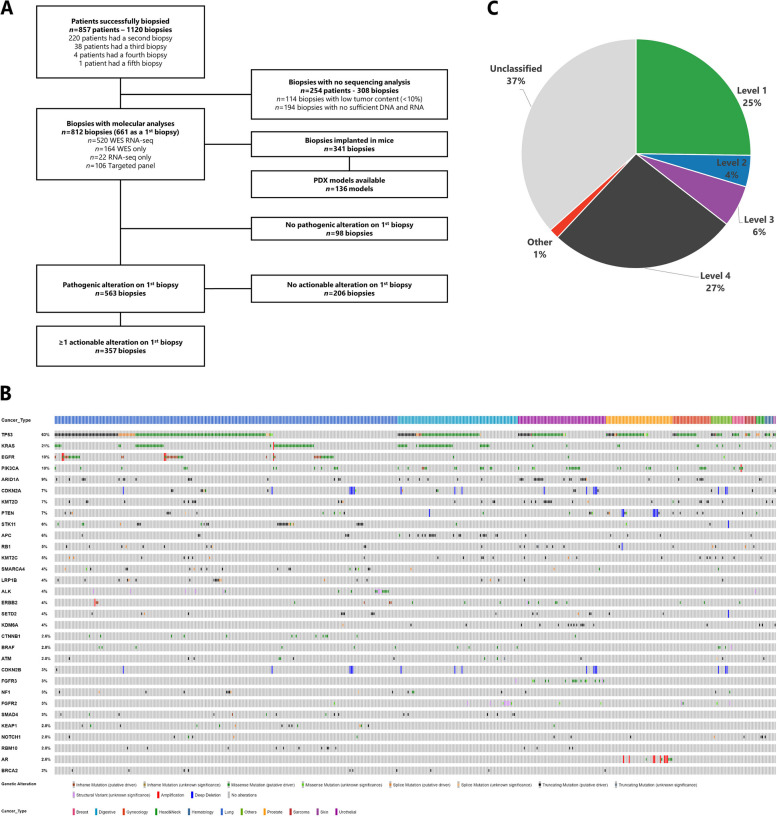
The study included resistant metastatic patients (pts) who accepted an image-guided tumor biopsy. After evaluation of tumor content (TC) in frozen tissue biopsies, targeted NGS (10 < TC < 30%) or Whole Exome Sequencing and RNA sequencing (TC > 30%) were performed before and/or after the anticancer therapy. Patient-derived xenografts (PDX) were established by implanting tumor fragments into NOD scid gamma mice and amplified up to five passages.
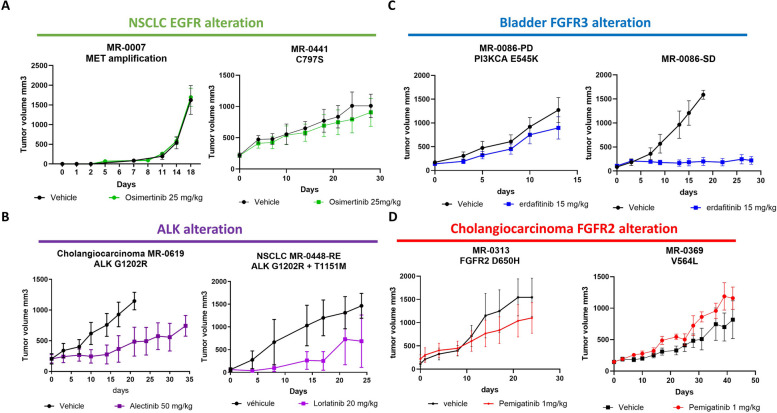
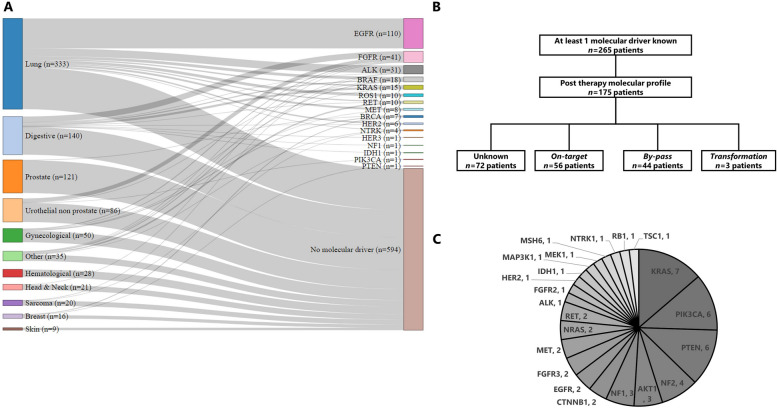
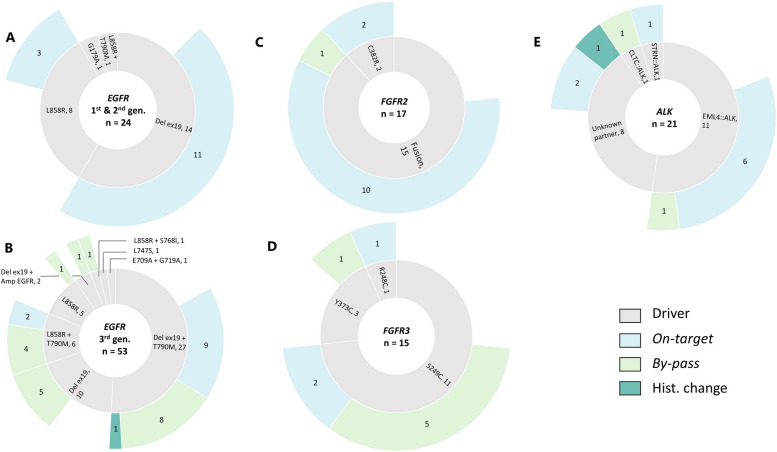
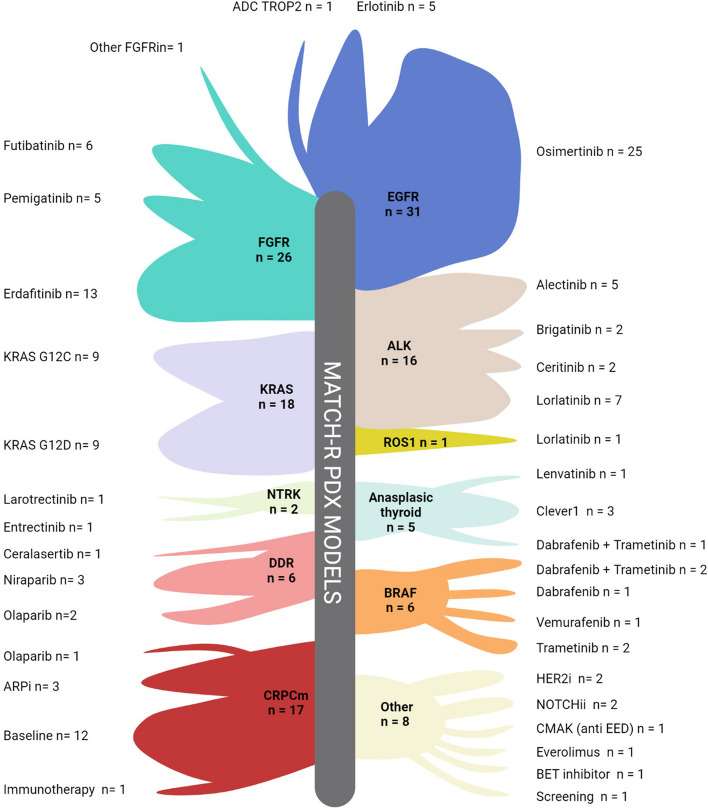
A total of 1,120 biopsies were collected from 857 pts with the most frequent tumor types being lung (38.8%), digestive (16.3%) and prostate (14.1%) cancer. Molecular targetable driver were identified in 30.9% (n = 265/857) of the patients, with EGFR (41.5%), FGFR2/3 (15.5%), ALK (11.7%), BRAF (6.8%), and KRAS (5.7%) being the most common altered genes. Furthermore, 66.0% (n = 175/265) had a biopsy at progression on targeted therapy. Among resistant cases, 41.1% (n = 72/175) had no identified molecular mechanism, 32.0% (n = 56/175) showed on-target resistance, and 25.1% (n = 44/175) exhibited a by-pass resistance mechanism. Molecular profiling of the 44 patients with by-pass resistance identified 51 variants, with KRAS (13.7%), PIK3CA (11.8%), PTEN (11.8%), NF2 (7.8%), AKT1 (5.9%), and NF1 (5.9%) being the most altered genes. Treatment was tailored for 45% of the patients with a resistance mechanism identified leading to an 11 months median extension of clinical benefit. A total of 341 biopsies were implanted in mice, successfully establishing 136 PDX models achieving a 39.9% success rate. PDX models are available for EGFR (n = 31), FGFR2/3 (n = 26), KRAS (n = 18), ALK (n = 16), BRAF (n = 6) and NTRK (n = 2) driven cancers. These models closely recapitulate the biology of the original tumors in term of molecular alterations and pharmacological status, and served as valuable models to validate overcoming treatment strategies.
The MATCH-R study highlights the feasibility of on purpose image guided tumor biopsies and PDX establishment to characterize resistance mechanisms and guide personalized therapies to improve outcomes in pre-treated metastatic patients.
了解肿瘤的耐药机制对于推进癌症治疗至关重要。由 Gustave Roussy 领导的前瞻性 MATCH-R 试验(NCT02517892)旨在通过对新鲜肿瘤活检进行分子分析来描述癌症治疗的耐药机制。本报告介绍了 2015 年至 2022 年进行的 MATCH-R 研究的基因组数据分析,重点是靶向治疗。
该研究纳入了接受图像引导肿瘤活检的耐药转移性患者(pts)。在评估冷冻组织活检中的肿瘤含量(TC)后,在抗癌治疗之前和/或之后进行靶向 NGS(10<TC<30%)或全外显子组测序和 RNA 测序(TC>30%)。通过将肿瘤碎片植入 NOD scid gamma 小鼠中建立患者来源的异种移植物(PDX),并扩增至五个传代。
从 857 名患者中采集了 1120 个活检,最常见的肿瘤类型为肺癌(38.8%)、消化系统癌(16.3%)和前列腺癌(14.1%)。在 30.9%(n=265/857)的患者中确定了分子靶向驱动因素,其中 EGFR(41.5%)、FGFR2/3(15.5%)、ALK(11.7%)、BRAF(6.8%)和 KRAS(5.7%)是最常见的改变基因。此外,66.0%(n=175/265)在靶向治疗进展时进行了活检。在耐药病例中,41.1%(n=72/175)没有确定分子机制,32.0%(n=56/175)显示靶标耐药,25.1%(n=44/175)显示旁路耐药机制。对 44 名旁路耐药患者的分子谱分析确定了 51 种变体,其中 KRAS(13.7%)、PIK3CA(11.8%)、PTEN(11.8%)、NF2(7.8%)、AKT1(5.9%)和 NF1(5.9%)是最改变的基因。为 45%的有耐药机制的患者制定了治疗方案,使临床获益延长了 11 个月。共植入了 341 个活检,成功建立了 136 个 PDX 模型,成功率为 39.9%。PDX 模型可用于 EGFR(n=31)、FGFR2/3(n=26)、KRAS(n=18)、ALK(n=16)、BRAF(n=6)和 NTRK(n=2)驱动的癌症。这些模型在分子改变和药理学状态方面很好地重现了原始肿瘤的生物学特征,并作为验证克服治疗策略的有价值的模型。
MATCH-R 研究强调了有目的的图像引导肿瘤活检和 PDX 建立以描述耐药机制并指导个体化治疗以改善预处理转移性患者结局的可行性。