Food Nutrition Dietetics and Health Department, Kansas State University, 1310 Research Drive Park, Manhattan, KS, 66502, United States.
Division of Biology, Kansas State University, 6 Ackert Hall, Manhattan, KS, 66506, USA.
BMC Microbiol. 2024 Oct 3;24(1):387. doi: 10.1186/s12866-024-03556-2.
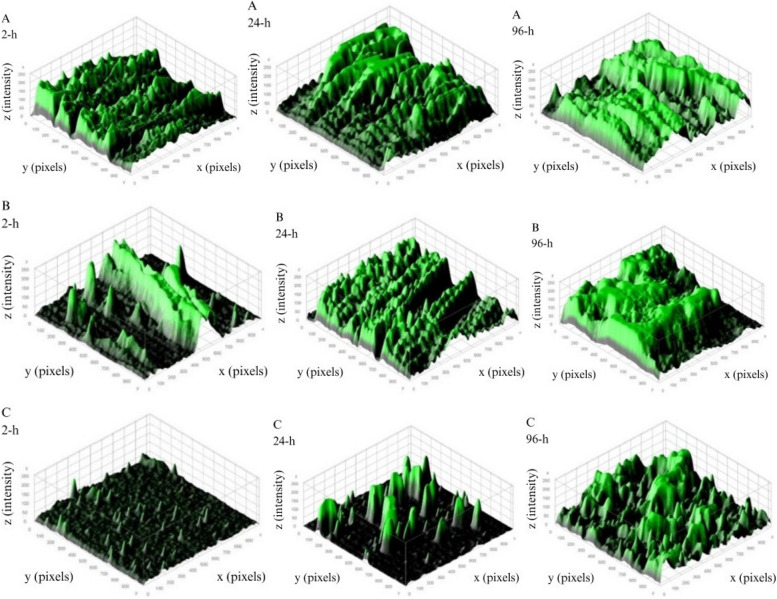
Salmonella forms biofilms, and persist on food contact surfaces. Once a biofilm is formed cleaning and sanitation protocols may be inadequate for effective removal. This study evaluated attachment characteristics, surface properties, and structure of Salmonella biofilms on food contact surfaces commonly used in the tree-fruit industry. Multi-strain Salmonella biofilms were grown in a Centers for Disease Control and Prevention (CDC) biofilm reactor at 22 ± 2 °C and sampling was conducted at 2, 24 and 96-h. After each incubation period, coupons weregently rinsed and the remaining cells enumerated. Biofilms were analyzed with Laser Scanning Confocal Microscopy (LSCM). Hydrophobicity was evaluated by measuring the contact angles of reference liquids method using a drop tensiometer instrument. Material type and biofilm age significantly influenced attachment and biofilm hydrophobicity (P < 0.05). The strength of attachment, across all time points, was highest on nylon followed by wood and high-density polyethylene. The highest contact angle measurements were observed after 96-h of biofilm formation for each material. All the results and observations from this study contribute to a better understanding of the attachment and hydrophobicity characteristics of Salmonella and might help producers make informed decisions when selecting containers for harvesting and storing in order to minimize biofilm formation and potential for cross-contamination.
沙门氏菌会形成生物膜,并在食物接触表面上持续存在。一旦形成生物膜,清洁和卫生协议可能不足以有效去除。本研究评估了在果树工业中常用的食品接触表面上的沙门氏菌生物膜的附着特性、表面性质和结构。多菌株沙门氏菌生物膜在疾病预防控制中心(CDC)生物膜反应器中于 22 ± 2°C 下生长,并在 2、24 和 96 小时进行采样。每次孵育后,轻轻冲洗小瓶并对剩余细胞进行计数。使用激光扫描共聚焦显微镜(LSCM)分析生物膜。通过使用滴张力计仪器测量参考液体方法的接触角来评估疏水性。材料类型和生物膜年龄显著影响附着和生物膜疏水性(P<0.05)。在所有时间点,尼龙的附着强度最高,其次是木材和高密度聚乙烯。对于每种材料,在生物膜形成 96 小时后观察到最高的接触角测量值。本研究的所有结果和观察结果有助于更好地了解沙门氏菌的附着和疏水性特征,并可能帮助生产者在选择用于收获和储存的容器时做出明智的决策,以最大程度地减少生物膜的形成和潜在的交叉污染。