Kawamoto Ryuichi, Kikuchi Asuka, Ninomiya Daisuke, Abe Masanori, Kumagi Teru
Department of Community Medicine, Ehime University Graduate School of Medicine, Toon, Japan.
Department of Internal Medicine, Seiyo Municipal Nomura Hospital, Seiyo, Japan.
Tob Use Insights. 2024 Oct 1;17:1179173X241275881. doi: 10.1177/1179173X241275881. eCollection 2024.
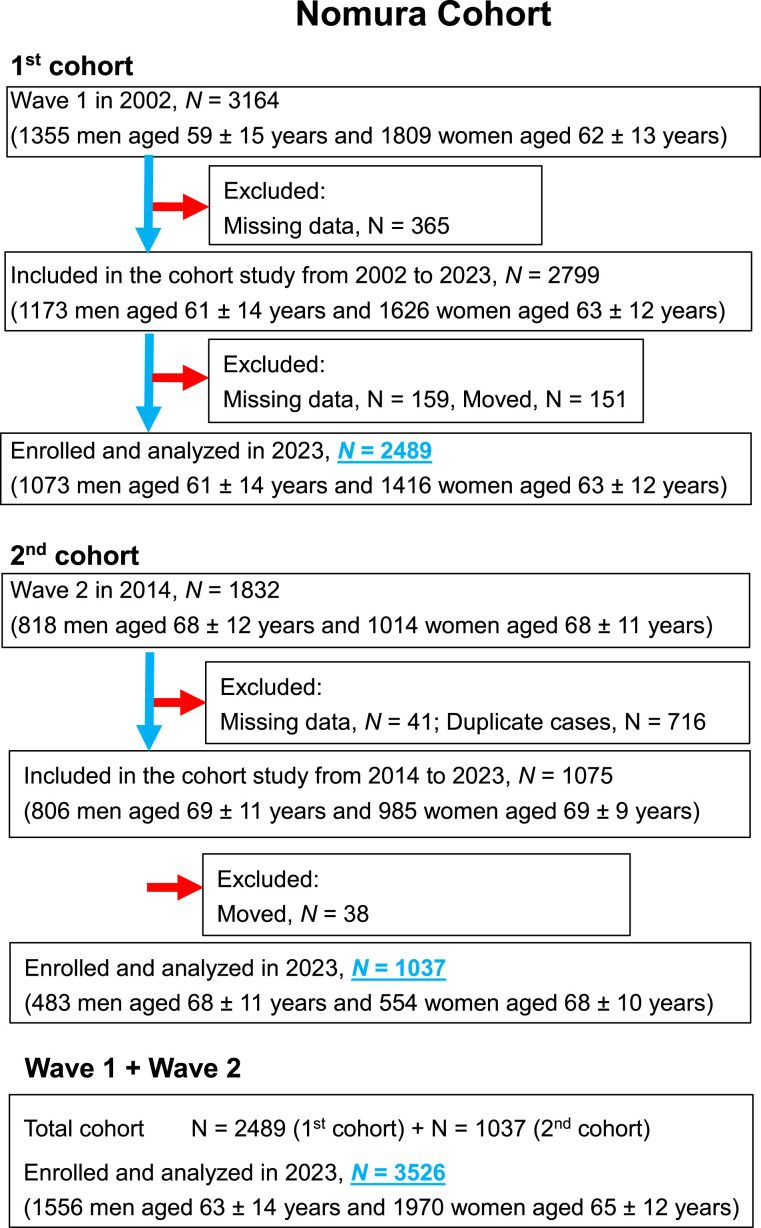
Smoking status is known to be an independent and significant predictor of health outcomes related to aging and plays a crucial role in overall mortality rates. This cohort study investigated the relationship between smoking status and survival outcomes over follow-up periods of 9 and 21 years. The sample consisted of 3526 participants with a mean age of 64 ± 12 years, 44.1% of whom were male. The median follow-up duration was 6315 days, with an interquartile range of 3441 to 7727 days. Smoking status [i.e., Brinkmann index (BI)] was calculated by multiplying the number of years smoked by the number of cigarettes smoked daily. Based on this, participants were categorized into non-smokers, former smokers, and current smokers. The data were analyzed using Cox regression, employing age as the time variable and accounting for various risk factors. A total of 1111 participants (49.2%) were confirmed to have died. Among these, 564 were male (36.2% of all male participants), and 547 were female (27.8% of all female participants). The multivariate-adjusted odds ratio (95% confidence interval) for all-cause mortality compared with never-smokers was 1.51 (1.17-1.96) for former smokers with BI > 800, 1.61 (1.20-2.17) for current smokers with BI of 400-799 and 1.62 (95% CI, 1.24-2.10) with BI of ≥800 ( for trend <0.001). Participants who died within three years of follow-up were excluded to avoid the possibility of reverse causation, but the results were essentially unchanged. We found that the BI is a valid predictor of future mortality risk and that BI 800 for former smokers and BI 400 for current smokers were useful cutoff values. Efforts to control smoking should focus not only on current smokers but also on former smokers to reduce the risk of premature death associated with smoking.
吸烟状况是与衰老相关的健康结果的独立且重要的预测因素,在总体死亡率中起着关键作用。这项队列研究调查了9年和21年随访期内吸烟状况与生存结果之间的关系。样本包括3526名参与者,平均年龄为64±12岁,其中44.1%为男性。中位随访时间为6315天,四分位间距为3441至7727天。吸烟状况[即布林克曼指数(BI)]通过吸烟年数乘以每日吸烟支数来计算。据此,参与者被分为非吸烟者、既往吸烟者和当前吸烟者。使用Cox回归分析数据,将年龄作为时间变量,并考虑各种风险因素。共有1111名参与者(49.2%)被证实死亡。其中,564名是男性(占所有男性参与者的36.2%),547名是女性(占所有女性参与者的27.8%)。与从不吸烟者相比,既往吸烟者BI>800的全因死亡率多变量调整比值比(95%置信区间)为1.51(1.17 - 1.96),当前吸烟者BI为400 - 799时为1.61(1.20 - 2.17),BI≥800时为1.62(95%CI,1.24 - 2.10)(趋势<0.001)。为避免反向因果关系的可能性,排除了随访三年内死亡的参与者,但结果基本不变。我们发现BI是未来死亡风险的有效预测指标,既往吸烟者的BI 800和当前吸烟者的BI 400是有用的截断值。控制吸烟的努力不仅应关注当前吸烟者,还应关注既往吸烟者,以降低与吸烟相关的过早死亡风险。