Inoue-Choi Maki, Liao Linda M, Reyes-Guzman Carolyn, Hartge Patricia, Caporaso Neil, Freedman Neal D
Division of Cancer Epidemiology & Genetics, National Cancer Institute, National Institutes of Health, Rockville, Maryland.
Office of Science, Center for Tobacco Products, US Food and Drug Administration, Silver Spring, Maryland.
JAMA Intern Med. 2017 Jan 1;177(1):87-95. doi: 10.1001/jamainternmed.2016.7511.
A growing proportion of US smokers now smoke fewer than 10 cigarettes per day (CPD), and that proportion will likely rise in the future. The health effects of smoking only a few CPD over one's lifetime are less understood than are the effects of heavier smoking, although many smokers believe that their level is modest.
To evaluate the associations of long-term smoking of fewer than 1 or 1 to 10 CPD (low intensity) with all-cause and cause-specific mortality compared with never smoking cigarettes.
DESIGN, SETTING, AND PARTICIPANTS: Prospective cohort study of 290 215 adults in the National Institutes of Health-AARP (formerly known as the American Association of Retired Persons) Diet and Health Study who were aged 59 to 82 years in calendar years 2004-2005 (baseline). Data were gathered with a questionnaire assessing lifetime cigarette smoking history. Hazard ratios (HRs) and 95% CIs were determined for all-cause mortality and cause-specific mortality through the end of 2011. Hazard ratios and 95% CIs were estimated using Cox proportional hazards regression models using age as the underlying time metric and adjusted for sex, race/ethnicity, educational level, physical activity, and alcohol intake. Data analysis was conducted from December 15, 2015, to September 30, 2016.
Current and historical smoking intensity during 9 previous age periods (from <15 years to ≥70 years) over the lifetime assessed on the 2004-2005 questionnaire.
All-cause and cause-specific mortality among current, former, and never smokers.
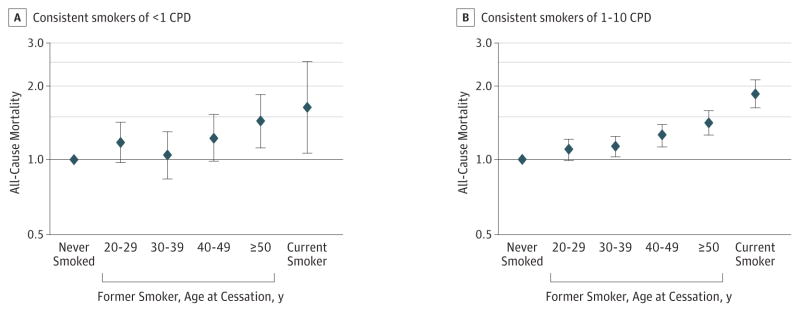
Of the 290 215 cohort participants who completed the 2004-2005 questionnaire, 168 140 were men (57.9%); the mean (SD) age was 71 (5.3) years (range, 59-82 years). Most people who smoked fewer than 1 or 1 to 10 CPD at baseline reported smoking substantially higher numbers of CPD earlier in their lives. Nevertheless, 159 (9.1%) and 1493 (22.5%) of these individuals reported consistently smoking fewer than 1 or 1 to 10 CPD in each age period that they smoked, respectively. Relative to never smokers, consistent smokers of fewer than 1 CPD (HR, 1.64; 95% CI, 1.07-2.51) and 1 to 10 CPD (HR, 1.87; 95% CI, 1.64-2.13) had a higher all-cause mortality risk. Associations were similar in women and men for all-cause mortality and were observed across a range of smoking-related causes of death, with an especially strong association with lung cancer (HR, 9.12; 95% CI, 2.92-28.47, and HR, 11.61; 95% CI, 8.25-16.35 for <1 and 1-10 CPD, respectively). Former smokers who had consistently smoked fewer than 1 or 1 to 10 CPD had progressively lower risks with younger age at cessation. For example, the HRs for consistent smokers of fewer than 1 and 1 to 10 CPD who quit at 50 years or older were 1.44 (95% CI, 1.12-1.85) and 1.42 (95% CI, 1.27-1.59), respectively.
This study provides evidence that individuals who smoke fewer than 1 or 1 to 10 CPD over their lifetime have higher mortality risks than never smokers and would benefit from cessation. These results provide further evidence that there is no risk-free level of exposure to tobacco smoke.
在美国,每天吸烟少于10支(CPD)的吸烟者比例正在上升,且未来这一比例可能还会增加。与重度吸烟的影响相比,人们对一生仅少量吸烟(每天少于10支)的健康影响了解较少,尽管许多吸烟者认为自己的吸烟量不大。
评估与从不吸烟相比,长期每天吸烟少于1支或1至10支(低强度)与全因死亡率和特定病因死亡率之间的关联。
设计、地点和参与者:美国国立卫生研究院-美国退休人员协会(原美国退休人员协会)饮食与健康研究中对290215名年龄在59至82岁之间(2004 - 2005年为基线)成年人进行的前瞻性队列研究。通过问卷调查收集一生吸烟史数据。通过2011年底确定全因死亡率和特定病因死亡率的风险比(HRs)及95%置信区间(CIs)。使用以年龄为基本时间指标的Cox比例风险回归模型估计风险比和95%置信区间,并对性别、种族/族裔、教育水平、身体活动和酒精摄入量进行调整。数据分析于2015年12月15日至2016年9月30日进行。
根据2004 - 2005年问卷评估的一生中9个先前年龄阶段(从<15岁至≥70岁)的当前和既往吸烟强度。
当前吸烟者、既往吸烟者和从不吸烟者中的全因死亡率和特定病因死亡率。
在完成2004 - 2005年问卷的290215名队列参与者中,168140名是男性(57.9%);平均(标准差)年龄为71(5.3)岁(范围为59 - 82岁)。大多数在基线时每天吸烟少于1支或1至10支的人报告称,他们在生命早期吸烟量要高得多。然而,这些人中有159人(9.1%)和1493人(22.5%)分别报告在每个吸烟年龄阶段持续每天吸烟少于1支或1至10支。与从不吸烟者相比,持续每天吸烟少于1支(HR = 1.64;95% CI = 1.07 - 2.51)和1至10支(HR = 1.87;95% CI = 1.64 - 2.13)的吸烟者全因死亡风险更高。全因死亡率在女性和男性中的关联相似,并且在一系列与吸烟相关的死亡原因中均有观察到,与肺癌的关联尤为强烈(每天吸烟少于1支和1至10支的HR分别为9.12;95% CI = 2.92 - 28.47和HR = 11.61;95% CI = 8.25 - 16.35)。在较年轻时戒烟的既往吸烟者中,持续每天吸烟少于1支或1至10支的人风险逐渐降低。例如,在50岁及以上戒烟的持续每天吸烟少于1支和1至10支的吸烟者的HR分别为1.44(95% CI = 1.12 - 1.85)和1.42(95% CI = 1.27 - 1.59)。
本研究提供的证据表明,一生中每天吸烟少于1支或1至10支的个体比从不吸烟者有更高的死亡风险,戒烟会使他们受益。这些结果进一步证明不存在无风险的烟草烟雾暴露水平。
