Department of Developmental, Molecular and Chemical Biology, Tufts University School of Medicine, Boston, Massachusetts, USA.
Department of Otorhinolaryngology: Head and Neck Surgery, University of Pennsylvania Perelman School of Medicine, Philadelphia, Pennsylvania, USA.
mBio. 2024 Nov 13;15(11):e0046224. doi: 10.1128/mbio.00462-24. Epub 2024 Oct 4.
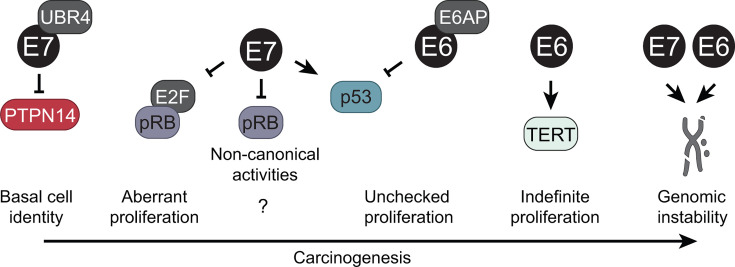
Human papillomavirus (HPV) infection is the leading viral cause of cancer. Over the past several decades, research on HPVs has provided remarkable insight into human cell biology and into the pathology of viral and non-viral cancers. The HPV E6 and E7 proteins engage host cellular proteins to establish an environment in infected cells that is conducive to virus replication. They rewire host cell signaling pathways to promote proliferation, inhibit differentiation, and limit cell death. The activity of the "high-risk" HPV E6 and E7 proteins is so potent that their dysregulated expression is sufficient to drive the initiation and maintenance of HPV-associated cancers. Consequently, intensive research efforts have aimed to identify the host cell targets of E6 and E7, in part with the idea that some or all of the virus-host interactions would be essential cancer drivers. These efforts have identified a large number of potential binding partners of each oncoprotein. However, over the same time period, parallel research has revealed that a relatively small number of genetic mutations drive carcinogenesis in most non-viral cancers. We therefore propose that a high-priority goal is to identify which of the many targets of E6 and E7 are critical drivers of HPV carcinogenesis. By identifying the cancer-driving targets of E6 and E7, it should be possible to better understand the distinct roles of other targets, perhaps in the viral life cycle, and to focus efforts to develop anti-cancer therapies on the subset of virus-host interactions for which therapeutic intervention would have the greatest impact.
人乳头瘤病毒(HPV)感染是癌症的主要病毒病因。在过去几十年中,对 HPV 的研究为深入了解人类细胞生物学和病毒及非病毒癌症的病理学提供了重要线索。HPV E6 和 E7 蛋白与宿主细胞蛋白相互作用,在受感染的细胞中建立有利于病毒复制的环境。它们重新布线宿主细胞信号通路,促进增殖,抑制分化,并限制细胞死亡。“高危”HPV E6 和 E7 蛋白的活性非常强,其失调表达足以驱动 HPV 相关癌症的起始和维持。因此,研究人员进行了大量研究,旨在确定 E6 和 E7 的宿主细胞靶标,部分原因是认为某些或所有病毒-宿主相互作用将是必不可少的癌症驱动因素。这些努力已经确定了每种致癌蛋白的大量潜在结合伴侣。然而,在同一时期,平行研究揭示了在大多数非病毒癌症中,相对较少的基因突变驱动了癌症的发生。因此,我们建议一个首要目标是确定 E6 和 E7 的许多靶标中哪些是 HPV 致癌作用的关键驱动因素。通过确定 E6 和 E7 的致癌靶标,应该有可能更好地了解其他靶标的不同作用,也许是在病毒生命周期中,以及将抗癌治疗的努力集中在具有最大治疗效果的病毒-宿主相互作用子集上。