MARBEC (Marine Biodiversity, Exploitation and Conservation), Univ Montpellier, CNRS, Ifremer, IRD, Montpellier, France.
HCMR (Hellenic Centre for Marine Research), Institute of Oceanography, Anavissos, Greece.
PLoS One. 2024 Oct 4;19(10):e0308505. doi: 10.1371/journal.pone.0308505. eCollection 2024.
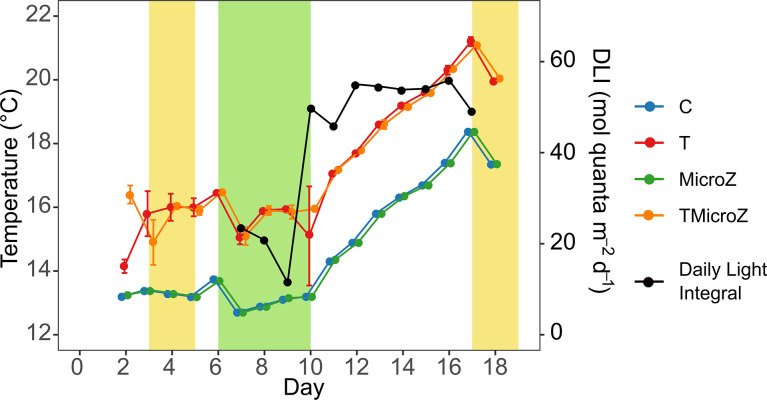
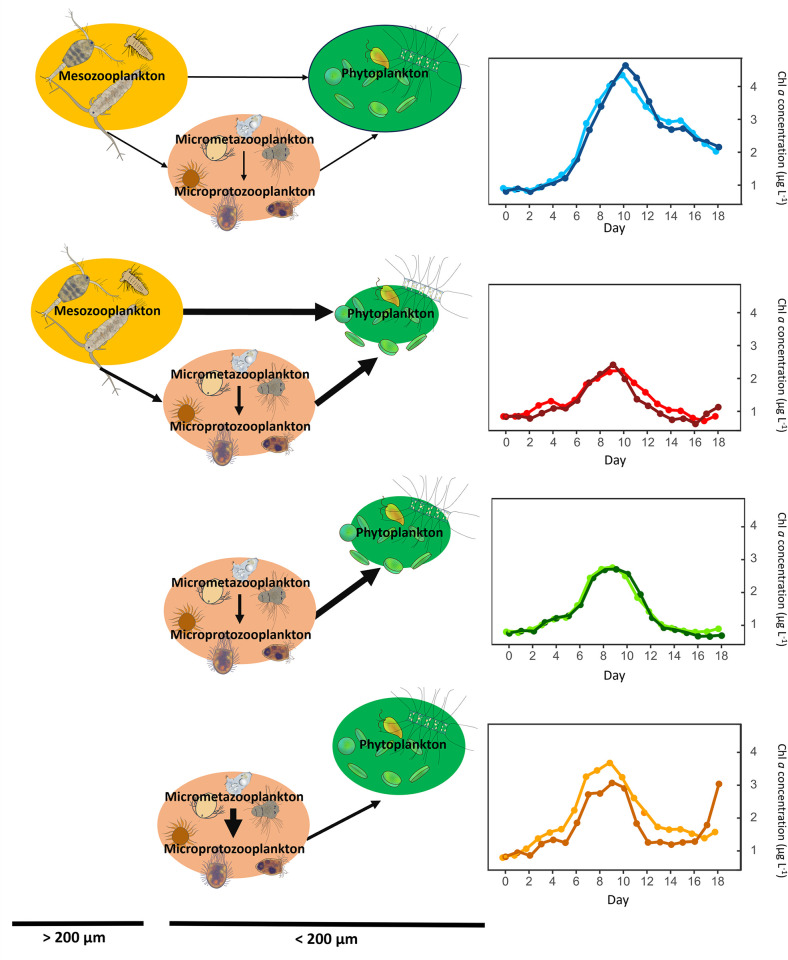
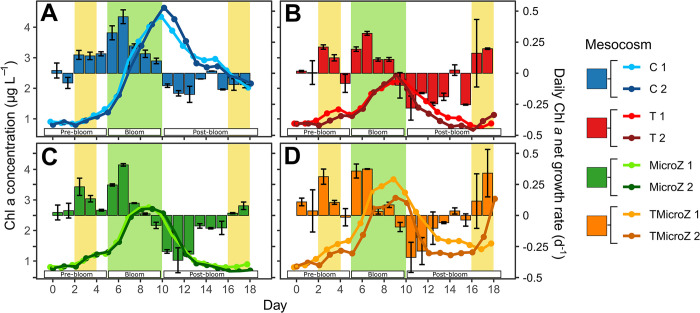
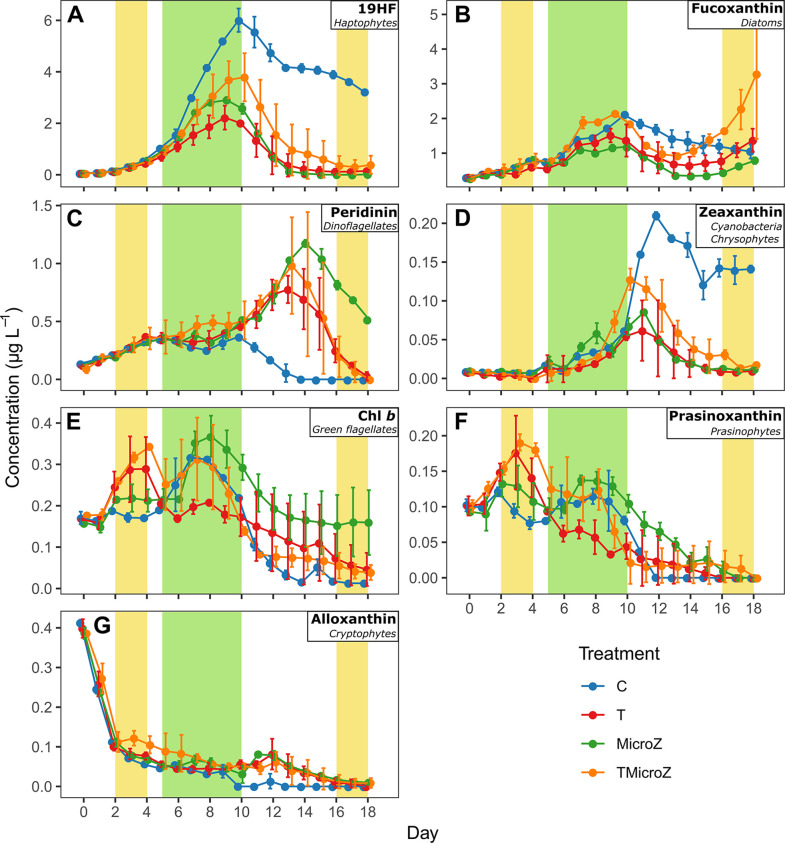
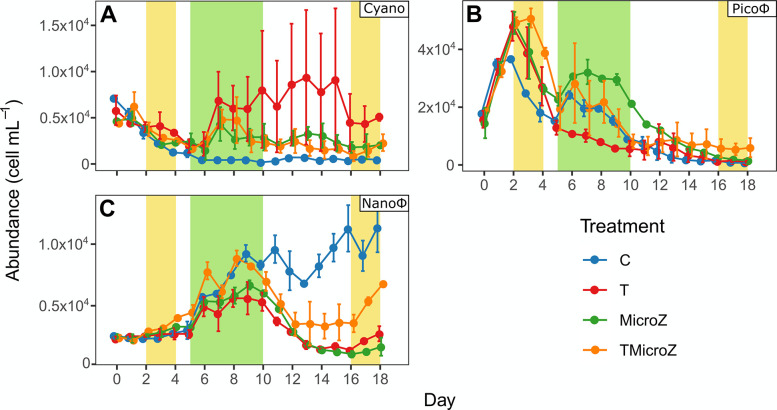
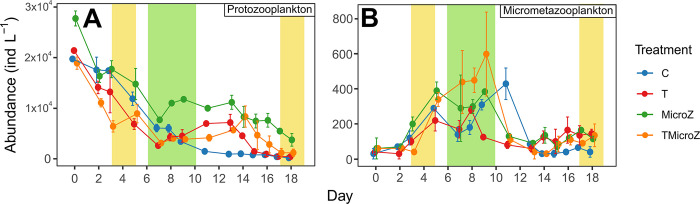
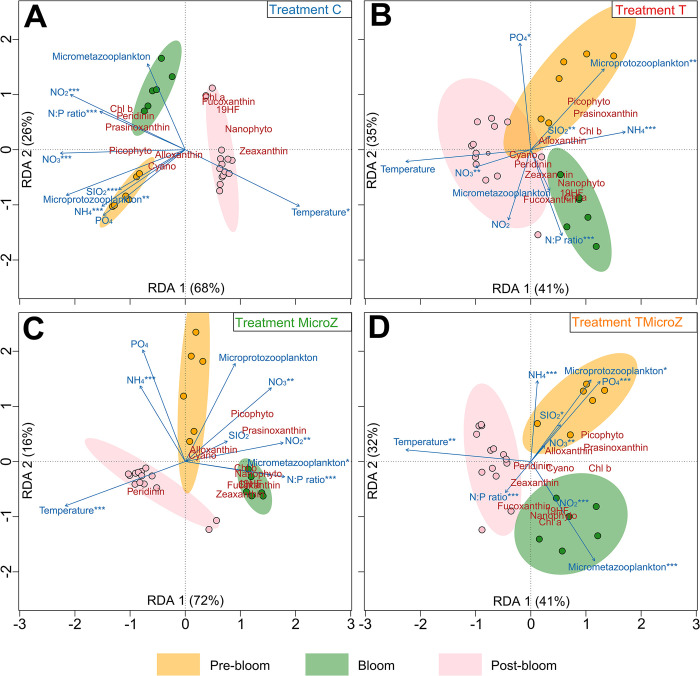
To better identify the responses of phytoplankton blooms to warming conditions as expected in a climate change context, an in situ mesocosm experiment was carried out in a coastal Mediterranean lagoon (Thau Lagoon, South of France) in April 2018. Our objective was to assess both the direct and indirect effects of warming on phytoplankton, particularly those mediated by top-down control. Four treatments were applied: 1) natural planktonic community with ambient water temperature (C); 2) natural planktonic community at +3°C elevated temperature (T); 3) exclusion of larger zooplankton (> 200 μm; mesozooplankton) leaving microzooplankton predominant with ambient water temperature (MicroZ); and 4) exclusion of larger zooplankton (> 200 μm; mesozooplankton) at +3°C elevated temperature (TMicroZ). Warming strongly depressed the amplitude of the phytoplankton bloom as the chlorophyll a concentration was twice lower in the T treatment. This decline under warmer conditions was most likely imputed to increase top-down control by zooplankton. However, removal of mesozooplankton resulted in an opposite trend, with a higher bloom amplitude observed under warmer conditions (MicroZ vs. TMicroZ) pointing at a strong interplay between micro- and mesozooplankton and the effect of warming for the spring phytoplankton blooms. Furthermore, both warming and mesozooplankton exclusion induced shifts in phytoplankton community composition during bloom and post-bloom periods, favoring dinoflagellates and small green algae at the expense of diatoms and prymnesiophytes. Moreover, warming altered phytoplankton succession by promoting an early bloom of small green flagellates, and a late bloom of diatoms. Our findings clearly highlighted the sensitivity of phytoplankton blooms amplitudes, community composition and succession patterns to temperature increases, as well as the key role of initial zooplankton community composition to elicit opposite response in bloom dynamics. It also points out that warmer conditions might favor dinoflagellates and small green algae, irrespective of zooplankton community composition, with potential implications for food web dynamics and energy transfer efficiency under future ocean condition.
为了更好地识别浮游植物水华对气候变化背景下预期变暖条件的响应,我们于 2018 年 4 月在法国南部沿海泻湖(索恩泻湖)进行了一项现场中尺度实验。我们的目的是评估升温对浮游植物的直接和间接影响,特别是那些由上层控制介导的影响。我们应用了四种处理方法:1)自然浮游生物群落和环境水温(C);2)自然浮游生物群落和 +3°C 高温(T);3)排除较大的浮游动物(>200μm;中型浮游动物),使微浮游动物占主导地位,环境水温(MicroZ);4)排除较大的浮游动物(>200μm;中型浮游动物)和 +3°C 高温(TMicroZ)。升温强烈抑制了浮游植物水华的幅度,因为 T 处理中的叶绿素 a 浓度低了一倍。在温暖条件下的这种下降很可能归因于浮游动物的上层控制增加。然而,去除中型浮游动物则导致相反的趋势,在温暖条件下观察到更高的水华幅度(MicroZ 与 TMicroZ),这表明微浮游动物和中型浮游动物之间存在强烈的相互作用以及升温对春季浮游植物水华的影响。此外,升温和中型浮游动物排除在水华和水华后期间都导致浮游植物群落组成发生变化,有利于甲藻和绿藻,而硅藻和金藻则减少。此外,升温通过促进小型绿藻的早期水华和硅藻的后期水华来改变浮游植物的演替。我们的研究结果清楚地强调了浮游植物水华幅度、群落组成和演替模式对温度升高的敏感性,以及初始浮游动物群落组成在水华动态中产生相反反应的关键作用。这也表明,无论浮游动物群落组成如何,温暖的条件可能有利于甲藻和小型绿藻,这可能对未来海洋条件下的食物网动态和能量转移效率产生影响。