• 文献检索
  • 文档翻译
  • 深度研究
  • 学术资讯
  • Suppr Zotero 插件Zotero 插件
  • 邀请有礼
  • 套餐&价格
  • 历史记录
应用&插件
Suppr Zotero 插件Zotero 插件浏览器插件Mac 客户端Windows 客户端微信小程序
定价
高级版会员购买积分包购买API积分包
服务
文献检索文档翻译深度研究API 文档MCP 服务
关于我们
关于 Suppr公司介绍联系我们用户协议隐私条款
关注我们

Suppr 超能文献

核心技术专利:CN118964589B侵权必究
粤ICP备2023148730 号-1Suppr @ 2026

文献检索

告别复杂PubMed语法,用中文像聊天一样搜索,搜遍4000万医学文献。AI智能推荐,让科研检索更轻松。

立即免费搜索

文件翻译

保留排版,准确专业,支持PDF/Word/PPT等文件格式,支持 12+语言互译。

免费翻译文档

深度研究

AI帮你快速写综述,25分钟生成高质量综述,智能提取关键信息,辅助科研写作。

立即免费体验

水、环境卫生和个人卫生(WASH):全球卫生与发展领域的演变。

Water, sanitation and hygiene (WASH): the evolution of a global health and development sector.

机构信息

Institute for History, Leiden University, Leiden, The Netherlands.

Freelance, Nairobi, Kenya.

出版信息

BMJ Glob Health. 2024 Oct 4;9(10):e015367. doi: 10.1136/bmjgh-2024-015367.

DOI:10.1136/bmjgh-2024-015367
PMID:39366708
原文链接:https://pmc.ncbi.nlm.nih.gov/articles/PMC11459319/
Abstract

Despite some progress, universal access to safe water, sanitation and hygiene (WASH) by 2030-a remit of Sustainable Development Goal 6-remains a distant prospect in many countries. Policy-makers and implementers of the WASH sector are challenged to track a new path. This research aimed to identify core orienting themes of the sector, as legacies of past processes, which can provide insights for its future. We reviewed global policy, science and programmatic documents and carried out 19 expert interviews to track the evolution of the global WASH sector over seven decades. We situated this evolution in relation to wider trends in global health and development over the same time period.With transnational flows of concern, expertise and resources from high-income to lower-income countries, the WASH sector evolved over decades of international institutionalisation of health and development with (1) a focus on technologies (technicalisation), (2) a search for generalised solutions (universalisation), (3) attempts to make recipients responsible for environmental health (responsibilisation) and (4) the shaping of programmes around quantifiable outcomes (metricisation). The emergent commitment of the WASH sector to these core themes reflects a pragmatic response in health and development to depoliticise poverty and social inequalities in order to enable action. This leads to questions about what potential solutions have been obscured, a recognition which might be understood as 'uncomfortable knowledge'-the knowns that have had to be unknown, which resonate with concerns about deep inequalities, shrinking budgets and the gap between what could and has been achieved.

摘要

尽管取得了一些进展,但到 2030 年,实现安全饮用水、环境卫生和个人卫生(WASH)的普及,这是可持续发展目标 6 的任务,在许多国家仍然是一个遥远的目标。WASH 部门的政策制定者和执行者面临着开辟新道路的挑战。本研究旨在确定该部门的核心定位主题,作为过去进程的遗留问题,为其未来提供启示。我们审查了全球政策、科学和方案文件,并进行了 19 次专家访谈,以跟踪全球 WASH 部门在过去 70 年中的演变。我们将这一演变与同期全球卫生和发展的更广泛趋势联系起来。随着对高收入和低收入国家的关切、专业知识和资源的跨国流动,WASH 部门在卫生和发展的几十年国际制度化过程中不断发展,(1)关注技术(技术化),(2)寻求普遍适用的解决方案(普遍化),(3)试图使接受者对环境卫生负责(责任化),(4)围绕可量化成果制定方案(计量化)。WASH 部门对这些核心主题的新承诺反映了卫生和发展领域为使贫困和社会不平等问题非政治化以推动行动而采取的务实回应。这引发了一些问题,即哪些潜在的解决方案被掩盖了,这种认识可以被理解为“令人不适的知识”——那些必须被忽视的已知知识,这与对深刻不平等、预算缩减以及可以实现和已经实现的目标之间差距的担忧产生了共鸣。
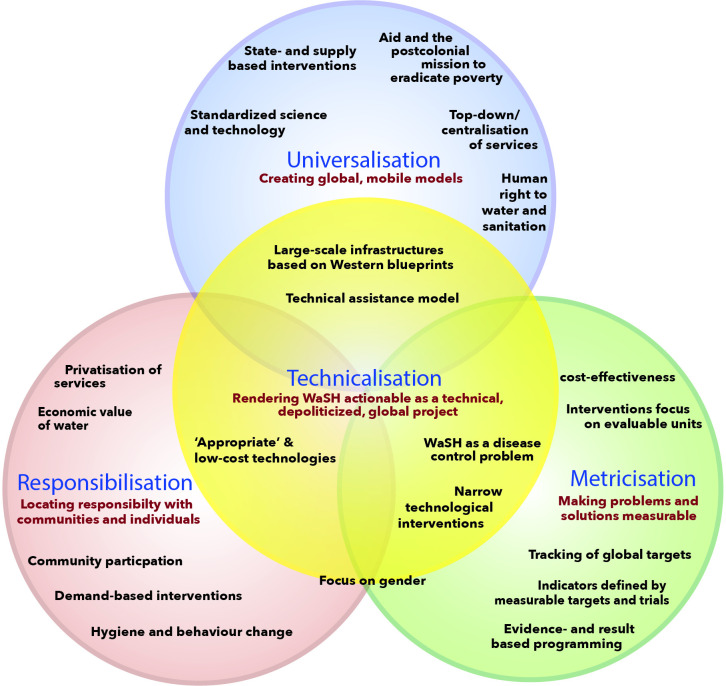
https://cdn.ncbi.nlm.nih.gov/pmc/blobs/9c7a/11459319/a20335ec5cb4/bmjgh-9-10-g003.jpg
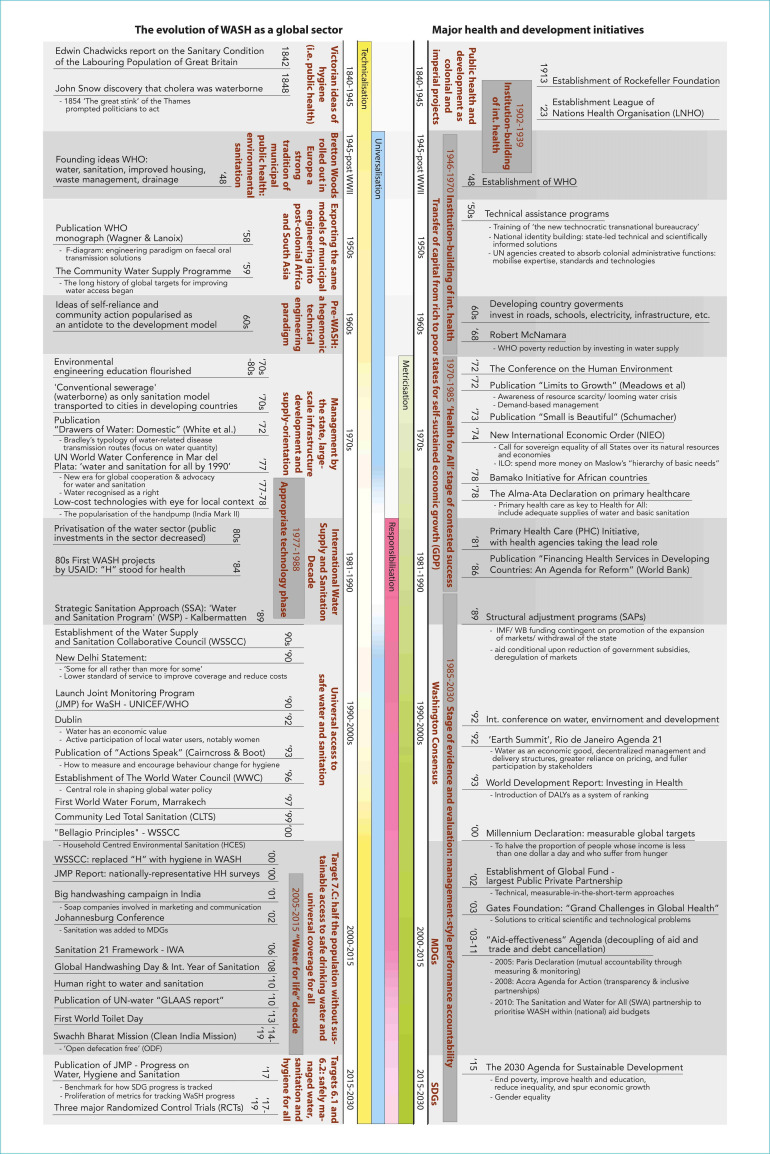
https://cdn.ncbi.nlm.nih.gov/pmc/blobs/9c7a/11459319/0ea6e280d15c/bmjgh-9-10-g001.jpg
https://cdn.ncbi.nlm.nih.gov/pmc/blobs/9c7a/11459319/9e5144737f92/bmjgh-9-10-g002.jpg
https://cdn.ncbi.nlm.nih.gov/pmc/blobs/9c7a/11459319/a20335ec5cb4/bmjgh-9-10-g003.jpg
https://cdn.ncbi.nlm.nih.gov/pmc/blobs/9c7a/11459319/0ea6e280d15c/bmjgh-9-10-g001.jpg
https://cdn.ncbi.nlm.nih.gov/pmc/blobs/9c7a/11459319/9e5144737f92/bmjgh-9-10-g002.jpg
https://cdn.ncbi.nlm.nih.gov/pmc/blobs/9c7a/11459319/a20335ec5cb4/bmjgh-9-10-g003.jpg

相似文献

1
Water, sanitation and hygiene (WASH): the evolution of a global health and development sector.水、环境卫生和个人卫生(WASH):全球卫生与发展领域的演变。
BMJ Glob Health. 2024 Oct 4;9(10):e015367. doi: 10.1136/bmjgh-2024-015367.
2
Interventions promoting uptake of water, sanitation and hygiene (WASH) technologies in low- and middle-income countries: An evidence and gap map of effectiveness studies.促进低收入和中等收入国家采用水、环境卫生和个人卫生(WASH)技术的干预措施:有效性研究的证据与差距图
Campbell Syst Rev. 2021 Oct 8;17(4):e1194. doi: 10.1002/cl2.1194. eCollection 2021 Dec.
3
A long way to go - Estimates of combined water, sanitation and hygiene coverage for 25 sub-Saharan African countries.任重道远——撒哈拉以南非洲25个国家的水、环境卫生和个人卫生综合覆盖率估计
PLoS One. 2017 Feb 9;12(2):e0171783. doi: 10.1371/journal.pone.0171783. eCollection 2017.
4
Kenyan school book knowledge for water, sanitation, hygiene and health education interventions: Disconnect, integration or opportunities?肯尼亚学校教材中的水、环境卫生和个人卫生教育干预措施:脱节、整合还是机遇?
Int J Hyg Environ Health. 2021 Jun;235:113756. doi: 10.1016/j.ijheh.2021.113756. Epub 2021 May 15.
5
21st century research in urban WASH and health in sub-Saharan Africa: methods and outcomes in transition.21 世纪撒哈拉以南非洲城市水、环境卫生和个人卫生与健康研究:转型中的方法和结果。
Int J Environ Health Res. 2019 Aug;29(4):457-478. doi: 10.1080/09603123.2018.1550193. Epub 2018 Dec 13.
6
Animal influence on water, sanitation and hygiene measures for zoonosis control at the household level: A systematic literature review.动物对家庭层面控制动物传染病的水、环境卫生与个人卫生措施的影响:系统文献回顾。
PLoS Negl Trop Dis. 2018 Jul 12;12(7):e0006619. doi: 10.1371/journal.pntd.0006619. eCollection 2018 Jul.
7
Collaborating to develop joint water, sanitation and hygiene (WASH) and neglected tropical disease (NTD) sector monitoring: an expert consultation.合作开展水、环境卫生与个人卫生(WASH)及被忽视热带病(NTD)部门联合监测:一次专家咨询会
Int Health. 2017 Jul 1;9(4):215-225. doi: 10.1093/inthealth/ihx008.
8
Principles for increasing equity in WASH research: understanding barriers faced by LMIC WASH researchers.提高水环境卫生研究公平性的原则:了解 LMIC 水环境卫生研究人员所面临的障碍。
BMJ Glob Health. 2023 Apr;8(4). doi: 10.1136/bmjgh-2022-010990.
9
Intersectoral (in)activity: towards an understanding of public sector department links between water, sanitation and hygiene (WASH) and childhood undernutrition in South Africa.跨部门(不)活跃:理解南非公共部门水、环境卫生和个人卫生(WASH)与儿童营养不足之间的联系。
Health Policy Plan. 2020 Aug 1;35(7):829-841. doi: 10.1093/heapol/czaa028.
10
The Lancet Commission on water, sanitation and hygiene, and health.柳叶刀水、环境卫生与个人卫生及健康委员会
Lancet. 2021 Oct 23;398(10310):1469-1470. doi: 10.1016/S0140-6736(21)02005-5. Epub 2021 Sep 3.

引用本文的文献

1
Impact of Health Education on Infectious Disease Knowledge in Indigenous Communities in Northwestern Malaysia.健康教育对马来西亚西北部原住民社区传染病知识的影响。
Trop Med Infect Dis. 2025 Jul 9;10(7):191. doi: 10.3390/tropicalmed10070191.
2
Decolonizing global health: a scoping review.去殖民化全球健康:一项范围综述
BMC Health Serv Res. 2025 Jul 1;25(1):828. doi: 10.1186/s12913-025-12890-8.
3
Exploring the Impact of Traditional Practices on Outbreaks in Rural Nigerian Communities: A Field Study with Educational and Behavioral Interventions.

本文引用的文献

1
On the coloniality of global public heath.论全球公共卫生的殖民性
Med Anthropol Theory. 2019 Dec 16;6(4):101-118. doi: 10.17157/mat.6.4.761.
2
The Lancet Commission on water, sanitation and hygiene, and health.柳叶刀水、环境卫生与个人卫生及健康委员会
Lancet. 2021 Oct 23;398(10310):1469-1470. doi: 10.1016/S0140-6736(21)02005-5. Epub 2021 Sep 3.
3
The Applications of Implementation Science in Water, Sanitation, and Hygiene (WASH) Research and Practice.实施科学在水、环境卫生和个人卫生(WASH)研究和实践中的应用。
探索传统习俗对尼日利亚农村社区疫情爆发的影响:一项采用教育和行为干预措施的实地研究
Int J Environ Res Public Health. 2025 Mar 24;22(4):483. doi: 10.3390/ijerph22040483.
4
The persistence of failure in water, sanitation and hygiene programming: a qualitative study.水、环境卫生与个人卫生项目中持续存在的失败问题:一项定性研究
BMJ Glob Health. 2025 Feb 24;10(2):e016354. doi: 10.1136/bmjgh-2024-016354.
Environ Health Perspect. 2021 Jun;129(6):65002. doi: 10.1289/EHP7762. Epub 2021 Jun 16.
4
Addressing power asymmetries in global health: Imperatives in the wake of the COVID-19 pandemic.应对全球卫生中的权力不对称:新冠疫情后的当务之急。
PLoS Med. 2021 Apr 22;18(4):e1003604. doi: 10.1371/journal.pmed.1003604. eCollection 2021 Apr.
5
Towards safe drinking water and clean cooking for all.迈向人人安全饮水和清洁烹饪目标。
Lancet Glob Health. 2021 Mar;9(3):e361-e365. doi: 10.1016/S2214-109X(20)30476-9. Epub 2021 Jan 11.
6
Why we should never do it: stigma as a behaviour change tool in global health.我们为何绝不应该这样做:污名化作为全球健康领域行为改变的工具。
BMJ Glob Health. 2019 Oct 23;4(5):e001911. doi: 10.1136/bmjgh-2019-001911. eCollection 2019.
7
Moving towards transformational WASH.迈向变革性的水、卫生与个人卫生(WASH)。
Lancet Glob Health. 2019 Nov;7(11):e1492. doi: 10.1016/S2214-109X(19)30396-1.
8
The implications of three major new trials for the effect of water, sanitation and hygiene on childhood diarrhea and stunting: a consensus statement.三项关于水、环境卫生和个人卫生对儿童腹泻和发育迟缓影响的大型新试验的意义:共识声明。
BMC Med. 2019 Aug 28;17(1):173. doi: 10.1186/s12916-019-1410-x.
9
The WASH Benefits and SHINE trials: interpretation of WASH intervention effects on linear growth and diarrhoea.WASH 效益和 SHINE 试验:解释 WASH 干预措施对线性生长和腹泻的影响。
Lancet Glob Health. 2019 Aug;7(8):e1139-e1146. doi: 10.1016/S2214-109X(19)30268-2.
10
Estimates of the global, regional, and national morbidity, mortality, and aetiologies of diarrhoea in 195 countries: a systematic analysis for the Global Burden of Disease Study 2016.估计 195 个国家的全球、区域和国家腹泻发病率、死亡率和病因:2016 年全球疾病负担研究的系统分析。
Lancet Infect Dis. 2018 Nov;18(11):1211-1228. doi: 10.1016/S1473-3099(18)30362-1. Epub 2018 Sep 19.