Mehjabeen Deena, Patel Kyle, Jindal Rahul M
Translational Health Research Institute, Western Sydney University, Campbelltown Campus, Campbelltown, NSW, Australia.
Johns Hopkins University School of Medicine, Baltimore, MD, USA.
BMC Health Serv Res. 2025 Jul 1;25(1):828. doi: 10.1186/s12913-025-12890-8.
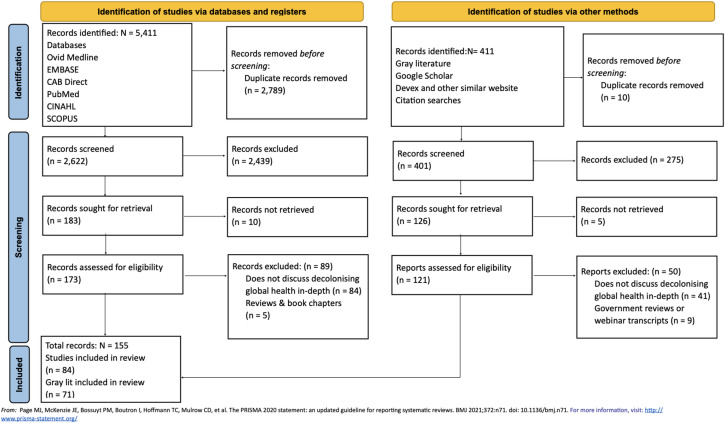
We summarize research on decolonizing global health and highlight existing gaps, including the lack of a formal definition and clear aims for the movement. We examine the decolonization of global health curricula and authorship in indexed journals, aiming to build a shared understanding among global health scholars. The review included studies from all global regions to ensure comprehensive geographical representation. Of the 155 identified records, most were published from 2021 onward and predominantly originated from the Global North. Studies focusing solely on racism were excluded. Additionally, non-English publications and studies prior to 2019 were excluded, which may have limited insights from other perspectives, such as those available in Spanish from Latin America. The included studies centered on topics such as curricula, the COVID-19 pandemic, and equity in authorship for Global South scholars. However, despite these discussions, voices from the Global South remain underrepresented in indexed journals, and there is limited focus on actionable strategies for shifting power dynamics to foster true decolonization in global health governance and funding. To address these issues, we recommend mentorship programs targeted at academics from the Global South, focusing on research capacity-building, grant writing, and leadership development. We call for broader structural reforms, including equitable funding allocation, the decolonization of research agendas, and the dismantling of hierarchical systems that privilege voices from the Global North over the Global South. The creation of collaborative networks focused on decolonization is critical in demonstrating a commitment to dismantling oppressive systems and fostering equity. While some progress has been made, further research is needed to explore how funding, knowledge systems and publishing can be more equitably distributed, supporting a truly decolonized global health agenda that advances social justice and health equity.
我们总结了全球卫生去殖民化的研究,并突出了现有差距,包括缺乏正式定义和该运动的明确目标。我们研究了全球卫生课程的去殖民化以及索引期刊中的作者身份问题,旨在在全球卫生学者之间建立共同理解。该综述纳入了来自全球所有地区的研究,以确保全面的地理代表性。在确定的155条记录中,大多数是2021年以后发表的,主要来自全球北方。仅关注种族主义的研究被排除在外。此外,非英语出版物和2019年之前的研究也被排除在外,这可能限制了来自其他视角的见解,比如拉丁美洲用西班牙语发表的研究。纳入的研究集中在课程、新冠疫情以及全球南方学者的作者身份公平性等主题上。然而,尽管有这些讨论,但全球南方的声音在索引期刊中仍然代表性不足,并且对于改变权力动态以促进全球卫生治理和资金投入方面真正去殖民化的可行策略关注有限。为解决这些问题,我们建议针对全球南方学者的指导计划,重点关注研究能力建设、资助申请撰写和领导力发展。我们呼吁进行更广泛的结构性改革,包括公平的资金分配、研究议程的去殖民化以及拆除使全球北方的声音优于全球南方的等级制度。创建专注于去殖民化的合作网络对于表明致力于拆除压迫性系统和促进公平至关重要。虽然已经取得了一些进展,但仍需要进一步研究,以探索如何更公平地分配资金、知识体系和出版资源,支持一个推进社会正义和卫生公平的真正去殖民化的全球卫生议程。