Qu Zihan, Zhao Yang, Ma Fei, Mei Le, Chen Xian-Kai, Zhou Haitao, Chu Xinbo, Yang Yingguo, Jiang Qi, Zhang Xingwang, You Jingbi
Laboratory of Semiconductor Physics, Institute of Semiconductors, Chinese Academy of Sciences, 100083, Beijing, P. R. China.
Center of Materials Science and Optoelectronics Engineering, University of Chinese Academy of Sciences, 100049, Beijing, P. R. China.
Nat Commun. 2024 Oct 4;15(1):8620. doi: 10.1038/s41467-024-52925-y.
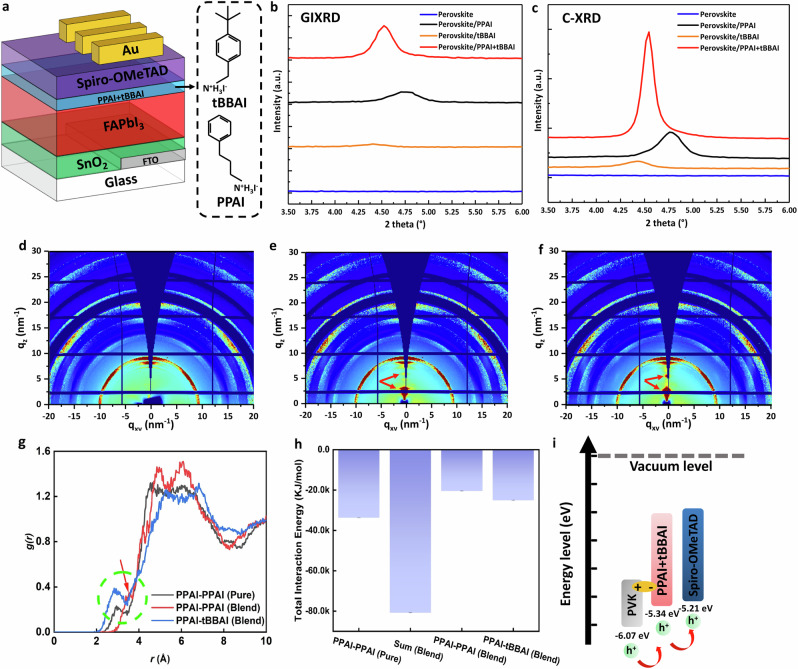
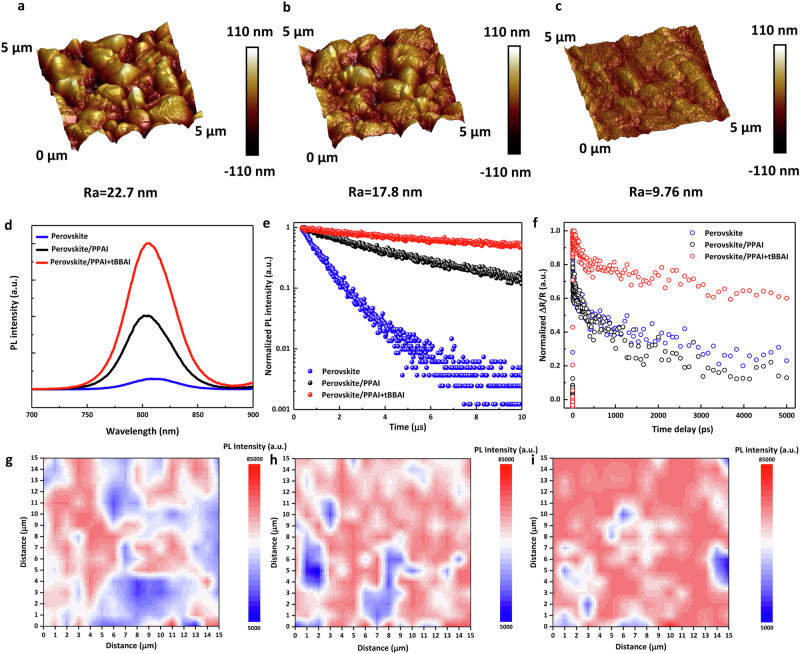
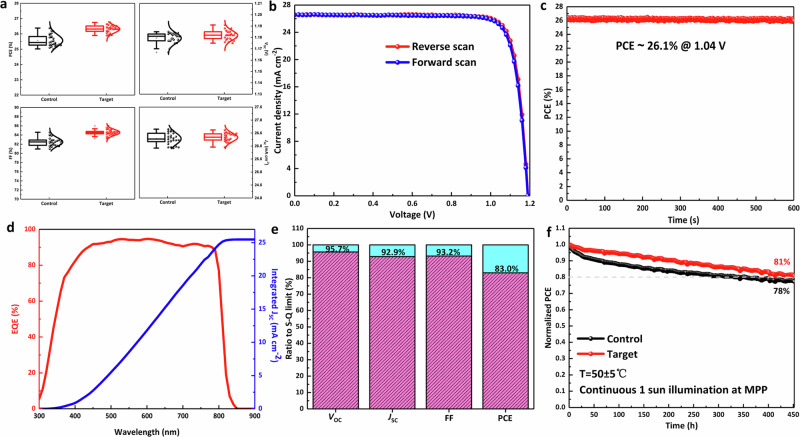
Surface passivation has been developed as an effective strategy to reduce trap-state density and suppress non-radiation recombination process in perovskite solar cells. However, passivation agents usually own poor conductivity and hold negative impact on the charge carrier transport in device. Here, we report a binary and synergistical post-treatment method by blending 4-tert-butyl-benzylammonium iodide with phenylpropylammonium iodide and spin-coating on perovskite surface to form passivation layer. The binary and synergistical post-treated films show enhanced crystallinity and improved molecular packing as well as better energy band alignment, benefiting for the hole extraction and transfer. Moreover, the surface defects are further passivated compared with unary passivation. Based on the strategy, a record-certified quasi-steady power conversion efficiency of 26.0% perovskite solar cells is achieved. The devices could maintain 81% of initial efficiency after 450 h maximum power point tracking.
表面钝化已被开发为一种有效的策略,以降低陷阱态密度并抑制钙钛矿太阳能电池中的非辐射复合过程。然而,钝化剂通常导电性较差,并对器件中的电荷载流子传输产生负面影响。在此,我们报告了一种二元协同后处理方法,即将4-叔丁基苄基碘化铵与苯丙基碘化铵混合,并旋涂在钙钛矿表面以形成钝化层。二元协同后处理的薄膜显示出增强的结晶度、改善的分子堆积以及更好的能带排列,有利于空穴的提取和转移。此外,与一元钝化相比,表面缺陷得到了进一步的钝化。基于该策略,钙钛矿太阳能电池实现了经认证的创纪录准稳态功率转换效率26.0%。在最大功率点跟踪450小时后,器件可保持初始效率的81%。