Department of Electrical Engineering, University of Utah, Salt Lake City, USA.
Department of Mechanical Engineering, University of Utah, Salt Lake City, USA.
Sci Rep. 2024 Oct 6;14(1):23248. doi: 10.1038/s41598-024-73855-1.
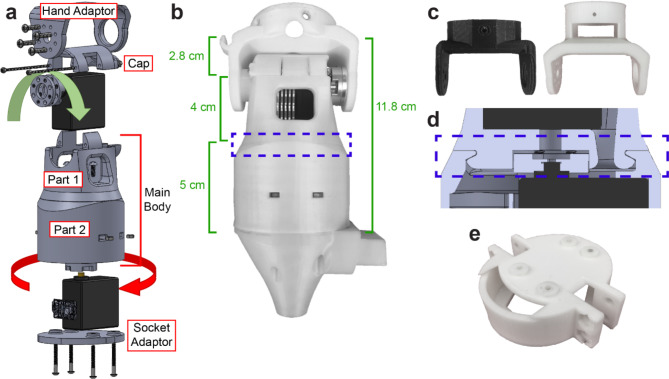
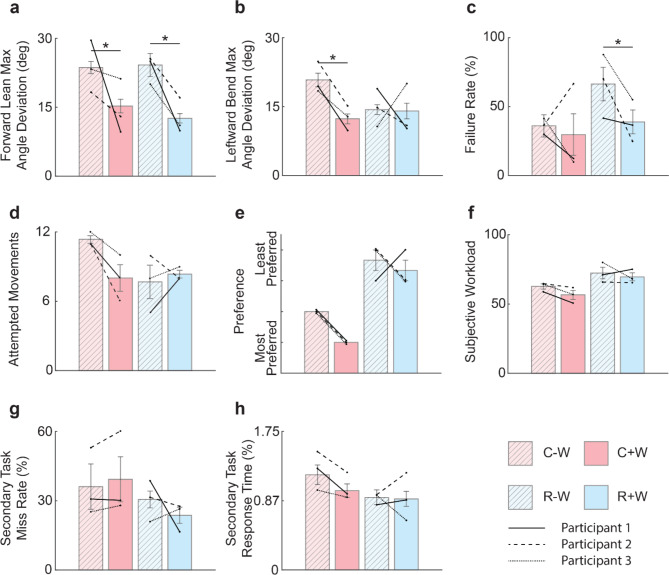
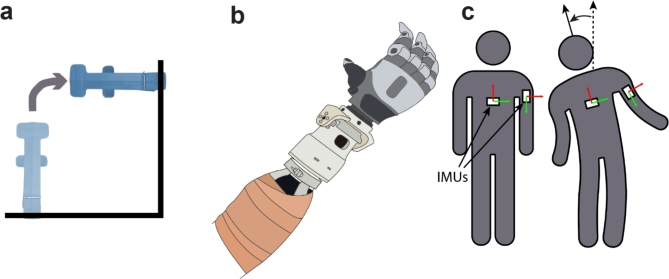
Wrist function is a top priority for transradial amputees. However, the combined functional, biomechanical, and cognitive impact of using a powered prosthetic wrist is unclear. Here, we quantify task performance, compensatory movements, and cognitive load while three transradial amputees performed a modified Clothespin Relocation Task using two myoelectric prostheses with and without the wrists. The two myoelectric prostheses include a commercial prosthesis with a built-in powered wrist, and a newly developed inexpensive prosthetic wrist for research purposes, called the "Utah wrist", that can be adapted to work with various sockets and prostheses. For these three participants, task failure rate decreased significantly from 66% ± 12% without the wrist to 39% ± 9% with the Utah wrist. Compensatory forward leaning movements also decreased significantly, from 24.2° ± 2.5 without the wrist to 12.6° ± 1.0 with the Utah wrist, and from 23.6° ± 7.6 to 15.3° ± 7.2 with the commercial prosthesis with an integrated wrist. Compensatory leftward bending movements also significantly decreased, from 20.8° ± 8.6 to 12.3° ± 5.3, for the commercial with an integrated wrist. Importantly, simultaneous myoelectric control of either prosthetic wrist had no significant impact on cognitive load, as assessed by the NASA Task Load Index survey and a secondary detection response task. This work suggests that functional prosthetic wrists can improve dexterity and reduce compensation without significantly increasing cognitive effort. These results, and the introduction of a new inexpensive prosthetic wrist for research purposes, can aid future research and development and guide the prescription of upper-limb prostheses.
腕部功能对于经桡骨截肢者至关重要。然而,使用动力假肢腕部对手部功能、生物力学和认知的综合影响尚不清楚。在此,我们量化了三位经桡骨截肢者在使用两种肌电假肢进行改良的别针移位任务时的任务表现、代偿运动和认知负荷,其中两种肌电假肢包括带有内置动力腕部的商业假肢和一种新开发的用于研究目的的廉价假肢腕部,称为“犹他腕部”,它可以与各种接受腔和假肢适配。对于这三位参与者,在使用犹他腕部时,任务失败率从无腕部时的 66%±12%显著降低至 39%±9%。代偿性向前倾斜运动也显著减少,从无腕部时的 24.2°±2.5 减少至使用犹他腕部时的 12.6°±1.0,从使用集成腕部的商业假肢时的 23.6°±7.6 减少至 15.3°±7.2。代偿性向左弯曲运动也显著减少,从使用集成腕部的商业假肢时的 20.8°±8.6 减少至 12.3°±5.3。重要的是,使用两种假肢腕部的同时肌电控制对认知负荷没有显著影响,这通过 NASA 任务负荷指数调查和次要检测响应任务评估。这项工作表明,功能性假肢腕部可以在不显著增加认知负担的情况下提高灵巧性并减少代偿。这些结果以及新开发的用于研究目的的廉价假肢腕部的引入,可以帮助未来的研究和开发,并指导上肢假肢的处方。