Hansen Taylor C, Citterman Abigail R, Stone Eric S, Tully Troy N, Baschuk Christopher M, Duncan Christopher C, George Jacob A
Department of Biomedical Engineering, University of Utah, Salt Lake City, UT, United States.
Handspring, Salt Lake City, UT, United States.
Front Neurorobot. 2022 Jun 17;16:872791. doi: 10.3389/fnbot.2022.872791. eCollection 2022.
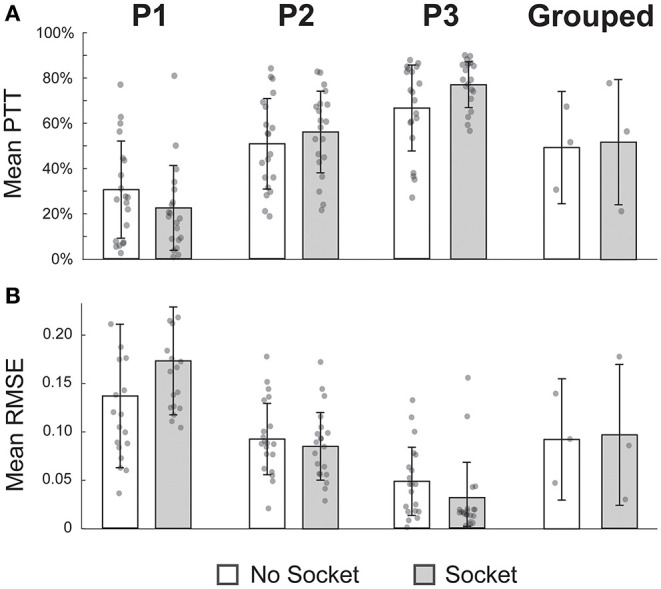
The validation of myoelectric prosthetic control strategies for individuals experiencing upper-limb loss is hindered by the time and cost affiliated with traditional custom-fabricated sockets. Consequently, researchers often rely upon virtual reality or robotic arms to validate novel control strategies, which limits end-user involvement. Prosthetists fabricate diagnostic check sockets to assess and refine socket fit, but these clinical techniques are not readily available to researchers and are not intended to assess functionality for control strategies. Here we present a multi-user, low-cost, transradial, functional-test socket for short-term research use that can be custom-fit and donned rapidly, used in conjunction with various electromyography configurations, and adapted for use with various residual limbs and terminal devices. In this study, participants with upper-limb amputation completed functional tasks in physical and virtual environments both with and without the socket, and they reported on their perceived comfort level over time. The functional-test socket was fabricated prior to participants' arrival, iteratively fitted by the researchers within 10 mins, and donned in under 1 min (excluding electrode placement, which will vary for different use cases). It accommodated multiple individuals and terminal devices and had a total cost of materials under $10 USD. Across all participants, the socket did not significantly impede functional task performance or reduce the electromyography signal-to-noise ratio. The socket was rated as comfortable enough for at least 2 h of use, though it was expectedly perceived as less comfortable than a clinically-prescribed daily-use socket. The development of this multi-user, transradial, functional-test socket constitutes an important step toward increased end-user participation in advanced myoelectric prosthetic research. The socket design has been open-sourced and is available for other researchers.
对于上肢缺失者而言,肌电假肢控制策略的验证受到与传统定制接受腔相关的时间和成本的阻碍。因此,研究人员常常依赖虚拟现实或机械臂来验证新的控制策略,这限制了终端用户的参与度。假肢师制作诊断性检查接受腔以评估和优化接受腔适配度,但研究人员无法轻易获得这些临床技术,且这些技术并非用于评估控制策略的功能。在此,我们展示一种多用户、低成本、经桡骨的功能性测试接受腔,用于短期研究,它能够快速定制适配并穿戴,可与各种肌电图配置结合使用,适用于各种残肢和终端设备。在本研究中,上肢截肢参与者在有和没有该接受腔的情况下,在物理和虚拟环境中完成功能任务,并报告他们随时间推移的舒适感。功能性测试接受腔在参与者到达之前制作完成,研究人员在10分钟内进行迭代适配,并在1分钟内穿戴好(不包括电极放置,电极放置因不同用例而异)。它可适配多个个体和终端设备,材料总成本低于10美元。在所有参与者中,该接受腔并未显著妨碍功能任务表现,也未降低肌电图信噪比。该接受腔被评为舒适程度足以使用至少2小时,不过预期其舒适度低于临床规定的日常使用接受腔。这种多用户、经桡骨的功能性测试接受腔的开发是朝着提高终端用户参与先进肌电假肢研究迈出的重要一步。该接受腔设计已开源,可供其他研究人员使用。