Wheless Lee, Guennoun Ranya, Michalski-McNeely Basia, Gonzalez Katlyn M, Weiss Rachel, Zhang Siwei, Yao Lydia, Madden Chris, Chen Hua-Chang, Triozzi Jefferson L, Tao Ran, Wilson Otis, Wells Quinn S, Hung Adriana, Bibee Kristin, Hartman Rebecca I, Xu Yaomin
Tennessee Valley Healthcare System VA Medical Center, Vanderbilt University Medical Center.
Departments of Dermatology.
medRxiv. 2024 Sep 16:2024.09.16.24313743. doi: 10.1101/2024.09.16.24313743.
Nicotinamide metabolites have recently been implicated in increased risk of major cardiovascular events (MACE). Supportive data about clinical risk of MACE for nicotinamide users is lacking.
To determine whether nicotinamide use results in an increase of MACE.
Retrospective cohort study of two patient cohorts, Vanderbilt University Medical Center (VUMC) and Military Veteran Program (MVP). The risk of MACE in patients exposed to nicotinamide was compared to the risk of MACE in unexposed patients. In the VUMC cohort, 1228 patients were exposed to nicotinamide based on keyword entry for "nicotinamide" or "niacinamide" and hand-review of charts, while 253 were unexposed but had documented recommendation for use. In the MVP cohort, there were 1594 with exposure to nicotinamide propensity score matched to 2694 without exposure.
The primary exposure for the VUMC cohort was a confirmed exposure to nicotinamide in chart review. The primary exposure for the MVP cohort was medication entry for "nicotinamide" or "niacinamide".
The primary outcome was development of MACE based on a validated phenotype.
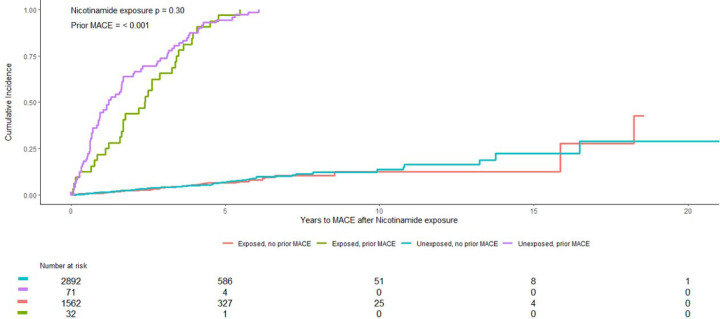
Between both cohorts, 6039 patients were included, of whom 5125 were male with a mean age of 63.2 years. Neither cohort had significant differences in mean age, sex, race and ethnicity between the nicotinamide exposed and unexposed groups. In the VUMC cohort, there was no significant association between nicotinamide exposure and the primary outcome of MACE (HR 0.76, 95% CI 0.46 - 1.25, p = 0.28). MACE prior to nicotinamide exposure was strongly associated with subsequent MACE (HR 9.01, 95% CI 5.90 - 13.70, p < 0.001). In the MVP cohort, we adjusted for MACE risk factors as potential confounding variables and saw no significant association between nicotinamide exposure and MACE (HR 1.00 95% CI 0.75 - 1.32), while history of prior MACE remained strongly associated with subsequent MACE (HR 9.50, 95% CI 6.38 - 14.1).
In this retrospective cohort study of 6039 adults from two different patient populations, we found no increased risk of MACE in patients with nicotinamide exposure.
烟酰胺代谢物最近被认为与主要心血管事件(MACE)风险增加有关。目前缺乏关于烟酰胺使用者发生MACE临床风险的支持性数据。
确定使用烟酰胺是否会导致MACE增加。
设计、设置、参与者:对两个患者队列进行回顾性队列研究,分别是范德比尔特大学医学中心(VUMC)和退伍军人项目(MVP)。将暴露于烟酰胺的患者发生MACE的风险与未暴露患者的MACE风险进行比较。在VUMC队列中,根据“烟酰胺”或“烟酰胺”的关键词录入以及图表人工审核,有1228例患者暴露于烟酰胺,而253例未暴露但有记录的使用推荐。在MVP队列中,有1594例有烟酰胺暴露倾向评分的患者与2694例无暴露的患者相匹配。
VUMC队列的主要暴露因素是在图表审核中确认暴露于烟酰胺。MVP队列的主要暴露因素是“烟酰胺”或“烟酰胺”的用药记录。
主要结局是基于经过验证的表型发生MACE。
两个队列共纳入6039例患者,其中5125例为男性,平均年龄63.2岁。在烟酰胺暴露组和未暴露组之间,两个队列在平均年龄、性别、种族和民族方面均无显著差异。在VUMC队列中,烟酰胺暴露与MACE的主要结局之间无显著关联(风险比[HR]0.76,95%置信区间[CI]0.46 - 1.25,p = 0.28)。烟酰胺暴露前的MACE与随后的MACE密切相关(HR 9.01,95% CI 5.90 - 13.70,p < 0.001)。在MVP队列中,我们将MACE风险因素作为潜在混杂变量进行了调整,发现烟酰胺暴露与MACE之间无显著关联(HR 1.00,95% CI 0.75 - 1.32),而既往MACE史与随后的MACE仍密切相关(HR 9.50,95% CI 6.38 - 14.1)。
在这项对来自两个不同患者群体的6039名成年人进行的回顾性队列研究中,我们发现暴露于烟酰胺的患者发生MACE的风险没有增加。