Williams Matthew J, Wang Xiaonan, Bastos Hugo P, Grondys-Kotarba Gabriela, Wu Qin, Jin Shucheng, Johnson Carys, Mende Nicole, Calderbank Emily, Wantoch Michelle, Park Hyun Jung, Mantica Giovanna, Hannah Rebecca, Wilson Nicola K, Pask Dean C, Hamilton Tina L, Kinston Sarah J, Asby Ryan, Sneade Rachel, Baxter E Joanna, Campbell Peter, Vassiliou George S, Laurenti Elisa, Li Juan, Göttgens Berthold, Green Anthony R
Department of Haematology, Wellcome-Medical Research Council Cambridge Stem Cell Institute, Jeffrey Cheah Biomedical Centre, University of Cambridge, Cambridge, United Kingdom.
Department of Haematology, University of Cambridge, Cambridge, United Kingdom.
Blood Adv. 2025 Jan 28;9(2):291-309. doi: 10.1182/bloodadvances.2024014046.
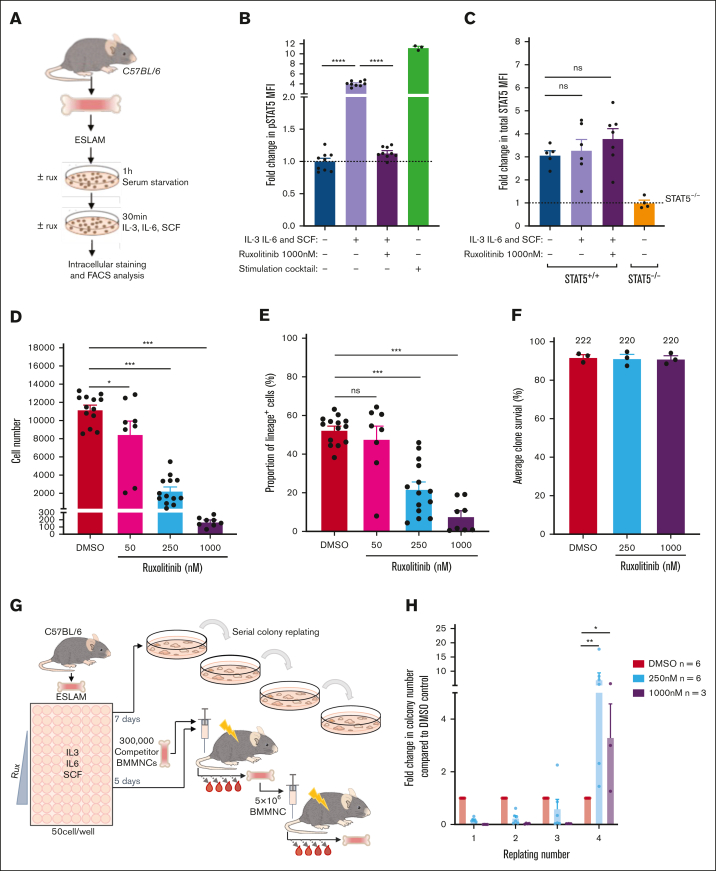
Adult hematopoietic stem cells (HSCs) are responsible for the lifelong production of blood and immune cells, a process regulated by extracellular cues, including cytokines. Many cytokines signal through the conserved Janus kinase (JAK)/signal transducer and activator of transcription (STAT) pathway in which tyrosine-phosphorylated STATs (pSTATs) function as transcription factors. STAT5 is a pivotal downstream mediator of several cytokines known to regulate hematopoiesis, but its function in the HSC compartment remains poorly understood. In this study, we show that STAT5-deficient HSCs exhibit an unusual phenotype, including reduced multilineage repopulation and self-renewal, combined with reduced exit from quiescence and increased differentiation. This was driven not only by the loss of canonical pSTAT5 signaling, but also by the loss of distinct transcriptional functions mediated by STAT5 that lack canonical tyrosine phosphorylation (uSTAT5). Consistent with this concept, expression of an unphosphorylatable STAT5 mutant constrained wild-type HSC differentiation, promoted their maintenance, and upregulated transcriptional programs associated with quiescence and stemness. The JAK1/2 inhibitor, ruxolitinib, which increased the uSTAT5:pSTAT5 ratio, had similar effects on murine HSC function; it constrained HSC differentiation and proliferation, promoted HSC maintenance, and upregulated transcriptional programs associated with stemness. Ruxolitinib also enhanced serial replating of normal human hematopoietic stem and progenitor cells (HSPCs), calreticulin-mutant murine HSCs, and HSPCs obtained from patients with myelofibrosis. Our results therefore reveal a previously unrecognized interplay between pSTAT5 and uSTAT5 in the control of HSC function and highlight JAK inhibition as a potential strategy for enhancing HSC function during ex vivo culture. Increased levels of uSTAT5 may also contribute to the failure of JAK inhibitors to eradicate myeloproliferative neoplasms.
成体造血干细胞(HSC)负责血液和免疫细胞的终身生成,这一过程受细胞外信号(包括细胞因子)调控。许多细胞因子通过保守的Janus激酶(JAK)/信号转导子和转录激活子(STAT)途径发出信号,其中酪氨酸磷酸化的STAT(pSTAT)作为转录因子发挥作用。STAT5是几种已知调节造血作用的细胞因子的关键下游介质,但其在HSC区室中的功能仍知之甚少。在本研究中,我们发现STAT5缺陷的HSC表现出异常表型,包括多谱系再增殖和自我更新能力降低,同时静息退出减少和分化增加。这不仅是由经典pSTAT5信号的丧失驱动的,也是由缺乏经典酪氨酸磷酸化的STAT5介导的独特转录功能(uSTAT5)的丧失驱动的。与此概念一致,不可磷酸化的STAT5突变体的表达限制了野生型HSC的分化,促进了它们的维持,并上调了与静息和干性相关的转录程序。JAK1/2抑制剂鲁索替尼增加了uSTAT5:pSTAT5的比例,对小鼠HSC功能有类似影响;它限制了HSC的分化和增殖,促进了HSC的维持,并上调了与干性相关的转录程序。鲁索替尼还增强了正常人造血干细胞和祖细胞(HSPC)、钙网蛋白突变小鼠HSC以及骨髓纤维化患者的HSPC的连续传代培养。因此,我们的结果揭示了pSTAT5和uSTAT5在控制HSC功能方面以前未被认识的相互作用,并强调JAK抑制作为在体外培养期间增强HSC功能的潜在策略。uSTAT5水平的增加也可能导致JAK抑制剂无法根除骨髓增殖性肿瘤。