Siefen Ann-Cathrine, Kurte Melina Sophie, Jakobs Florian, Teichert Marcel, von Tresckow Bastian, Reinhardt Hans Christian, Holtick Udo, Atta Johannes, Jehn Christian, Sala Elisa, Warnecke Anke, Hänel Mathias, Scheid Christof, Kron Florian
Faculty of Medicine, University of Duisburg-Essen, Essen, Germany.
VITIS Healthcare Group, Cologne, Germany.
Front Oncol. 2024 Sep 23;14:1466803. doi: 10.3389/fonc.2024.1466803. eCollection 2024.
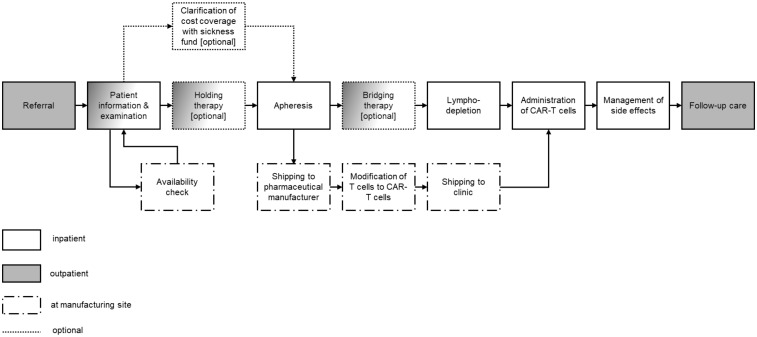
Treatment with chimeric antigen receptor T (CAR-T) cells involves a large number of interdisciplinary stakeholders and is associated with complex processes ranging from patient-specific production to follow-up care. Due to the complexity, maximum process optimization is required in order to avoid efficiency losses. This study aimed at systematically determining the preconditions for a frictionless flow of the CAR-T process by surveying the stakeholders involved.
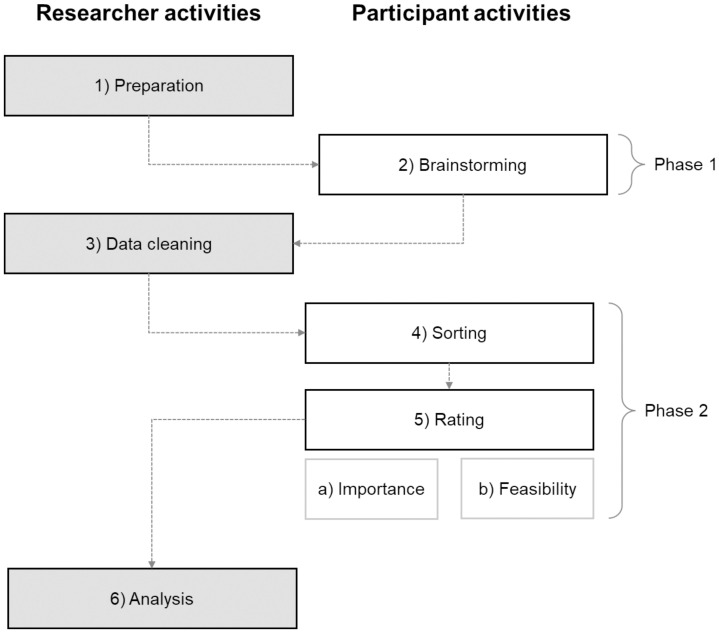
A Group Concept Mapping (GCM) analysis, a mixed-methods participatory research, was conducted. CAR-T experts from different professional backgrounds went through three steps: 1) Brainstorming relevant aspects (statements) for a frictionless process, 2) Sorting the collected statements based on their similarity, and 3) Rating the importance and feasibility of each statement. A cluster map reflecting the overarching topics was derived, and mean ratings per statement and cluster were calculated.
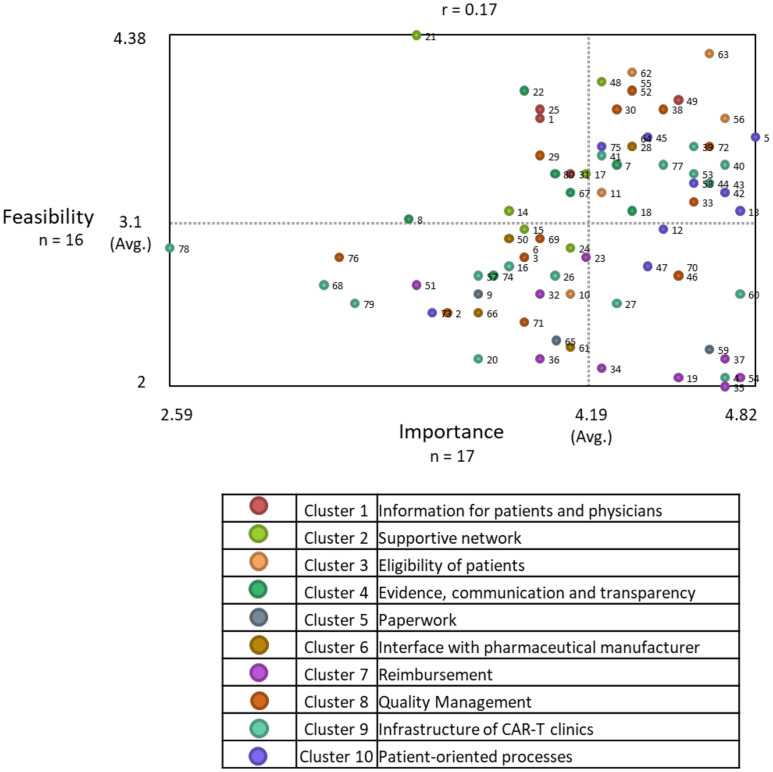
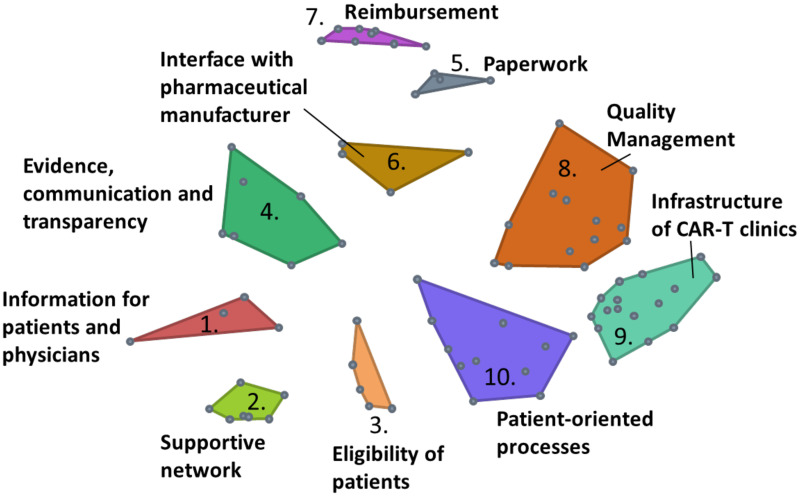
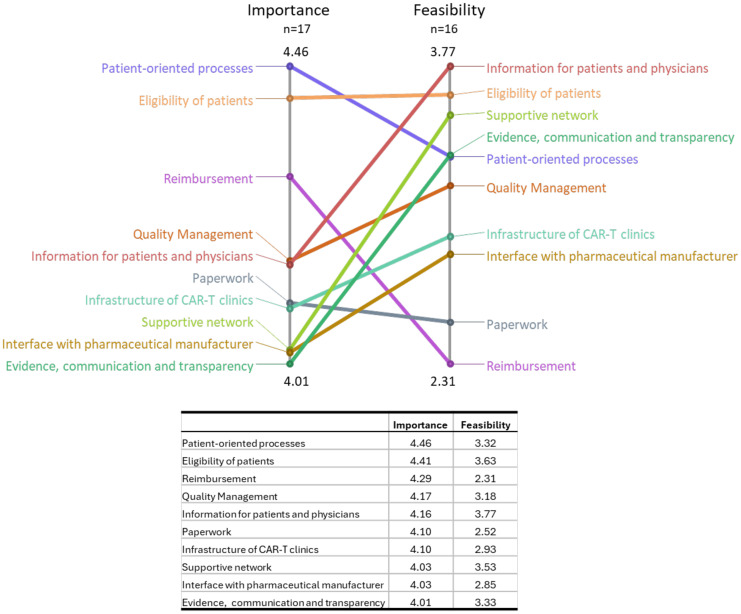
Overall, 20 CAR-T experts participated. A total of 80 statements were collected, resulting in a map of the following 10 clusters (mean importance/feasibility): Information for patients and physicians (4.16/3.77), Supportive network (4.03/3.53), Eligibility of patients (4.41/3.63), Evidence, transparency and communication (4.01/3.33), Paperwork (4.1/2.52), Interface with pharmaceutical manufacturer (4.03/2.85), Reimbursement (4.29/2.31), Quality Management (4.17/3.18), Infrastructure of CAR-T clinics (4.1/2.93), and Patient-oriented processes (4.46/3.32).
The 80 statements underlined the complex and manifold nature of the CAR-T treatment process. Our results reflect the first step in overcoming hurdles: identifying potential hurdles and required preconditions. Decision-makers and stakeholders can use the results to derive strategies and measures to further promote a frictionless process.
嵌合抗原受体T(CAR-T)细胞治疗涉及众多跨学科利益相关者,且与从个性化生产到后续护理的复杂过程相关。由于过程复杂,需要进行最大程度的流程优化以避免效率损失。本研究旨在通过调查相关利益相关者,系统地确定CAR-T治疗流程顺畅进行的前提条件。
进行了一项群组概念映射(GCM)分析,这是一种混合方法参与式研究。来自不同专业背景的CAR-T专家经历了三个步骤:1)就顺畅流程的相关方面(陈述)进行头脑风暴,2)根据相似性对收集到的陈述进行分类,3)对每个陈述的重要性和可行性进行评分。得出了反映总体主题的聚类图,并计算了每个陈述和聚类的平均评分。
共有20名CAR-T专家参与。总共收集到80条陈述,形成了以下10个聚类的图谱(平均重要性/可行性):患者和医生信息(4.16/3.77)、支持网络(4.03/3.53)、患者资格(4.41/3.63)、证据、透明度和沟通(4.01/3.33)、文书工作(4.1/2.52)、与制药商的接口(4.03/2.85)、报销(4.29/2.31)、质量管理(4.17/3.18)、CAR-T诊所的基础设施(4.1/2.93)以及以患者为导向的流程(4.46/3.32)。
这80条陈述突显了CAR-T治疗过程的复杂性和多样性。我们的结果反映了克服障碍的第一步:识别潜在障碍和所需前提条件。决策者和利益相关者可利用这些结果制定策略和措施,以进一步推动流程顺畅进行。