Department of Exercise Science, Arnold School of Public Health, University of South Carolina, Columbia, SC, USA.
Johns Hopkins Trial Innovation Center, Johns Hopkins School of Medicine, Baltimore, MD, USA.
Exp Brain Res. 2024 Dec;242(12):2715-2726. doi: 10.1007/s00221-024-06934-4. Epub 2024 Oct 8.
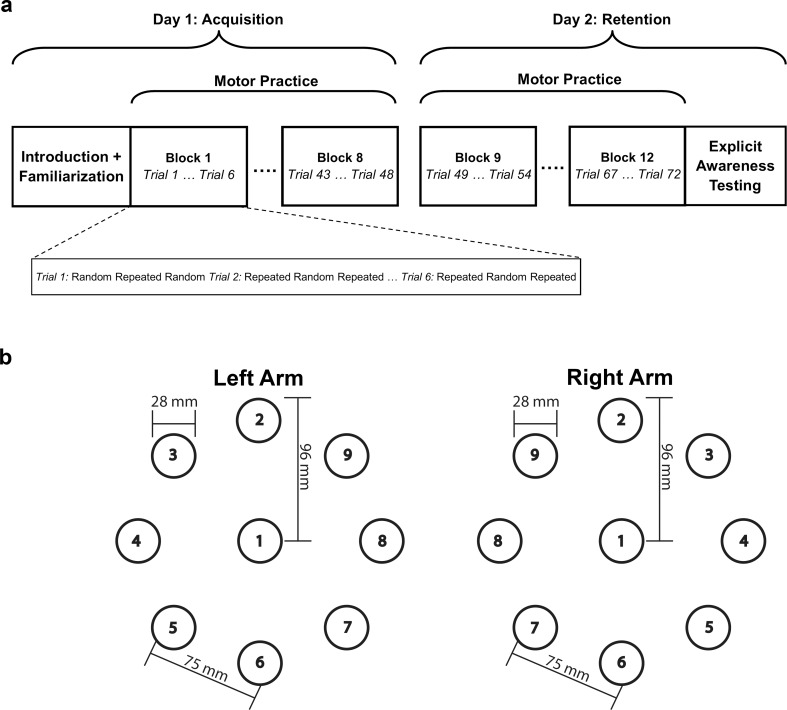
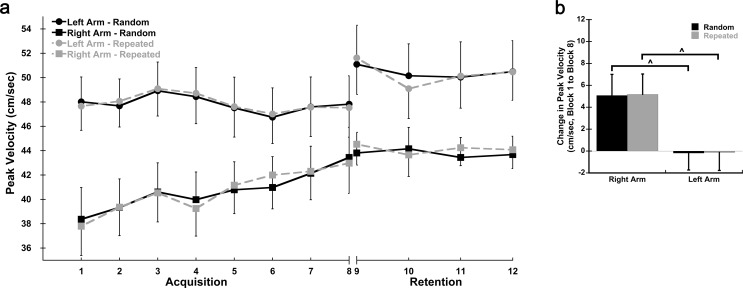
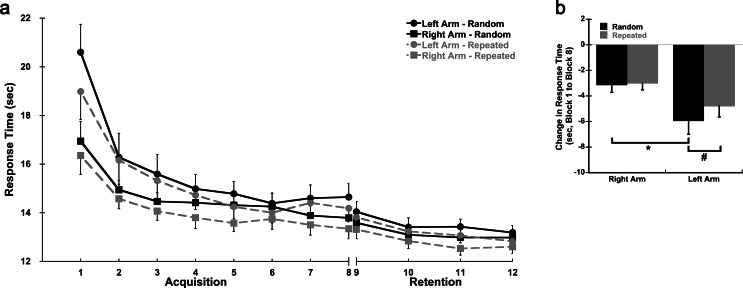
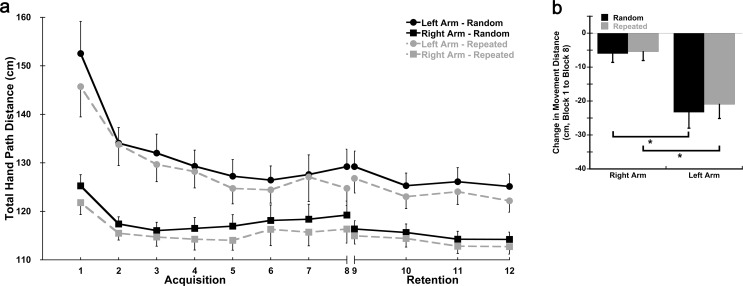
Interlimb differences in reach control could impact the learning of a motor sequence that requires whole-arm movements. The purpose of this study was to investigate the learning of an implicit, 3-dimensional whole-arm sequence task with the non-dominant left arm compared to the dominant right arm. Thirty-one right-hand dominant adults completed two consecutive days of practice of a motor sequence task presented in a virtual environment with either their dominant right or non-dominant left arm. Targets were presented one-at-a-time alternating between Random and Repeated sequences. Task performance was indicated by the time to complete the sequence (response time), and kinematic measures (hand path distance, peak velocity) were used to examine how movements changed over time. While the Left Arm group was slower than the Right Arm group at baseline, both groups significantly improved response time with practice with the Left Arm group demonstrating greater gains. The Left Arm group improved performance by decreasing hand path distance (straighter path to targets) while the Right Arm group improved performance through a smaller decrease in hand path distance combined with increasing peak velocity. Gains made during practice on Day 1 were retained on Day 2 for both groups. Overall, individuals reaching with the non-dominant left arm learned the whole-arm motor sequence task but did so through a different strategy than individuals reaching with the dominant right arm. The strategy adopted for the learning of movement sequences that require whole-arm movements may be impacted by differences in reach control between the nondominant and dominant arms.
肢体间的 reach 控制差异可能会影响需要整个手臂运动的运动序列的学习。本研究的目的是比较惯用右手的个体使用非优势的左手和惯用右手的个体使用右手,研究在三维环境中进行隐式、全臂序列任务的学习。31 名右利手成人连续两天在虚拟环境中练习运动序列任务,分别使用他们的惯用右手和非惯用左手。目标依次呈现随机和重复序列。任务表现由完成序列的时间(反应时间)来表示,运动学测量(手路径距离、峰值速度)用于检查运动随时间的变化。虽然在基线时,左手组比右手组慢,但两组在使用左手练习时均显著提高了反应时间,左手组的提高幅度更大。左手组通过减少手路径距离(更直的路径到达目标)来提高表现,而右手组通过手路径距离的较小减少和峰值速度的增加来提高表现。两组在第一天练习中取得的收益在第二天都得到了保留。总体而言,使用非优势左手的个体学会了全臂运动序列任务,但他们的学习策略与使用优势右手的个体不同。对于需要整个手臂运动的运动序列的学习采用的策略可能会受到非优势和优势手臂之间 reach 控制差异的影响。