Department of Thoracic Surgery, Thoraxklinik, University Hospital Heidelberg, Roentgenstrasse 1, 69126, Heidelberg, Germany.
Translational Lung Research Centre Heidelberg (TLRC-H), German Centre for Lung Research (DZL), Heidelberg, Germany.
Respir Res. 2024 Oct 8;25(1):363. doi: 10.1186/s12931-024-03002-x.
In recent years, the importance of sex as a factor influencing medical care has received increasing attention in the field of intensive care medicine. The objective of this study was to examine the influence of sex in prolonged weaning.
A retrospective analysis of patients undergoing prolonged weaning at Thoraxklinik, University Hospital Heidelberg between 12/08 and 12/23 was conducted. Patients with neuromuscular diseases were excluded from the analyses. The risk factors for weaning failure in men and women were identified through stepwise cox-regression analyses.
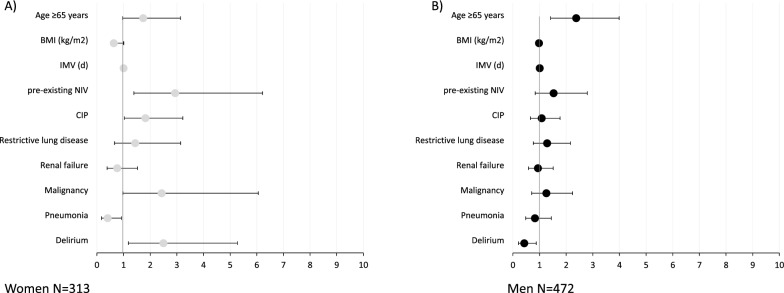
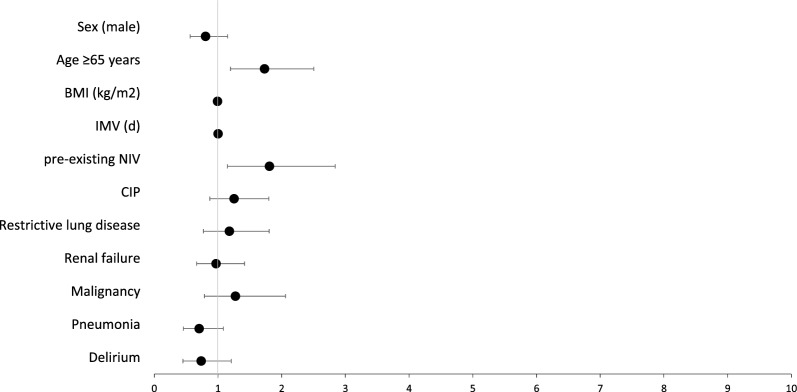
A total of 785 patients were included, of whom 313 (39.9%) were women. 77.9% of the women and 75.4% of the men were successfully weaned from invasive ventilation. In group comparisons and multivariable analyses, sex was not found to be a risk factor for weaning failure. Cox regression analyses were performed separately for both sexes on the outcome of weaning failure, adjusting for relevant covariates. The results indicated that age ≥ 65 years (HR 2.38, p < 0.001) and the duration of IMV before transfer to the weaning centre (HR 1.01/day, p < 0.001) were independent risk factors in men. In women, however, the duration of IMV before transfer (HR 1.01, p < 0.001), previous non-invasive ventilation (HR 2.9, p 0.005), the presence of critical illness polyneuropathy (HR 1.82; p = 0.040) and delirium (HR 2.50, p = 0.017) were identified as relevant risk factors. In contrast delirium was associated with a favourable weaning outcome in men (HR 0.38, p = 0.020) and nosocomial pneumonia as a reason for prolonged weaning in women (HR 0.43; p = 0.032).
The analyses indicate that there are sex-based differences in the risk factors associated with weaning failure. Further studies, ideally prospective, should confirm these findings to assess whether sex is a factor that should be taken into account to improve weaning outcomes.
近年来,性别作为影响医疗的因素在重症监护医学领域受到越来越多的关注。本研究旨在探讨性别对长时间撤机的影响。
对海德堡大学胸科医院 2018 年 12 月 8 日至 12 月 23 日期间接受长时间撤机的患者进行回顾性分析。排除神经肌肉疾病患者。通过逐步 Cox 回归分析确定男性和女性撤机失败的危险因素。
共纳入 785 例患者,其中 313 例(39.9%)为女性。77.9%的女性和 75.4%的男性成功从有创通气撤机。在组间比较和多变量分析中,性别并不是撤机失败的危险因素。分别对男性和女性进行 Cox 回归分析,调整相关协变量。结果表明,年龄≥65 岁(HR 2.38,p<0.001)和转至撤机中心前 IMV 时间(HR 1.01 天,p<0.001)是男性的独立危险因素。然而,在女性中,转至撤机中心前 IMV 时间(HR 1.01,p<0.001)、既往无创通气(HR 2.9,p<0.005)、危重病性多神经病(HR 1.82;p=0.040)和谵妄(HR 2.50,p=0.017)是相关危险因素。相反,谵妄与男性撤机结局良好相关(HR 0.38,p=0.020),医院获得性肺炎是女性长时间撤机的原因(HR 0.43;p=0.032)。
分析表明,撤机失败的危险因素存在性别差异。需要进一步的研究,理想情况下是前瞻性研究,以证实这些发现,以评估性别是否是改善撤机结局的一个因素。