Zubair Abdulahi A, Abdullateef Ridwanullah, Davis Samuel, Olaniyi Adedamola, Joshua Inioluwa, Emma-Nwachukwu Marvellous, Jessie Orugbo O, Kolawole Ayo-Oladapo, Umeh Akudo B, Sunmola Azeezat A, Oladeji Emmanuel O
Trauma and Orthopaedics, Surgery Interest Group of Africa, Lagos, NGA.
Orthopaedics, Surgery Interest Group of Africa, Lagos, NGA.
Cureus. 2024 Sep 8;16(9):e68925. doi: 10.7759/cureus.68925. eCollection 2024 Sep.
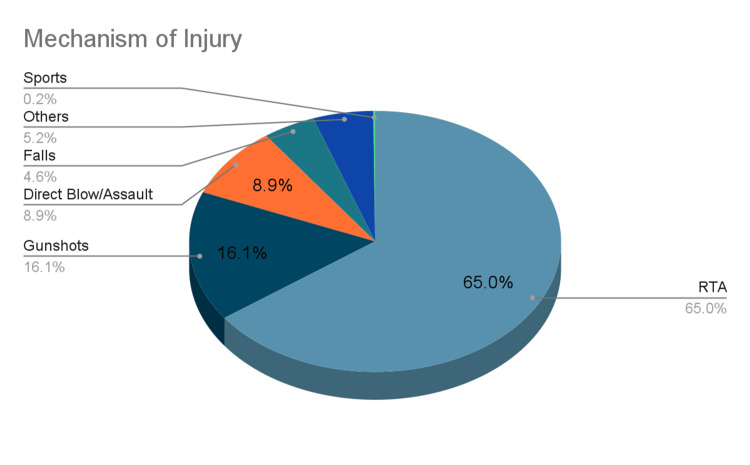
An open fracture is when the fractured part of a bone is exposed to the external environment by breaching the overlying soft tissue and skin. Open fractures often arise from high-energy injuries, and the risk of microbial contamination is high. There is a need to understand the management of open fractures in Africa by assessing the overall prevalence of open fractures, the mechanisms of injury, management approaches and outcomes. A literature search was conducted using PubMed, African Journal Online, and Google Scholar regarding open fracture management in Africa from inception till date. Thirty-nine (39) studies were included in this review. Road traffic accidents represented the majority of all mechanisms of open fractures, with the Tibia being the most affected bone. 320 cases were classified as Gustilo Anderson Type 1, with 487 classified as Type 2. Type 3 was divided into 3A (330), 3B (248), and 3C (34). Most studies recorded the immediate administration of intravenous antibiotics, but tetanus prophylaxis was only given in 13 studies, while initial debridement and washout were done in 35 studies. External fixators and Kirschner wires were most used for initial fixation. Follow-up for patients was between six weeks to 50 months. There were 645 cases of malunion, 83 cases of non-union, and 88 patients who had delayed union. There were 147 cases of wound infection and 119 cases of pin tract infections. Our findings emphasize the need for standardized protocols and robust emergency services to manage open fractures within Africa.
开放性骨折是指骨折部位通过穿透覆盖其上的软组织和皮肤而暴露于外部环境。开放性骨折通常由高能量损伤引起,微生物污染风险高。有必要通过评估开放性骨折的总体患病率、损伤机制、治疗方法和结果来了解非洲对开放性骨折的治疗情况。使用PubMed、《非洲在线期刊》和谷歌学术搜索了从开始到现在关于非洲开放性骨折治疗的文献。本综述纳入了39项研究。道路交通事故是所有开放性骨折机制中的大多数,胫骨是受影响最严重的骨骼。320例被分类为 Gustilo Anderson 1型,487例为2型。3型分为3A(330例)、3B(248例)和3C(34例)。大多数研究记录了立即静脉注射抗生素,但只有13项研究进行了破伤风预防,而35项研究进行了初期清创和冲洗。外固定器和克氏针最常用于初期固定。患者的随访时间为6周至50个月。有645例骨愈合不良,83例骨不连,88例延迟愈合。有147例伤口感染和119例针道感染。我们的研究结果强调,在非洲需要标准化方案和强大的急诊服务来处理开放性骨折。