Omoke Njoku Isaac, Madubueze Christian Chukwuemeka, Ahaotu Francis Ndubuisi, Nwigwe Chinedu Gregory, Anagor Anthony Anakweze, Amaraegbulam Peace Ifeoma, Egwu Agama Nnachi, Lasebikan Omolade Ayoola
Department of Surgery, Ebonyi State University, Alex Ekwueme Federal University Teaching Hospital Abakaliki Ebonyi State.
Department of Surgery, National Hospital Abuja Nigeria.
Afr J Emerg Med. 2022 Sep;12(3):270-275. doi: 10.1016/j.afjem.2022.05.002. Epub 2022 Jun 24.
Machete cut fracture is a unique subset of open fracture. The sharp force of a wielded machete that cleanly divides soft tissue envelope with minimal or no contusion results in an open fracture wound that is relatively less prone to infection. However, in resource-limited settings, the wound infection rate after machete cut fracture is relatively high. This study aimed to determine the risk factors for wound infection after extremity machete cut fractures in a Nigerian setting.
We undertook a retrospective analysis of the patients who were seen in the Emergency room of two tertiary hospitals in Nigeria with a machete cut extremity fracture from 2009 to 2018. The association of wound infection with population and wound characteristics as well as intervention related factors were evaluated. Statistical significant factors for wound infection in the Univariable analysis were entered into a Multivariable regression analysis to evaluate the risk of each factor when adjusted to other factors.
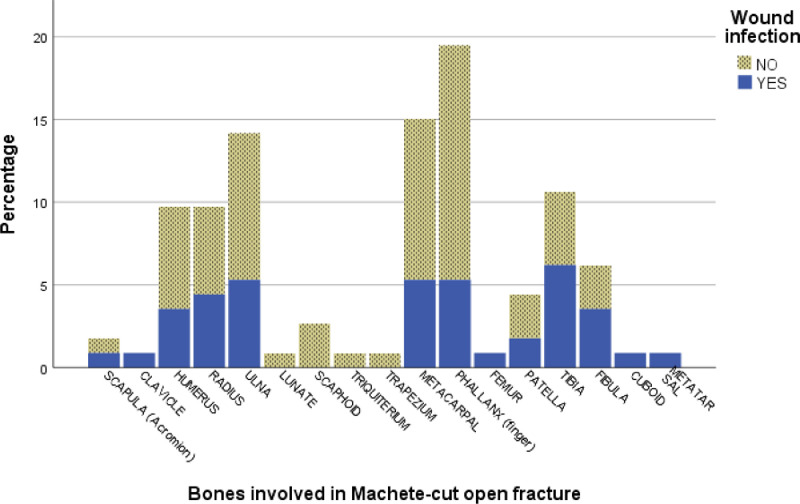
There were 113 machete-cut fractured bones in 67 eligible patients and wound infection was a complication in 45 (39.8%) of the cases (95%CI 30.3 - 49.7%).The factors significantly associated with high wound infection rate were smoking, haematocrit < 30%, fractures sustained outdoors, lower extremity fractures, a wound size of >5cm in length, injury-to-hospital arrival interval > 6hrs. Multivariable regression analysis identified wound size >5 cm (aOR 14.142, 95%CI (2.716 - 73.636); p = 0.002), injury-to- hospital arrival interval later than 6hrs (aOR 4.410, 95% CI (1.003-19.394); p = 0.050) and administration of antibiotics later than 3hrs of injury (aOR 5.736, 95%CI (aOR1.362 - 24.151; p = 0.017) as independent risk factors for wound infection.
Wound infection after open fractures caused by machetecut is more likely to occur in patients that present later than six hours after injury, wounds more than 5cm in length and delayed antibiotic administration. Appropriate treatment protocols can be instituted with this knowledge.
大砍刀砍伤骨折是开放性骨折中的一个独特类型。挥舞的大砍刀产生的锐利力量能干净利落地切开软组织包膜,造成的挫伤极小或没有挫伤,从而导致开放性骨折伤口相对不易感染。然而,在资源有限的环境中,大砍刀砍伤骨折后的伤口感染率相对较高。本研究旨在确定尼日利亚环境下四肢大砍刀砍伤骨折后伤口感染的危险因素。
我们对2009年至2018年在尼日利亚两家三级医院急诊室就诊的大砍刀砍伤四肢骨折患者进行了回顾性分析。评估了伤口感染与人群、伤口特征以及干预相关因素之间的关联。单变量分析中伤口感染的统计学显著因素被纳入多变量回归分析,以评估在调整其他因素后每个因素的风险。
67例符合条件的患者中有113处大砍刀砍伤骨折,45例(39.8%)出现伤口感染并发症(95%置信区间30.3 - 49.7%)。与高伤口感染率显著相关的因素有吸烟、血细胞比容<30%、在户外发生的骨折、下肢骨折、伤口长度>5cm、受伤至入院间隔>6小时。多变量回归分析确定伤口长度>5cm(调整后比值比14.142,95%置信区间(2.716 - 73.636);p = 0.002)、受伤至入院间隔晚于6小时(调整后比值比4.410,95%置信区间(1.003 - 19.394);p = 0.050)以及受伤后3小时后使用抗生素(调整后比值比5.736,95%置信区间(调整后比值比1.362 - 24.151;p = 0.017)为伤口感染的独立危险因素。
大砍刀砍伤导致的开放性骨折后伤口感染更可能发生在受伤后6小时以上就诊、伤口长度超过5cm以及抗生素使用延迟的患者中。有了这些知识,就可以制定适当的治疗方案。