Guangxi University of Chinese Medicine, Nanning, Guangxi, China.
Faculty of Nursing, Tung Wah College, Homantin, Hong Kong.
J Int Med Res. 2024 Oct;52(10):3000605241285858. doi: 10.1177/03000605241285858.
To evaluate the effect of wearable device training on improving upper limb motor function in patients who experienced strokes.
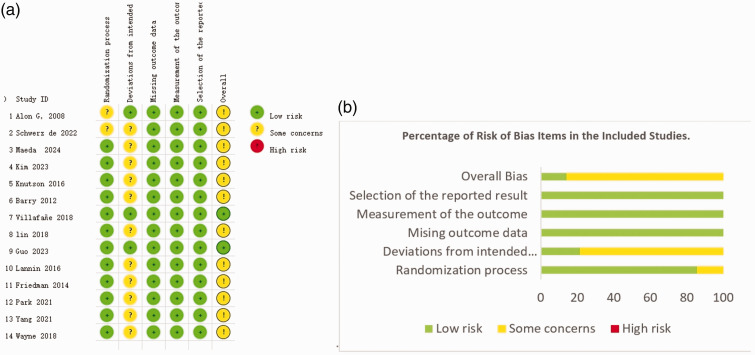
The PubMed, Embase, Cochrane Library, Web of Science, MEDLINE, SCOPUS, China National Knowledge Infrastructure, WanFang, and VIP databases were searched for randomized controlled trials (RCTs) that assessed the effectiveness of wearable device training in improving upper limb motor function in patients with stroke. Two investigators independently screened studies by their titles and abstracts and cross-checked, downloaded, and evaluated the results. Disagreements were resolved by a third highly experienced researcher. Risk of bias was evaluated using the Cochrane risk-of-bias tool. This meta-analysis was registered in PROSPERO (registration No. CRD42023421633).
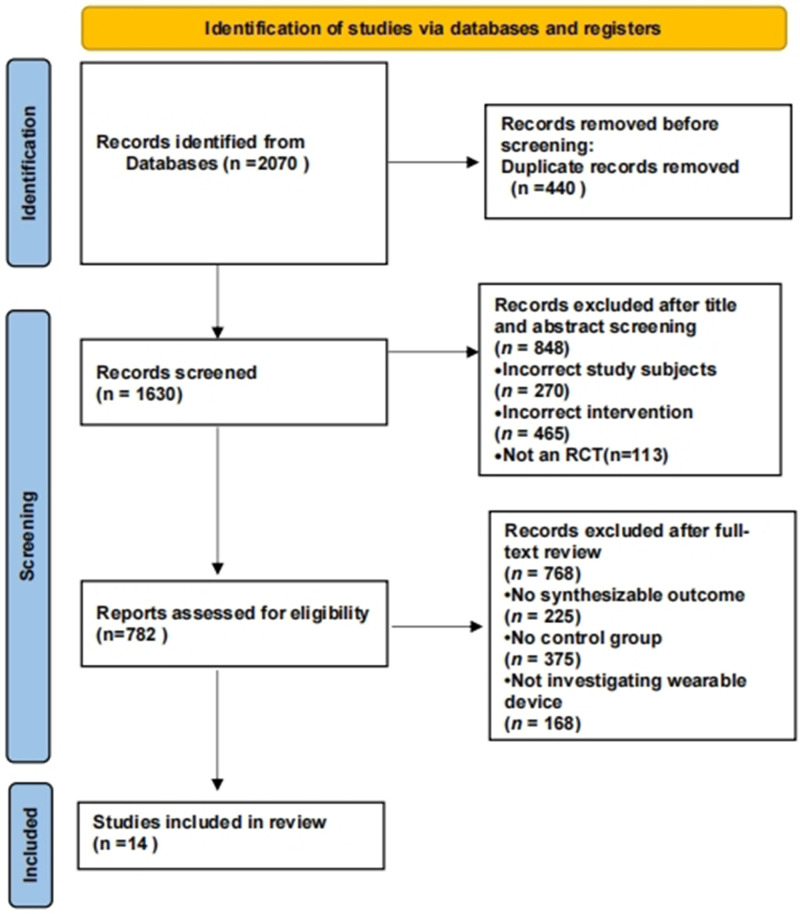
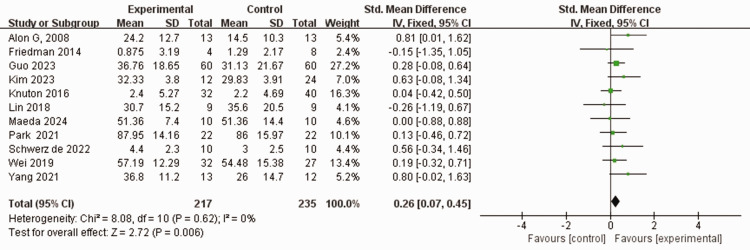
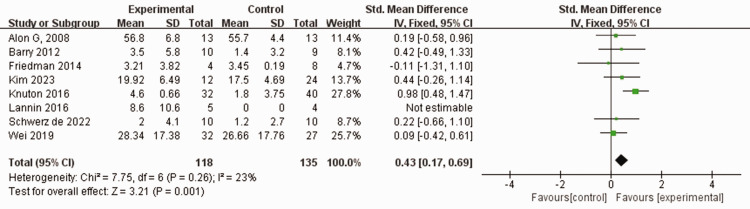
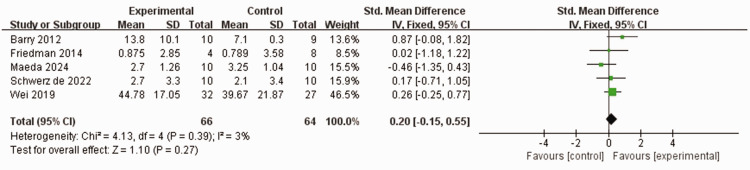
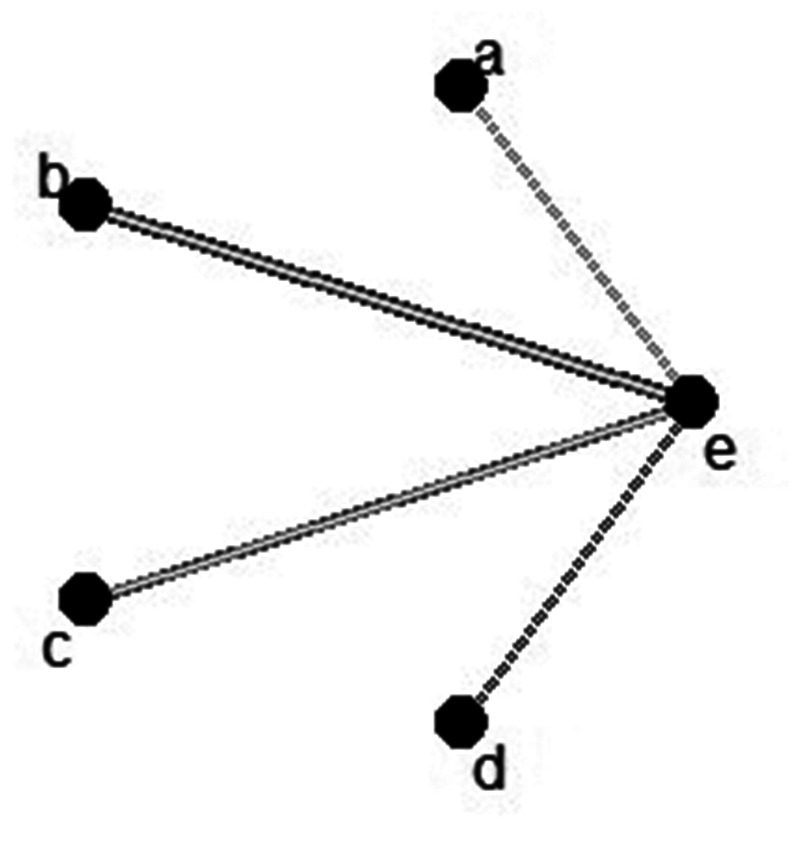
This study comprised 508 patients from 14 RCTs. The experimental group assessed various wearable devices, including 3D-printed dynamic orthoses, inertial measurement unit (IMU) sensors, electrical stimulation devices, and virtual reality (VR) devices for virtual interactive training. The control group received traditional rehabilitation therapies, including physical and conventional rehabilitation. The experimental group scored better on the Fugl-Meyer Assessment (FMA-UE) scale (standardized mean difference [SMD] 0.26, 95% confidence interval [CI] 0.07, 0.45) and Box and Block Test (BBT) (SMD 0.43, 95% CI 0.17, 0.69) versus controls. No significant intergroup differences were observed in the Action Research Arm Test (SMD 0.20, 95% CI -0.15, 0.55), motor activity log (mean difference [MD] 0.32, 95% CI -0.54, 0.33), and modified Ashworth scale (MD -0.08, 95% CI -0.81, 0.64). The probability rankings of wearable devices that improved FMA-UE scores in patients with stroke were: orthotic devices, with the highest probability ranking of 0.45, followed by sensor devices at 0.23, electrical stimulation devices at 0.21, and VR devices at 0.11.
Wearable device training was found to significantly improve upper limb motor function in patients with stroke, particularly for large-range movements. Improvements in FMA-UE and BBT scores reflected reduced impairment and enhanced manual dexterity, respectively. However, the training had no significant effect on hand movement frequency, fine motor skills, or spasticity. Among the different wearable devices tested, orthoses produced the most effective results.
评估可穿戴设备训练对上运动神经元损伤后患者上肢运动功能的影响。
检索了 PubMed、Embase、Cochrane 图书馆、Web of Science、MEDLINE、SCOPUS、中国知网、万方、维普数据库,纳入了评估可穿戴设备训练对上运动神经元损伤后患者上肢运动功能影响的随机对照试验(RCT)。两名研究员独立筛选标题和摘要,交叉核对、下载并评估结果。分歧由第三位经验丰富的研究员解决。使用 Cochrane 偏倚风险工具评估偏倚风险。该荟萃分析在 PROSPERO(注册号:CRD42023421633)中进行了注册。
本研究纳入了 14 项 RCT 中的 508 名患者。实验组评估了各种可穿戴设备,包括 3D 打印动态矫形器、惯性测量单元(IMU)传感器、电刺激装置和用于虚拟互动训练的虚拟现实(VR)设备。对照组接受了传统的康复治疗,包括物理和常规康复。实验组在 Fugl-Meyer 上肢评估量表(FMA-UE)评分(标准化均数差[SMD]0.26,95%置信区间[CI]0.07,0.45)和 Box 和 Block 测试(BBT)(SMD0.43,95%CI0.17,0.69)上的得分优于对照组。在动作研究上肢测试(SMD0.20,95%CI0.15,0.55)、运动活动日志(平均差[MD]0.32,95%CI-0.54,0.33)和改良 Ashworth 量表(MD-0.08,95%CI-0.81,0.64)方面,两组间无显著差异。对改善卒中患者 FMA-UE 评分的可穿戴设备的概率排名为:矫形器,概率最高为 0.45,其次是传感器设备(0.23)、电刺激装置(0.21)和 VR 设备(0.11)。
可穿戴设备训练对上运动神经元损伤后患者的上肢运动功能有显著的改善作用,特别是对大运动范围的运动。FMA-UE 和 BBT 评分的改善反映了损伤程度的降低和手功能的提高。然而,训练对手部运动频率、精细运动技能或痉挛没有显著影响。在测试的不同可穿戴设备中,矫形器的效果最显著。